“Discussion of Race Relations,” Abilene Christian College, 1955
Author: Bobby Valentine | Filed under: Black History, Church, Church History, Race Relations, Restoration History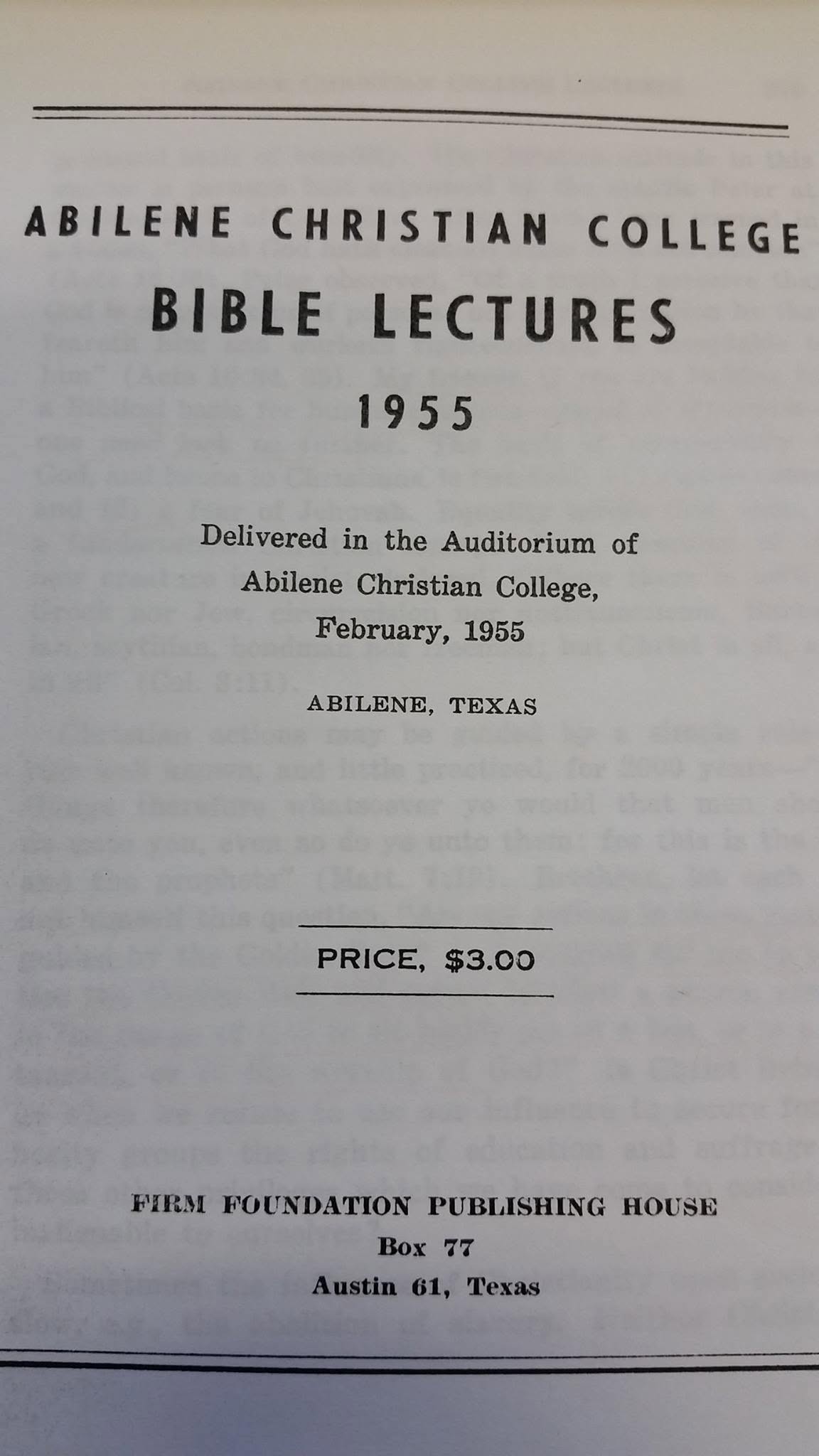
“It is not expedient for Christians, white or black, to participate in radical efforts to uproot deep-seated social customs that are not directly inconsistent with living the Christian life.” (L. M. Graves, seems to sum up the general position of most white preachers in 1955 and seems to be retained in 2026).
The Year is 1955. To my knowledge the first time any lectureship among “us” addressed the issue of race was the ACC Lectures in 1955 note quite a year after the unanimous Supreme Court ruling in Brown vs Board of Education May 17, 1954. At the ACC Lectures there was a panel “Discussion of Race Relations” consisting of four men, each delivered a very short speech. They were:
- J. Roy Willingham, Jr., “What Should the Christian’s Atttidue Be Toward Race Relations?”
- Leon Locke, “The Congregational Attitude Toward Race Relationships
- J. W. Treat, “What Does the Bible Teach About Race Relationship?”
- L. M. Graves, “Without Respect of Persons, The Negro and Race Relationships.“
The universal consent among the speakers was that “the Negro” is created in the image of God, that Christians should not discriminate, but equality before God is not social equality in relationships. One seems to dissent from this and I will get there in a moment. All suggest that the guide in race relationships is the “Golden Rule.”
It begs the question, as the presentations go, if segregation is how “we” (white people) would like to be treated.
Willingham, addressing individual relationship, says there is no basis for racial supremacy. He is sad that “modernists and infidels” are seen defending “these Christian principles” while Bible believers do not. Willingham’s is the strongest of the speeches. But he, like the rest, thinks “Christianity is rather an evolutionary force in society” that does not directly impact society. Therefore “we should not be overzealous in attempting to produce changes in social and political structure.” We are to speak where the Bible speaks and be silent where the Bible is silent.
This begs the question, are the Psalms, the Prophets, Ephesians, the Epistle of James and Revelation silent on the matters of justice in the public sphere? They in fact address the matter as much as any subject.
Leon Locke spoke briefly on how congregations should view race relationships. He states that the purpose of the church is “preaching the gospel. Its purpose is not the accomplishment of social or political reforms.” Noting that Paul did not lead a campaign to oppose slavery in the Roman Empire he argued we do not need to that that either. The church does not rock the boat … I quote him at length on the matter of integrated churches:
“Most of us were born into a society that not only recognizes some racial segregation, but in some instances has required it by civil law … Where it is true [segregation] each congregation should strive to maintain a maximum influence by avoiding any social situation that would hinder its work … Segregation of races on a voluntary basis where each recognizes and respects the problems of the other, has much to commend it in the Lord’s work … But a mingling of different races in one congregation would jeopardize the influence of the church with a large segment of those it needs to reach with the truth, segregation on this voluntary basis would be required by the simple rule of expediency … Where segregation is the social order of the day, let us not allow the church to become a part of organized agitation for reform.”
This amounts to an apology for the status quo that existed (and still exists) in Churches of Christ across the South. It is a truism that the old saw “we are to obey God rather than man” never seems to have any bearing on the issue of justice and righteousness in race relations.
J. W. Treat says a word about what the Bible says about race relationships. He does declare certain interpretations commonly held about the curse of Ham to be untrue. Humanity is, he says, of “one blood.” He then quotes a series of passages that emphasize the universality of the gospel message for “all nations.” The Golden Rule is how we approach race relationships.
L. M. Graves addresses the idea of “The Negro and Race Relationships.” He speaks of how Memphis is 35% black. He offers a series of statistics that seem to be offered to support the notion that blacks are “morally and socially immature as a race.” He admits that discrimination has existed in all areas of life. The Nashville Christian Institute and Southwestern Christian College “are making valiant efforts within their limited means” to correct these shortcomings of the black race. Then Graves addresses the issue of segregation. Segregation and discrimination are not the same he claims. “Improvement of man’s attitude toward his fellow man comes through acceptance and practice of Christianity and not through judicial pronouncements or following social theories … Integration may come in the future” he says but it is “through a process of evolution.” “It is not expedient for Christians, white or black, to participate in radical efforts to uproot deep-seated social customs that are not directly inconsistent with living the Christian life.”
There you have the highlights from the first panel of discussion on Race Relations in the Churches of Christ on a major college campus, the 1955 Abilene Christian College Lectures. I am sometimes astounded by what we said, and continue to say.
Related Articles
Racial Concerns in Churches of Christ, Trends since King, 1950-2000
Embracing Differences for the Sake of Unity: Some Theological Reflections
Leave a Reply