Framing Thought Reading Ephesians

Ephesians has long been my favorite Pauline book. I have read and reread it for years. I went through it with Dr. Richard Oster at Harding Graduate School while living in Grenada, MS years ago. I have preached through it, taught through, done two seminars on it. My views and grasp of Ephesians have been deepened and enriched by many scholars. In my view one of the best ways to describe Ephesians is it is it could easily be a “commentary” or “interpretation” of Romans 9-15.

The Jewish apostle, a Pharisee, to Gentiles works mightily to show Gentiles that they are now incorporated into (fellow heirs) the God of Israel’s historic Covenant People, Israel. As such they are now equal with ethnic Jews, by grace. At the same time, they do not “replace” Israel” they are brought into Israel itself by the Jewish Messiah, King Jesus. All of this is, in Ephesians language “to the praise of his glory.” Again, if we read Romans 9-15 and then read Ephesians 1-6 there is remarkable “connectivity.” In my view, Paul speaks primarily if not exclusively to Gentiles in Ephesians.

Reading Ephesians, like all of Paul’s epistles, must be approached through the Hebrew Bible (Gen-Malachi). This is not the only context that informs Paul but it is the primary one. The Torah, the history of Israel, the Prophets, the Psalms, the Temple are the “inkwell” Paul has Tychicus dip his reed into for writing.

The language of Ephesians is both shaped by the Hebrew Bible (especially its Greek translation the Septuagint) and Israel’s long history worship. We all know language that sounds “like church.” When a brother or sister leads prayer and it is filled with echoes of traditional words used primarily in the worship we recognize it immediately.

Ephesians, from the very first sentence, sounds like one of the great worship Gatherings in the Temple courts. Long sentences sound “lyrical” as material fitting for worship Gathering in the Jerusalem Temple. If words on a page could have an aroma, the ink Tychicus used smells like the Temple of Yahweh.

I frequently read Ephesians with the Psalms of Ascents (Pss 120-134) and Psalms 15 and Psalm 24. I encourage you to do that. “Tuning” our ears to “here”” is very helpful. And the “world” of Ephesians is very much like these Psalm texts (in the very book Paul tells the Ephesians to go sing so they can learn the “will of God” (5.17, 19).

OUR TEXT, 5.1-2

In our text, Paul is reframing the life of the former pagan Gentiles. He has told them “you MUST NOT live as Gentiles any more” (4.17; cf. 2.11; 3.1; 3.8 ). Paul gives a laundry list of Gentile ways in 4.17-32.

With the word “therefore” (5.1) Paul tells the Gentiles to be “imitators of God.” This is the God of Israel whom they at one point did not know (2.12). Look at the God of Israel and do what that God does in the ways that that God does them. This is quite a radical thought for former pagans because the gods were not models to imitate. One did not want to be like Zeus unless they were a moral reprobate.

Here Paul is saying the same thing Moses does in Leviticus, “be holy for I am holy.” Paul calls for divine imitation. The Jerusalem Council (Acts 15) bound Leviticus 17 and 18 upon Gentiles with its emphasis on holiness, especially against various kinds of fornication. Paul warns against this very thing in 5.3-5.

But he makes the God of Israel the model. Just as Leviticus does. They will be “children of light” (Israel was to be the light of the world, Isaiah 49.6 & 60.1-3, just as Yahweh wraps himself in “light” (Psalm 104.1, etc).

But Paul grounds their ways of life in worship, specifically the Messiah’s own sacrifice. Sacrifice is an act of worship and Jesus the Messiah offering himself as a “fragrant offering” is also an liturgical act of worship. These offerings in the Temple were accompanied by “psalms, hymns and spiritual songs” btw where the Gathered “saints” praised the Lord through the sacrifice as a graciously forgiven, healed and blessed people.

THE WAYS OF LOVE, AROMA OF SACRIFICE

So, Paul uses the word “love” in three different grammatical forms in Ephesians 5.1-2. An adjective. A noun. And a verb. This stresses the contrast of their former state. They once were “by nature children of wrath” (2.3). BUT NOW they are (an epic change has occurred)

Beloved children” (an adjective)

Told to

live in love” (a noun)

Because Messiah (King of Israel) has

loved us” (a verb)

Beloved. Love. Loved.

The most powerful motivation to live like God is to know how much the God of Israel loves us and sacrificed for us. This divine love is on every page of the Hebrew Bible, indeed God’s very “name” seems to be “Steadfast Love” (Hesed, Exodus 34.6). This truth thunders in the Psalms 176x. But its ultimate revelation is the gift of the Messiah, Jesus of Nazareth. Oh what objects of love God’s creation is (cf.. Psalm 103, Psalm 104, Psalm 136). Not just Jews but for Gentiles too!

Gentiles who did not even know who Yahweh was are loved and beloved by Yahweh.

If we “imitate” God’s love then we will be willing to also be a fragrant offering and sacrifice to God as we love one another. We become altars of God – altars of love – in a world consumed with greed, malice, and degrading one another. The Gathered People of God is supposed to be an Altar of Incense. Not because we have power over anyone, a sacrifice surrendered.

Love is that sweet smelling aroma that fills the Temple of God where the Holy Spirit dwells.

Paul tells the Gentiles, God loved you (and Jews too) so much that he allowed the promised Jewish Messiah to die as a shalom offering that heals the breach between the pagans and the Creator God of Israel but also between the Gentiles and the Jews. They are BEloved. They are objects of love. They are planted in love (3.17).

Former Gentile Life is Reframed first in GOD’S love. Second, they are to respond by imitating God’s love. Third, they are Reframed through the Messiah’s own imitation of God’s love for them. Our life is surrounded by and rooted in divine love. This, and only this, will mark them as the People of God.

Now they imitate God by loving to the extreme. This is how we are children of light.

Shalom.

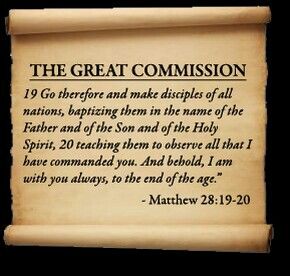
When Matthew penned his conclusion to his story of King Jesus the son of David, he intended us to hear it as the conclusion to his book. His book is the story of the “King of the Jews.” There was no “New Testament” there was however Matthew’s Gospel and the Hebrew Bible of which Matthew explicitly links his story.

The conclusion, which is now known as “The Great Commission “ a name it never had until 1800 (coined by Hudson Taylor) years after Matthew wrote, connects with the opening and ever ignored genealogy.

“The book of genesis of Jesus the Messiah, the son of David.” Matthew summarizes the entire history of Israel in his genealogy. He names many but David alone is called “King.” David is the King. Jesus is his “son.” Jesus is the Messiah, the “anointed” (1.16). Matthew follows this up with the naming of Jesus saying he will be called “Emmanuel” (1.23), that is “God with us.” This is followed by gentiles seeking the one “BORN KING of the Jews” (2.1-2). These all show up in the “Great Commission.” All are understood by Matthew’s connection to the Hebrew Bible.

1) Jesus’s words are drenched in the Hebrew Bible in which Matthew has placed his story of Jesus the King of the Jews. The King is fulfilling Israel’s original mission and empowering his followers to share in that mission.

2) “heaven and earth” a deeply Hebrew way of describing all Yahweh’s created realm. The phrase peppers the Hebrew Bible but none more important than the Book of Genesis which Matthew has termed his own book of King Jesus (Genesis 1.1; etc, etc; Mt 1.1). The Jewish King is now claiming all of God’s creation.
3) Jesus then says “all authority given to me.” No Jew missed this. Here is Davidic language. First Matthew has already told us in the skipped genealogy that Jesus is the “Son of David,” that he was “born to be king of the Jews” and that he was crucified as the “King of the Jews.” “Having been given” is what Jesus says (Ἐδόθη) an aorist passive verb, Jesus received something, he did not take something. Isael’s king’s authority was derivative; it comes from God. He is established on the throne as we will see.

Jesus statement, in the narrative of the Gospel, comes after Yahweh has reversed the decree of the rebellious nations who mocked and made war upon the “king of the Jews.” Psalm 2, a critical text throughout the NT writings, supplies the framework. Yahweh, the God of Israel, sits in heaven and laughs at the arrogance of the nations that make war upon “the LORD’s anointed.” Yahweh, in the face of their rebellion, has “installed my king on Zion, my holy hill.” The kings of the world are then commanded to come acknowledge the Lordship of the King of Israel (this is a frequent theme in the Psalms btw). In Psalm 2 the Lord’s “anointed” is also God’s king whom he installs upon the throne.

Jesus says ALL authority, in all God’s created order, has now been given to him because Yahweh has made him king. He was born King. The nations conspired (and the powers in Israel colluded) against him. Yet Yahweh has installed him as King anyway. Jesus is the Davidic King. The commission is to inform the nations a new king is in town. Now Jesus confesses the reality of what is proclaimed in Matthew 1.1.
4) “making disciples of all nations.” Matthew has already told us the pagans came seeking the Jewish king (Mt 2.1-2). But here Jesus, the anointed and installed King of the Jews, is assuming the very role that God created Israel for in the first place. He is after all the “son of Abraham” too (Mt 1.1). All nations will be blessed through Abraham (Gen 12.3). Israel was created to be a “light to the nations” (Isa 49.1-7). Israel was to the world what the tribe of Levi was to Israel, set apart as Priests. They were to intercede for, to worship for, to be a light … to show the glory of the One full of Hesed. Israel by and large failed in that calling by mimicking the nations treatment of the poor, the orphans, the widows, the aliens all usually rooted in the false worship of idolatry (are we any different??). But Jesus the anointed King, the representative of all Israel, has in fact been faithful. The Psalms are loaded with calls for the nations to come and worship the God of Israel. Now Jesus tells his disciples the faithful King of the Jews has been installed by God, it is time to tell the nations to acknowledge him and worship.

“Baptizing them.” Passing through water is deeply embedded in the Story of Israel. The Exodus was not just gracious God deliverance from slavery but a passage through water to a new life free from the aroma of death in Egypt. Israel would pass through water again to enter into the Promised Land. It is this very symbolism that lies behind John the Baptizer’s ministry at the Jordan River. It was alive and well with the Essenes of Qumran. The Pharisee Apostle Paul, states point blank that former Gentiles (ethne) at Corinth went through a “baptism” like the Israelites (1 Cor 10). Here at the conclusion of Matthew’s Gospel, the King of the Jews says that the pagans will pass through water too.

5) “teaching them to obey all.” Throughout the Gospel of Matthew Jesus is not only presented as the Son of David but he routinely sounds like Moses, especially in Deuteronomy. Moses at the end of his ministry, like Jesus at the end of his earthly ministry in Matthew, exhorts his disciples (Israel is Moses’s disciples). Israel was to demonstrate to the world the wisdom and nearness of Yahweh, “Surely this great nation is a wise and understanding people.” ‘What other nation is so great as to have their gods near them the way the LORD our God is near us whenever we pray to him?” (4.6-7). So in a passage that Matthew has already shown us was near Jesus’s heart when he was in the Wilderness being tested (i.e. is he a faithful son??), Deuteronomy 8. Moses says, “Be careful to follow every command I am giving you” (8.1; cf. v.6, etc, etc). What is the content of this? The Gospel of Matthew itself! The Sermon on the Mount. The Parables of the Kingdom in Matthew 13. “I did not come to destroy the law …” Servanthood. Judgement (Mt 25). And that Jesus is King of the Jews. The nations will come to Israel’s King and listen as he, like Moses, delivers the faithful word from the throne of David.

6) “I am with you …” This is the return to Matthew’s opening. It is also in the middle of Matthew, “where two or three are gathered in my name I am with you.” But this, and do not miss this, is one of the most fundamental declarations of the Hebrew Bible. Yahweh delivers Israel and then dwells in their midst. “I will place my dwelling in your midst” (Leviticus 26.9-13). “Do not fear for I am with you” (Isaiah 41.10; Jeremiah 42.11; Haggai 2.5; etc, etc, etc, etc). We can literally cite dozens of texts.

7) What does all this mean? The so called “Great Commission” is not something new. It is in fact the very mission of Israel from the beginning. Jesus has been declared to be King by God himself and installed as “my king in Zion.” This King, unlike even David the King (recall the genealogy reminds us of David’s sexual assault upon Bathsheba, 1.6b), has been faithful. In the King, Israel is finally living up to what she was created for, a light and a blessing to the pagans (ethne means both gentiles/nations and pagans). The Great Commission shows at the conclusion of the first book of the New Testament that God’s People will always have:

The Same God
The Same Promise
The Same King
The Same Mission

In fact our commission means nothing “separate and apart” from the Hebrew Bible and what it contains. It is in the providence and wisdom of the Holy Spirit of God that the Gospel of Matthew is the first book we are invited to hear in our assemblies for in the Second Century there were strong and powerful currents that wanted to deny everything we have just written. They were called Marcionites.

Thank you for reading. Be blessed.

I received a message because I wrote about the Psalms.

“Brother …, 2 Ti 2:15 tells us to rightly divide the word of truth. Rightly divide means to divide the Old Testament from the New Testament. We are not under the old law.”

This brother regularly posts similar misunderstandings on my posts. My Reply was as follows:

“Rightly divide” has nothing whatsoever to do with “dividing” that is separating, the “Old Testament” and the “New Testament.” Not only is there not a shred of evidence from the context to support such a position that is not what the word means.

That particular translation comes from the KJV from 1611. What that phrase meant in 1611 did not MEAN to distinguish or separate OT from NT. Nor does 2 Timothy 2.15 have that meaning today.

A person does not need to know Greek to “study to show themselves approved.” They can pull down multiple translations to make sure they are “correctly understanding” what the text actually says. The value of numerous translations is they help us understand what is actually said.

So, what does Paul say to Timothy in 2 Timothy 2.15. He says not one iota about distinguishing between the “Old” Testament (something neither Paul nor Timothy had ever heard of in their entire life) and the “New” Testament (something neither Paul nor Timothy had also never heard of). Here are various translations of 2 Timothy 2.15:

“handling aright the word of truth” (ASV)
“interprets the message of truth correctly” (CEB)
“rightly handling the word of truth” (ESV)
“correctly teaches the message of God’s truth” (TEV)
“teaching the message of truth accurately” (NET)
“correctly handles the word of truth” (NIV)
“correctly explains the word of truth” (NLT)
“rightly explaining the word of truth” (NRSV)

Second Timothy 2.15, ironically, is not “rightly divided” when some one claims it is dividing the “Old Testament” from the “New Testament.”

28 Aug 2025

AMERICAN/POLITICAL QUESTION FROM 2024

Author: Bobby Valentine | Filed under: American Empire, Bobby's World, Politics

I posted this on Facebook a year ago today (August 28, 2024). Seems even more relevant than then …

MY POLITICAL/AMERICAN QUESTION: I normally stay out of overt political discussion (I do have theological perspectives on the issues). But today, I ask a question as an American. I grew up in the South and was either a Republican or politically conservative voter all my voting life (ive been part of no party since 2008). I’ve had the privilege of seeing Ronald Reagan and George W. Bush. But the GOP today is not even remotely what it was before.

So here is my question for those committed to Donald Trump. I have many issues with Donald Trump from a purely Christian point of view. From an American POV, January 6 was the biggest embarrassment in the history of the United States. My view is DT is absolutely responsible for that debacle and refused to ensure the American Miracle. The USA has had numerous hotly contested elections from Thomas Jefferson to Abraham Lincoln to James A. Garfield to Harry Truman … some in the middle of a Civil War (Lincoln) and there has NEVER been anything like January 6. Ronald Reagan in his inaugural address addressed President Jimmy Carter and Vice President Walter Mondale, Tip O’Neal and others there on the steps of the Capital and described the peaceful transfer of power between opposing political parties as an American “Miracle.” (Follow link Reagan on American Miracle).

1) “Does it not concern you that the vast majority of those who served on his staff and in his Administration have refused to endorse him and a large number actively campaign against him?

2) “Do you think these people have suddenly become Democrats?

3) “Does it even give you reason for concern?”

I confess it does me.

My question(s) are quite specific.

I have never witnessed anything like the repudiation of Trump by his former staff. I have never seen a Vice President publicly say “I will not endorse” the President he served under. Mike Pence was the rave of Evangelicals while serving as VP but has suddenly become persona nongrata. On what grounds? Here is an extremely partial list of Trump’s former Admin members who have publicly refused to endorse him:

Mike Pence (his VP);
Mike Esper (Defense Secretary);
Cassidy Hutchison (senior staff member aka access to the Oval Office);
Stephanie Grisham (Press Secretary);
Sarah Matthews (Deputy Press Secretary);
Ty Cobb (White House Counsel);
Alyssa Farah Griffin (White House Communications Director);
John Bolton (National Security Advisor);
Mike Mulvaney (Chief of Staff);
General John Kelly (Chief of Staff);
General Mark Milley (Chairman of the Joint Chiefs);
General Jim Mattis (Defense Secretary);
General H. R. McMaster (National Security Advisor)
Etc., etc., etc.

This is a STUNNING list that can go on for a mile. In fact over 200 former members of Trump’s staff and Administration have publicly endorsed Harris. Again I have never witnessed anything quite like this. Most of these were dyed in the wool supporters at one time. Are we to believe these people have suddenly become Democrats who “hate” America?

I will post a link to a portion Ronald Reagan’s speech. Reagan publicly commends President Carter for ensuring this miracle. I cannot even imagine DJ making such a gracious speech. Just as G. H. W. Bush did when he lost to President Clinton. And what President Obama did himself for Donald Trump! Donald J. Trump is the only President in the history of the United States to spit in the face of America (as i see it).

I will post links for Mike Pence too.

So if you can be RESPECTFUL, no acrimony (no epitaphs, no diatribes, I will delete any bile) I would love to hear why the POV of the people who worked with Trump intimately has absolutely no influence upon you. Please comment below and watch links especially if you are pro-Trump.

The Apostle Paul writes to Timothy in Ephesus the following oft quoted words,

Anyone who does not provide for their relatives, and especially for their own household, has denied the faith and is worse than an unbeliever” (1 Tim 5.8, NIV).

I was asked to provide my understanding of this verse, so I am happy to do so.

One of the massive disservices that is done to modern readers by translations of the Bible like the King James Version, the New King James Version and the New American Standard is the printing of individual verses as an independent paragraph. It appears as if this verse (as the rest) is something of an aphorism or a generalized truth. It is neither. Always think paragraphs in narratives and epistles. Never think verse. Always think Paragraphs. Always.

I frequently say, like a broken record at PV and Eastside that there are two rules for reading the Bible: context and context. First Timothy 5. 8 is in a paragraph. The words in the sentence and the sentence as a whole have meaning in that paragraph and the subject matter under consideration by Paul.

Verse 8 (quoted above) is part of a paragraph that begins in v.3 and the section goes down to v.16. Verse 8 is in the middle of this discussion. Here Paul is addressing the entire church, “give proper attention/recognition to WIDOWS who are really in need.” In fact Paul is addressing Timothy and the gathered church through him as the letter is read to the whole congregation. Neither this verse nor any verse in First Timothy (nor any epistle in the NT) is addressed to non-Christians/unbelievers/the world. It is the widows of the church that are in need.

In the historical context of Ephesus these widows need not be in their 80s or 90s. In fact we know they are not. They are more likely in their 20s and 30s (a person in their 40s was a senior citizen).

Paul is concerned about two things simultaneously:

1) the care of the poor – in this case widows (a massive theme in Scripture, I mean massive; Deut 10.12-22; Ps 72; James 1.27; etc):

2) the resources of the local church to be used for those in genuine need. Most of the members themselves will be on the lower economic spectrum, a number likely slaves themselves. So Paul counsels younger widows to get remarried (v.14).

Here Paul is concerned about those who cannot get remarried or those who have no one to take care of them (there was no social security in the first century Roman Empire). Those widows who have either children or grandchildren (i.e. family), it is those children or grandchildren should take in the widow. That is v.4. The “anyone” of verse 8 is not a generalized statement but is the Christian family of the widow that is identified in v.4.

This verse, like the entire paragraph, I stress again is directed to the church, that is Christians. Notice how Paul says, “these should learn first of all to put their religion into practice by caring for their own family and so repaying their parents and grandparents, for this is pleasing to God.” This for Paul is nothing more and nothing less than obedience to the Ten Commandments, he cites it directly to the church in Ephesians (1 Timothy is written to the Ephesians as well) 6.2, “Honor your father and mother, which is the first commandment with a promise.” This is why Paul tells these Christians they have an obligation – because of their faith – to take care of the widow. They are honoring her.

Failing to care for the poor, the powerless, (widows/orphans/aliens) places these so called Believers in the same category as the Pagans. The Pagans frequently abandoned their elderly, they “exposed” their unwanted children who either starved to death or became enslaved in brothels and other unsavory places. God’s Family is NOT like that. Paul is not going to let that happen. So the believing family is the safety net for the widow.

In verses 5 and 6 Paul uses a trope to talk about two kinds of widows (who are like two ordinary people). One trusts in God and one lives for him/herself. The destitute widow who “trusts in God” will be cared for by God’s family. The church is now her family of the widow who either has no physical believing family or is abandoned by her family. That is if she has no believing family to care for her.

The line in v.6 is related to the wider problem in 1 Timothy of women influenced by the Goddess Artemis (whose massive temple was in Ephesus). Women, including younger widows” are “busybodies” going from “house to house” who are “saying/TEACHING” things they ought not as the apostle says in vv.13 but read from 11 to 15 (and this is directly related to what Paul says in that grossly taken out of context passage in chapter 2 of 1 Timothy). To read v.8 properly we need to read all of chapter 5.3-16 where he tells the younger widows to remarry (v.14).

Verse 8 is aimed directly at those Christian’s (identified in v.4) who have widows in their family but are refusing to take care of them. They are the one’s who are not putting their faith in practice. If we love our neighbor as ourselves, our first neighbor is our physical family. Again Paul says in Eph 6.2, they are to honor not just widows but mothers and fathers as the Ten Commandments say. Those Christians in Ephesus who are not taking care of their family – the widow – are worse than the pagans (unbelievers). They have denied the faith they claim to have embraced.

This text is not a general statement about unbelievers. It is directed to the church. A non-believer can never “deny the faith.” And be a nonbeliever cannot be “worse than an unbeliever!” They are in fact already a nonbeliever. So verse 8, like all of First Timothy is directed to people who have claimed to believe that Jesus is the King (Messiah).

The context is about how to take care of widows. To summarize:

1) younger widows (and these are Christian widows throughout) should get remarried. They can and should do this.

2) Older widows should have family that takes care of them. The family that does not take care of their family are in fact no better than the pagans in Ephesus because that is what the pagans do – abandon the weak and poor.

3) Those widows who have no one – that is believing family – to care for them – are to be dedicated to God. They ought to be learners as Paul says in chapter 2. They have trusted in God and will not be abandoned. Those who gather with the Ephesian church who refuse to care for their own family have denied the faith. The church, the “household of God” (i.e. family of God) will be the sons, daughters, brothers and sisters of the widow when her family (which is no real family) abandons her.

Read all of 1 Timothy 5.3-16. It is about the same thing (carrying for poor widows) and is a unit. Verse 8 is smack in the middle of this teaching on how to properly care for widows.

That is what 1 Timothy 5.8 is all about. If we love God then we will love our neighbor. In this case our neighbor is a widow in our family. And the church is that family for the widow who has no family.

10 Jun 2025

Theological Question Begging

Author: Bobby Valentine | Filed under: Apologetics, Bible, Exegesis, Patternism, Precision Obedience, Sectarianism, Unity

Years ago I took a number of classes that were supposed to be of help in Christian apologetics. Every bachelor’s degree should require at least some exposure to history and philosophy but the class I had was called “Logic and the Bible.” Correct reasoning, as defined in various syllogisms, was the proper way of reading the Bible (it is not, exegesis and syllogisms are not the same thing).

Over the years, I have discerned great irony among some of my brothers and sisters. In an effort to establish their bona fide credentials they commit the most basic fallacies that we learn even in an introduction to Philosophy class. The three I see regularly are equivocation, special pleading and begging the question. The latter is especially prominent. Note this rather typical example,

According to our progressive brethren, the way for the Lord’s church to grow is for it to surrender its biblical convictions concerning homosexuality, divorce and remarriage for just any reason, women preachers, the use of instrumental music in worship, belief in everlasting punishment in hell, its opposition to denominationalism, its conviction that the New Testament is the pattern which the church is to follow in all ages” (end quote)

This quotation is one extended logical fallacy, it is begging the question. What is the question? What is actually the “biblical” position on various topics. The writer simply assumes his position is correct and then condemns those who disagree with no effort given, nor expected from the Amen corner, to actually establish the correctness of whatever the biblical position may be on a given matter.

There is a “biblical conviction” regarding:

divorce/remarriage – his
women preaching – his
instrumental music – his
patternism – his

The writer has not established that his position is the “biblical conviction” in the slightest. But if you or I disagree with his fallacy then we are “progressive” and therefore do not actually take Scripture seriously. His position is simply assumed to be exactly and one hundred percent the “biblical conviction” without the slightest effort made to show that it is so.

The Bible’s conviction, not Bobby Valentine, disagrees with this brother’s question begging.

I do not grant his assumed conclusion as the “biblical conviction.” There is neither shadow nor turning in my own mind that the WHOLE BIBLE is inspired, authoritative, the unvarnished truth in all things that God leads us but I do not accept the fallacy of begging the question as a means of doing theology.

9 Jun 2025

Grace & Grace in the Dead Sea Scrolls

Author: Bobby Valentine | Filed under: Grace, Jesus, Jewish Backgrounds, Paul

Grace and Grace in the Dead Sea Scrolls

It is a common view promoted in myriads of Protestant sermons that Jews of Jesus’s day thought they were working their way to salvation, that they had no understanding of grace, that their religion was devoid of genuine spirituality. This foil is used to preach certain passages in Paul, that Paul was miserable and desperately fleeing legalism.

There are massive problems with this picture. First, the people thinking like this do not read the Hebrew Bible where God’s Hesed/grace, mercy, forgiveness is the foundation of everything. Second, people thinking like this do not read the Apocrypha which has some of the finest proclamations on God’s grace and mercy to be found. And third, this point of view is demolished by all kinds of writings by Jews outside the canon of Scripture. I will share two marvelous texts found in the Dead Sea Scrolls: One from the Community Rule/Manual of Discipline and the other from the Hymns.

1) Manual of Discipline/Community Rule

“For mankind has no way, and man is unable to establish his steps
since justification is with God …
As for me, if I stumble, the mercies of God
shall be my eternal salvation.
If I stagger because of sin of flesh,
my justification shall be by the righteousness of God which endures forever.
When my distress is unleashed
He will deliver my soul from the Pit
and will direct my steps to the way.
He will draw me near by His grace,
and by His mercy will He bring my justification.
He will judge me in the righteousness of His truth
and in the greatness of His goodness
He will pardon all my sins.
Through His righteousness he will cleanse me
of the uncleanness of man
and of the sins of the children of men,
that I may confess to God His righteousness,
and His majesty to the Most High.
(Community Rule XI.11-15)

2) The Hymns

“As You have said by the hand of Moses,
You forgive transgression, iniquity, and sin,
and pardon rebellion and unfaithfulness”
(IV.10. This is almost a quotation of the God Creed in Exodus 34.6)

“Righteousness, I know, is not of man,
nor is perfection of way of the son of man [=way of humans] …
For I remember my sins
and the unfaithfulness of my fathers.
When the wicked rose against Your Covenant
and the condemned against Your word
I said in my sinfulness,
‘I am forsaken by Your Covenant.’ …
I lean on Your grace
and on the multitude of Your mercies,
for You will pardon iniquity,
and through Your righteousness
You will purify man of his sin.”
(XII.30-37)

Read these out loud. Here we have a window into the faith of pious Jews in Jesus’s day. Some of these passages in fact sound almost like Paul himself could have written them.

Sometimes we need some historical context to hear what Jesus and the New Testament writers were all about and what the real issues actually were.

Related Articles

Unbearable Burden? Did Jews (Paul) Believe the Torah was a “Burden?”

Prayer of Manasseh: Heartbeat of Jewish Spirituality

Ten Shocking Facts about the “Law” Your Preacher never Told You

Not what Philippians 2.12 is talking about

[I posted the following on Facebook on April 2, 2015. I have decided to post it here because the issue came up once again].

WORKING OUR YOUR SALVATION in Fear & Trembling (Philippians 2.12 April 2, 2015)

This morning I read the Kingdom New Testament’s version of Philippians for an upcoming lesson. I especially like how it renders 2.12-13, a text often misapplied in my Christian life. So, in the spirit of K. C. Moser who wrote many articles under the heading “Text & Context” in the Gospel Advocate, I want to make a comment on this text in its context. The verse reads in the Kingdom NT,

Your [plural] task is now to work at bringing about your [plural] own salvation; and naturally you’ll be taking this with utter seriousness. After all, God himself is the one who’s at work among you [plural], who provides both the will and the energy to enable you [plural] to do what pleases him.”

This is a frequently misapplied text from Paul. Let me explain.

First, in much literature only verse 12 is quoted without any of the surrounding context. The “tradition” of approaching not only this text but many in an atomistic manner is first rooted in the printing habits of the 1611 King James Version where individual verses were printed essentially as individual complete thoughts/paragraphs. The KJV empowered proof-text style reading of the biblical text. Updates in the KJV “tradition” have continued this horrific presentation of the biblical text (i.e. NASB; NKJV).

One of the primary faults of the King James Version was, according to Alexander Campbell, was these contextless fragments that essentially take on a meaning all their own. This is why in the Living Oracles published in 1826, Campbell placed the text is paragraphs and literally removed the verse numbers. A sentence fragment has no meaning and a sentence without a context also has no meaning. Think PARAGRAPHS always. It is way past time for the KJV to retire.

Thus Philippians 2.12 growing up was usually highly individualistic (that is on ME) along with a corresponding emphasis that I was following some prescribed pattern with exactitude and precision obedience in “fear and trembling.” The emphasis was INDIVIDUAL and PELAGIAN (emphasis not shouting). That is on me personally, as if my salvation depended on my human effort to get things correct to make sure that I can go to heaven when I die. As a general rule about 85 percent of the time we encounter ‘you’ or ‘your’ in the NT epistles it is a plural not singular. In good Alabama talk it is, “all YALL.” Not ME but US.

Second, context is usually ignored. Philippians 2.12 is not even a complete sentence but the KJV has enabled us to simply proof text that verse devoid of the context. The actual sentence continues into verse in that v.13 that identifies the SOURCE of the power and strength to do whatever it is that Paul is urging. In the NRSV v.13 begins with “for it is God who is at work …” The Kingdom NT renders it most excellently with “After all, God himself is the one who’s at work …” Paul grounds the Philippians in the infinite power of Almighty God not in themselves.

Third, somewhere in the 1990s, I figured out that v.12 and 13 go together and that it is not a works salvation verse. But even if we recognize the connection with v.13 we can still miss totally what Paul is talking about.

The text, in its context, has nothing to do with my INDIVIDUAL salvation at all (i.e. in the sense of me going to heaven at the end of time). Paul has been explicitly discussing COMMUNAL, corporate, life of the Philippian congregation since 2.1 (and before that). Paul’s concern is life within the Body, in the church.

Specifically, Paul has been addressing unity and strife within the Philippian church. The “mind of Messiah/Christ,” The sacrifice of Christ – the self-denial of the One who had the form of God but gave that up in the interests of others (the Philippians!) – is presented as the model/pattern for Body, for the church, for the corporate existence of God’s people. The collective Body is transformed and does collectively what Jesus did. The Community seeks not its own benefit but that of each other.

In 2.12 Paul uses “therefore” (hoste) to show that his instructions are explicitly rooted in the hymn that narrates the giving up done by the Messiah/King. Indeed, 2.12 points us back to 2.5 where the Community is to have the “mind of Christ.” Paul uses plurals throughout, not singulars. The “working out your salvation” is addressed to the GROUP, to the gathered people.

Philippians 2.13 is not talking about God working in ME primarily but among US. The Kingdom New Testament brings this out by rendering “After all, God himself is the one who’s at work AMONG YOU” (second person plural). Paul speaks to the entire Gathered People calling the community itself to pattern its life self-sacrifice upon that of the Messiah’s. Just as his self-denial results in his exaltation so will the self-denial of the church result in ITS exaltation on the “day of Christ” (cf. 1.6, 11).

Philippians 2.12-13 addresses “me” as a part of the Body. It applies to “me” as part of the Gathered People. But the Text in its Context is not about MY individual salvation (especially about going to heaven), much less me working hard to make sure I got all my iota’s perfect with precision obedience.

Rather 2.12 and 13 is the Body, filled with the power of God, that imitates Christ/King to be transformed into a place in this Age that demonstrates it really belongs to another Age (the future on display in the here and now). The church is supposed to the place where shalom reigns, a picture of what heaven WILL be.

The Age of New Creation is supposed to be functioning in the present in the group of believers in Philippi. A community that shows “salvation” by being sacrificial to the point of dying for others, of being of One Mind … salvation here is that the Mind of Christ is operative in the local congregation.

It is God, in the words of Ephesians, empowering the Body thru his Holy Spirit that is that unbelievable power AMONG US that conforms US … working out our salvation TOGETHER in love and peace where none of us seek our own good but only that of others.

“Working out” does not mean producing salvation, getting salvation, or the like. Rather “working out” salvation is more akin to spreading yeast in dough where the dough (i.e. the Philippian church) is thoroughly “infected” with the salvation that is already theirs. God is kneading us! (working salvation into us). Working out salvation is LIVING out salvation in the relationships that are within the Body of Messiah.

Well I could go on. Just remember Philippians is about us, not just me. Philippians is about social relationships reflecting the new creation not going to heaven after we die. And it is about God who is working in (transforming) us into a picture of the new heavens and new earth in the here and the now.

Related Articles

JOY: A Brief Meditation on Philippians 3.1 & 4.4

Preaching Through Philippians

Every Shabbat Jesus would likely sing Psalm 92, the “Sabbath Psalm.” James, Peter, and Paul would have this Psalm imprinted upon their DNA. Psalm 92 reinforces the theological meaning of Shabbat for the people of God: the God of Israel displayed his infinite Hesed/steadfast love/grace and his infinite wisdom in creating and redeeming. When we see Creation we see the beauty of the Lord. One cannot read Genesis 1 without being overwhelmed with the sheer diversity, and “very goodness,” of what Hesed and Wisdom has wrought. These are radical differences … diversity:

– Night & Day

– Objects as different as the sun and moon

– Water & Land

– Creatures that breath air and Creatures that do not

– Creatures that walk and Creatures that fly

– Males & Females different but equally imagers and rulers of God

– Every bit of it bathed in Hesed, the display of Wisdom and every last atom of it … very good

And as Psalm 92 notes … a world that calls for worship and most of all JOY in the Kingship of the God of Israel

Diversity testifies to three profound truths: God’s Hesed, God’s wisdom and God’s beauty.

Lately we have had some political pundits, TV commentators and even followers of Jesus who want us to believe that diversity is actually bad if not outright dangerous. “Strength in diversity” was literally declared “stupid” by a prominent political appointee.

Anyone who buys into this rhetoric seriously fails to understand the biblical message of King Jesus. Our God is Trinitarian: Father, Son and Holy Spirit – diversity is the core of Christianity. Jesus the Incarnate Word became an Olive-brown Jew who is elder brother of a family of every tribe and nation. Jesus is the King of many/diverse nations. Diversity is at the heart of the church. Paul who was shot thru with shabbat theology, the apostle to the diverse nations, put it like this:

God who created all things, so that through the church the wisdom of God in its RICH VARIETY might be made known …” (Eph 3.10, NRSV).

The old KJV uses the term “manifold wisdom.” This is just an adjective that means many, numerous, multifarious, various. Other translations of this familiar text read:

The purpose of this enlightenment is that through the church the multifaceted wisdom of God” (NET)

his wisdom in all its different forms.” (GNB/TEV)

God’s purpose is now to show the rulers and powers in the heavens the many different varieties of his wisdom” (CEB)

The Gathered People is the display case of Yahweh’s creational wisdom, the focus of his creating and redeeming Hesed, the reflection of God’s beauty itself. That is what it is supposed to be. That is the purpose according to Rabbi Paul in Ephesians.

Diversity is the very wisdom and beauty of the Creator God beloved. Those who deny this, like these politicians, TV personalities, and even supposed preachers are the very “rulers and authorities” the church exists to proclaim that truth to.

It is no surprise the “powers” deny God’s wisdom, beauty and goodness in diversity. They have a different agenda for God’s creation. Their power is threatened by diversity but Jesus the Messiah is the King of Diversity.

The church is the restoration of God’s original “very good” creation in diversity. Oneness in Diversity. Strength in Diversity. Do we understand our own message to the world? God’s renewed creation preaches as holy and blood bought diversity that is united under the Jewish Messiah – whose very reign depends upon differences. Think about it.

In this way, the wisdom of God in its infinite variety might be made known through the Church to the principalities and powers” (NCV).

Shalom

Related Articles

Psalm 92: Sabbath Psalm, Beginning and Ending in Divine Love

“I Don’t See Color!” But I Do … The Bible Celebrates Diversity in Unity

Genes in our DNA: Unity & Diversity Can Co-Exist

FAITHFUL DEFIANCE: MARSHALL KEEBLE’S LIFE and LEGACY (2025), edited by C. Leonard Allen

A new volume on Marshall Keeble, one of the most famous preachers among Churches of Christ has appeared. Faithful Defiance grows out of the 2024 Carroll B. Ellis Symposium at Lipscomb University that brought together five black (Edward Robinson, Tanya Smith Brice, Jefferson Caruthers Jr, Orpheus Heyward, David Holmes) and three white (Leonard Allen, John Mark Hicks, Rita Cato Cochrane) scholars on Marshall Keeble’s Life and Legacy.

Faithful Defiance is divided into three sections. Part 1 in three chapters places Keeble in his historical context both in the Stone-Campbell Movement and in the context of black preaching in America.

Part 2 examines Keeble’s life in four chapters. There is an examination of his early life, his preaching life, his later years and chapter on his evangelism and the challenge of race in his preaching.

Part 3 in three chapters examines the legacy of Keeble in how did white and black exhibit “unity” in Keeble’s ministry. We follow his legacy into the work of his students Fred Gray and W. F. Washington. And what may follow from Keeble.

The book has an Introduction and has two appendices.

Faithful Defiance is an excellent look at the remarkable life of Marshall Keeble, a man who faced constant racism both in and out of the Churches of Christ and even physical violence. Sometimes we wonder just how he did it. For example, we learn that many white people attended Keeble’s gospel meetings but if one responded it was unacceptable for Keeble baptize that person. The American church is still wrestling with just how culturally defined it has been in its theological praxis.

The real strength of this volume is that both white and black authors take historically informed and honest looks at both Keeble and the church that he ministered in. We learn how his students both follow and modify his work. And we learn that we are children of the world in which we live.

This is not a criticism but I think it would have really helped the volume if there was a chapter that compared and contrasted Marshall Keeble’s navigation of race with someone like Samuel Robert Cassius.

The volume is available on Amazon on both Kindle and paperback editions (10 and 18 bucks) and on audio book (1 dollar). I will place an Amazon link in the title above).

If you have any interest at all in Marshall Keeble, church history, preaching, American history then you need to read this excellent book. (I make no money from this review or recommendation).