Bobby Valentine, simple desert disciple, with roots in the Stone-Campbell Movement, finding a way through this present age in the hope of the New Heavens & New Earth
As long as there has been “recorded” history humanity has been asking questions about pain, suffering, loss, … in short “evil.” Indeed one of the oldest civilizations known, that of the Sumerians, preserved the agonizing cries of a now anonymous sufferer. Samuel Noah Kramer dubbed this 24th century BC poet as “The First Job” (see brief discussion and translation in History Begins at Sumer: Thirty-Nine Firsts in Recorded History, pp. 111-115).
I have always had some sort of interest in this subject and took a number of philosophy classes with Dr. David Lipe and Kippy Myers way back in the day, one was on The Problem of Evil. I do not remember much from the class on evil (nor Logic and the Bible with Dr. Lipe) but I have never departed far from this subject. Through the often deep losses by some of my dearest friends I have simply continued to ask the same question of the first Job – WHY!? Then I after what seemed like a storybook life (except being dismissed from a church once in MS) I went through an earth shattering divorce. Then after several years I remarried and went through the same hell again. I was saying “let me out of this rock & roll hell” (KISS, or if you prefer Bachman, Turner, Overdrive).
My loss is nothing like the loss of some people I count as my dearest friends. But it again forced me back to the bedrock of my faith and say “Bobby what do you really believe in?” “What is this all about?” I do not wish to rate a person’s suffering or their sense of loss. Such is beyond foolish. Loss is loss. Yet some loss does seem to force you to the mat and raise your hands to the night and say … no scream … “why!?”
So back to the text, texts, and resources searching for answers … often finding profound thinking, profound faith, and profound humility in face of something beyond explanation. I have found philosophers (and even some forms of religion) that totally insult the human condition by denying the reality of evil and suffering. I refuse to do that.
I have found however much truth in Paul who seems to think we often grow and are transformed through suffering and loss. I am not the same person I was in December 2007 for example. I offer the following list as suggestions for meditation, reading and even worship. I know that there are a myriad of resources out there that I will not list. Some I have read. Many I have not. But these texts and resources have provided Spiritual nourishment for me as I have sat up in the middle of the dark night. I believe all of these works will bless you if you are a fellow sufferer or if you know some one suffering or you have questions. You probably fit in all three categories. What follows includes biblical texts to affirm faith and express loss along with other book resources to reflect on suffering and growing through it. As I mentioned I have not chosen to be comprehensive but I have chosen material that has pastoral relevance for everyone and preachers in particular. But none of the sources listed are very difficult to engage. Be Blessed
1) Biblical Texts
Psalms. I cannot stress how the Psalms have enriched my walk with God but have also helped me go through the Grief Cycle and find healing with saints and with Jesus. Within Psalms some specific texts have been written into my journal more than once: Ps 13; Ps 22; Ps 23; Ps 44; Ps 73; Ps 88, Ps 104, Ps 107, etc. The Laments should be devoured.
Isaiah. A truly comforting chapter in the Bible is Isaiah 40. I would add Isaiah 52.13-53-12 as a text deserving our frequent communion.
Jeremiah. There are a series of texts sometimes called “The Confessions of Jeremiah” that give vent to this Prophet’s frustration with the status of the world. I treasure them. They are 11.18-12.6; 15.10-21; 17.14-18; 18.18-23; 20.7-18. I would add Jeremiah 30-31 here as incredibly comforting texts. A message of consolation and hope. The final text in Jeremiah that I find so very powerful because it proclaims to us that God shares our pain himself and sheds his own tears over us, chapter 8.18-9.22.
Lamentations. I have dubbed Lamentations as one of the five most ignored books of the Bible by Christians, much to our loss.
Habakkuk. Habakkuk does not speak so much to the people on behalf of the Lord but to the Lord on behalf of the people. Truly a profound book on trusting faith in God when the world makes no earthly sense. Chapter 3.17-19 is one of the most profound statements on faith when there is no reason to have any in either Testament.
“Though the fig tree does not bud and there are no grapes on the vines, though the olive crop fails and the fields produce no food, though there are no sheep in the pen and no cattle in the stalls, yet I will rejoice in the Lord, I will be joyful in God my Savior.
The Sovereign Lord is my strength; he makes my feet like the feet of a deer, he enables me to tread on the heights.“ (Habakkuk 3.17-19)
The Passion Narratives. Some times we do not spend enough time with the Crucified One. Allow yourself to be drawn into the story as an actor within the drama. The Gospel of Matthew chapters 26-27 deserve slow prayerful reading. (The parallels and John do too: Mark 14-15; Luke 22-23; John 18-19).
Romans. One of the greatest chapters of the Bible has to be Romans 8. I think it could be argued that it contains the whole of the Pauline understanding of the Gospel and its plan for God’s suffering and groaning creation.
Revelation. Some may be shocked to find Revelation here. However I have found that Revelation is incredibly profound in its vision of the reigning king and being the people of God in the middle of a completely messed up world. This is faith in the face of evil! Meditate on Revelation 4-5 and 21-22.
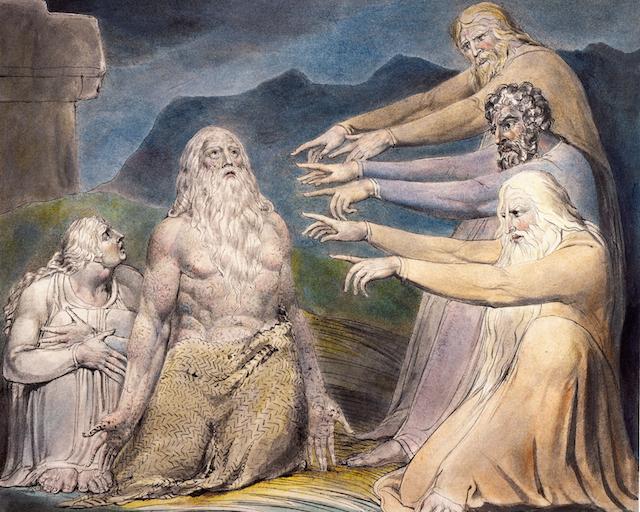
Job. I save Job for last because that is often what people think of first. Job does not try to solve “the problem of suffering.” The whole book is easily described as an “argument” with God. Yet it does have common religious answers argued by Job’s friends why bad things happen to good people … ideas that end up being profoundly wrong. I love Job. Chapters 26-31 contain some of the greatest stuff in the Bible.
2) Music
Music has Spiritual power of this I am convinced. Both “sacred” and “secular” (the Spirit can mysteriously move in either!). My choice of music may not be your choice but music that gives voice to the human condition and hope are worth being on our iPods or phones …
“Be Thou My Vision” is one of my favorite songs though old as the hills as they say
Pink Floyd, “The Wall” the whole album
Pink Floyd, “Wish You were Here.”
Pink Floyd, “Sorrow”
Gustav Mahler, Symphony No.2 “Resurrection” (some may be surprised I know what a symphony is!! lol)
Lots more
3) Books
Elie Wiesel. Night. I place this work first by a non-Christian Jewish thinker. I do not believe I have read a more profound book in my life than Night. Every human being (which includes Christians) needs to read Night. It is small, a mere 109 pages. I believe the Cross of Jesus which turned into the “night” at midday is God’s reply.
C. S. Lewis. The Problem of Pain. This is classic Lewis writing on the cusp of World War II. Not a difficult read and full of insight. One of the fascinating chapters is on the suffering of animals a concept that many American Evangelicals never give a second thought too.
C. S. Lewis. A Grief Observed. This work is, in my opinion, every bit the classic that Night is. Written 20 years after The Problem of Pain, and after living through the death of his beloved wife to cancer, a Grief Observed is confessional, searching and wrestling. It is a struggle to trust God when it does not seem like God can be trusted. Authentic faith is the goal.
Stephen E. Broyles, The Wind that Destroys and Heals: Trusting the God of Sorrow and Joy. This is a gem of a treasure. It is not a book you can breeze through. This is not because it is difficult reading because it is not. Rather it is they way Broyles weaves his own life, his wife’s death to cancer on Christmas morning and the Bible. Broyles was one of my teachers back in the day and I well remember the morning Elizabeth died. Rich. Profound. Moving.
Philip Yancy & Paul Brand, Where is God when it Hurts? Yancy is one of my favorite pop authors of Evangelicalism. This work is stimulating and begins by showing that not all pain is “evil.” In fact pain often has a redemptive function. It is a thought provoking book.
Martin Luther King Jr, “Suffering and Faith” in A Testament of Hope: The Essential Writings of Martin Luther King, Jr. MLK was no stranger to evil and its manifestation in hate and suffering. Writing in 1960 this short essay helps us know that sometimes the only way to make it through suffering is not by denying faith but by running to it. Faith is the ground of hope.
John Mark Hicks, Christine Fox Parker, Bobby Valentine: Surrendering to Hope: Guidance for the Broken. This small book offers “fellowship” with the suffering. In short chapters we sit on the ash heap with those who have lost children, wives, suffered trauma of abuse, divorce, struggles is racism and sexual identity. We hear the story, we see the impassioned cries for God and we see faith with grit.
4) Books to Dig Deep
Leslie C. Allen, A Liturgy of Grief: A Pastoral Commentary on Lamentations. Do not let the word “Commentary” keep you from reading this outstanding work of both biblical scholarship but also real world contact. Allen brings the Lamentations from the ashes of Jerusalem to the ashes of our own hearts as individuals and communities of faith. Suddenly Lamentations is a powerful word from God to the suffering of our 21st century and becomes an instrument of healing. Allen does not address the “problem of evil” per se rather like Lamentations itself focuses upon processing grief. I devoured this book.
John Mark Hicks, Yet Will I Trust Him: Understanding God in a Suffering World. Hicks is no stranger to more than his share of Jobian experiences. In this book he wrestles with the Bible pure and simple. Does the Bible have some kind of perspective on suffering and does it have a “plan” on how to address it? Can we have a real, genuine authentic faith that does not insult the reality the experiences of so many in the face of evil. Some folks have asked me “Bobby what is the practical rational for your crazy new creation theology?” The answer is first of all that it is simply biblical. But beyond that it is because it gives HOPE in the face of EVIL in the world. This book shows exactly how. It gives direction to life in a world out of kilter. This work weaves autobiographical narrative with close reading of various texts in both Testaments.
N. T. Wright, Evil and the Justice of God. Beginning with a survey of how the Enlightenment turns evil on its head, Wright says that evil is “still a four letter word” that will not go away by denying it. Then he argues that Bible does not so much as answer the question of “where does evil come from” but instead argues “what God can do and is doing about evil.” The final chapter on “Deliver us from Evil” in which he discusses the Christian alternative to evil in forgiveness in light of the Crucified God is worth the book. And sooooooooooo hard.
Christopher J. H. Wright, The God i Don’t Understand: Reflecting on Tough Questions of Faith. Christopher Wright is one of my favorite scholars. Insightful and critical but reverent and trusting. In this work he works thru 4 questions that all relate to evil and the integrity of God. These are suffering? The Canaanites (did God perpetuate evil?)? How the Cross addresses Evil and the deep issues of “Sin” (much more than white lies) and finally the promise of Resurrection and Renewed Creation. Genuine work by a serious scholar but not aimed at scholars.
Christian faith is not a set of pat answers to the question “how to find the right church.” It is not pat answers to “how to avoid hell.” We often misconstrue what Christianity is really all about.
Christianity is the Story of Hope. It is the hope of the Creator God loving the created who brings ultimate healing to the world. This is the Christian faith.
“May the Lord bless you and keep you and make his face shine upon you“ (Numbers 6.22f)
“Justice, and only justice, you shall pursue, so that you may live and occupy the land that the LORD your God is giving you” (Deuteronomy 16.20, NRSV).
Prelude
In November 1920, Warren G. Harding defeated Democrat James M. Cox to win the twenty-ninth presidency of the United States. It was not called a landslide but “an earthquake.” The progressive Republican Harding had won every state except eleven, all eleven of those in the Deep South. In fact the election of Harding followed the exact same lines as the election of Abraham Lincoln a couple generations before. There was a reason for this.
I have been fascinated with the 1920s for many years. It was a decade of profound importance for my religious tribe, the USA, and the world. It was a decade of parties, optimism, the Harlem Renaissance, virulent racism, and unbridled violence. Today I want to remember an event that took place in 101 years ago this month on October 26, 1921 in my home state of Alabama in the city of Birmingham: The Best Speech by the “Worst?” President.
Warren Gamaliel Harding (1865-1923):The Best of the Worst Presidents
Warren G. Harding, the 29th President of the United States, came from an abolitionist family in Ohio. I became interested in Harding in 2010 when I read a book on the 1920 election by David Pietrusza, 1920, The Year of Six Presidents. In many ways 1920 has many eerie similarities to the 2020 election. It was filled with conspiracy theories, rumors, intrigue, and lies. Hiram Johnson even ran on a “America First” slogan! Former President Theodore Roosevelt was a front runner with solid progressive Republican credentials. He unexpectedly died and the Republican Party was desperate to find a candidate.
Through Pietrusza, I learned of all the rumors surrounding Warren G. Harding. From his childhood, Harding had been called the inflammatory racial slur (the “N” word). His father-in-law also believed he was not “white” and practically disowned his daughter for marrying him. When he ran for President, a Professor of History at Wooster College, William Chancellor, went on the war path against Harding publishing several documents proclaiming “Warren Gamaliel Harding Is Not a White Man.” Chancellor claimed he had evidence that Harding’s great-grandmother was black therefore he was “one-eighth” black. In the lingo of the day, an “Octoroon.” But the “One-Drop Rule” would make Harding black. In the 1920s and decades following tens of thousands of “black” Americans “passed” as white for reasons the reasons that produced the animosity toward Harding (see the story of Gail Lukasik who discovered her mother was “black” doing DNA research on her family, “My Mother Spent her Life Passing. Discovering Her Secret Changed My View“). Harding, actually never responded to the rumors. But in 2015, DNA tests on his grandchildren revealed African heritage in Harding was “not likely.”
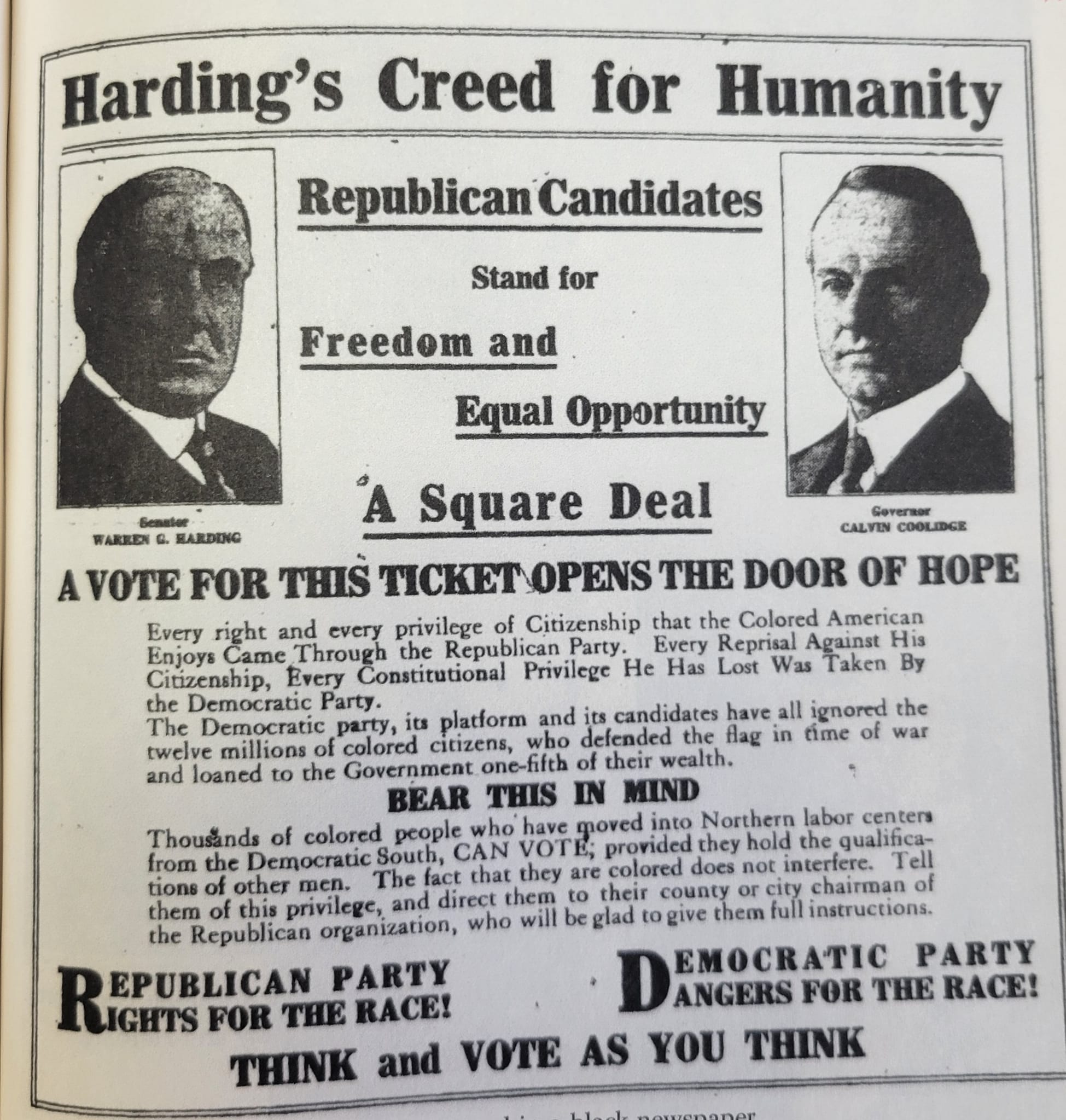
Harding Campaign Advertisement, 1920 (click to read)
Southern Democrats violently opposed Warren G. Harding, with or without, rumors of his great-grandmother. His record on progressive Republican values (of the day) was a clear and present danger to them. Arkansas Governor Charles H. Brough publicly railed against Harding for urging black’s to vote.
“This, of course, strikes at the very heart of white supremacy … The presidential election means everything in the south and I urge you … to explain to your people [i.e. in Ohio] just what Senator Harding’s triumph would mean in robbing the south of her most cherished birth-right, Anglo-Saxon supremacy.” (cited in Pietrusza, p. 366).
But Harding ran on a progressive Republican ticket with Calvin Coolidge. He won in a landslide victory with the massive turn out of women voters of 1920 (their first Presidential election). Harding had sought the “black vote” too.
As a Senator he had supported the Dyer Anti-Lynching Bill introduced by Leonidas Dyer of Missouri in the wake of the riots in East St. Louis in 1918. Harding, as President, would introduce and ask the Republican controlled Congress to pass the Bill. Harding released a statement. “If the Senate of the United States passes the Dyer anti-lynching bill, it wont be in the White House three minutes before I’ll sign it and having signed it, enforce it.” But the bill died in the Senate by means of a southern filibusterer in 1922. As a candidate Harding publicly supported the Bill. Recently Congress finally passed such legislation but was opposed by Republican Rand Paul. When Harding was elected, he reversed the policy of the virulent racist Woodrow Wilson of expunging African Americans from federal appointments and filled a number of positions.
Early in Harding’s Administration, the Tulsa Race Massacre took place. Unbridled carnage was unleashed upon “Black Wall Street” from May 32 to June 1, 1921. Thirty-five city blocks looked as desolate as a lunar landscape, hundreds were murdered, and thousands dislocated. Unknown to almost every Republican (and likely most Americans), a week after Tulsa, President Harding journeyed to Pennsylvania to do the Commencement address at the oldest degree granting Black college in America, Lincoln University. In stunning contrast to a Republican 100 years later who went to Tulsa itself, he addressed the students about the status of America. First thing he did was acknowledge, and thank, 367,000 black American “patriots” who fought in World War I. He addressed the students as “my fellow countrymen.” And at that black university he made a public statement on Tulsa, a prayer. “God grant that, in the soberness, the fairness, and the justice of this country, we never see another spectacle like it.” And shocking to many, he then went down the line and individually congratulated and shook the hand of every one of them. But he was not done.
Presidential Platform in Birmingham
Trip to Birmingham, Alabama October 1921
President Harding’s trip to Lincoln University is virtually forgotten even by professional historians. When they write about Presidents that have visited historically black colleges and universities, it is not mentioned. But he was the first and the occasion was significant.
Five months after Tulsa and addressing the students at Lincoln University, Harding would become the first sitting President to travel to the Deep South since the Civil War. He would travel to non-other than Birmingham Alabama for its “semi-centennial.” The trip was a favor for his old Democrat Senator friend, Oscar Underwood. Birmingham was the “Magic City.” It did not even exist in the Civil War. It was the icon of what could be in the “New South.” The President coming to the party brought out well over 150,000 people.
When he arrived via train to Birmingham he received a 21-gun salute and rode in a Preston Motor Corporation automobile manufactured in the Magic City (I never heard of them until I began investigating this history years ago). Harding rode in the car to the hotel with his wife Florence, former Mayor John B. Wood, and an African American named Frank McQueen. Perhaps a harbinger of what was to come. In the heart of the former Confederacy, a President would call for full participatory citizenship for African-Americans.
Speech to 150,000 in Woodrow Wilson Park
Some say as many as 170,000 were gathered in the recently renamed Woodrow Wilson Park on October 26 for the President arriving for the “Semicentennial of the Founding of the City of Birmingham, Alabama.” Both white and black came from all over Alabama and surrounding states. The crowds were separated by a barrier to ensure there was no “race mixing.” All were eager to have the President in the Magic City. Harding appeared before the massive crowd at 11:30. After Alabama Governor Thomas Kilby and Birmingham Mayor Nathanial Bartlett shared some words with the crowd, Harding stood. What he said that day is something I never heard a word about until a decade ago. His words that day were like an explosion. Harding became the first President to address the matter of Civil Rights and he did it in Alabama.
The Speech
Warren Harding was no Barack Obama or Ronald Reagan when it came to public speaking. But what he did say revealed a man who was a student, who had digested sources and had reflected on the issues of the day.
Harding opens by reminiscing on how the South had responded in moments of crises in the past. How industry had sort of just “magically” appeared where there was none previously (Birmingham the prime example of “Magic”). Then he makes a statement that foreshadows concerns he will address in the speech. “I have many times wished that there might be a wider appreciation of the energy, resourcefulness, and genius for industrial development which the people of the South demonstrated during that [Civil] war.” Harding voices the belief that such energy devoted “would present a picture of opening opportunity and widening horizon whose contemplation would challenge every remaining vestige of prejudice.” Harding reviews such advances as the telegraph, telephone, automobiles and marvels that were put to service in the World War. Harding knows where he is and has been quite tactful. He wants to be heard.
Then in paragraph ten, Harding remains “presidential” and diplomatic, but turns reflective and challenging. He wants Birmingham, and the South, to see that a new world is emerging. He said to the 150,000+ people, “there never was a time when we needed so much to study our past and, in the light of its lessons, give earnest thought to the tomorrows.” He said, “it may be proper to suggest a few thoughts regarding the critical times which are faced by our country.” Alabama was about to get more than it bargained for with the first Presidential trip to the Deep South since the Civil War.
President Harding reveals himself to be surprisingly perceptive of cultural trends and pressures in the the USA and even the world. He believed that the World War was producing incredible changes that America must face honestly. Second, and I personally was surprised to see him recognize this, change has been brought about “by a great migration of colored people to the North and West.” He states forthrightly “the World War brought us to full recognition that the race problem is national rather than merely sectional.” Hundreds of thousands of black soldiers fought honorably in Europe and “as patriotically as did the white men” and they “experienced life of countries where their color aroused less antagonism” than in the States. The War had produced a sense of pride and “citizenship” in Black America that simply could not be denied nor ignored.
Suddenly, Harding brings up the well known race apologist Lothrop Stoddard and his book, The Rising Tide of Color. Stoddard was a white supremacist who believed (as did W. E. B. DuBois) that race and European white hegemony would be the defining issue of the 20th century. England and the USA was called to action by Stoddard. As the Governor began to squirm, Harding rejected Stoddard and endorsed an article in the Edinburgh Review (a semi-scholarly literary and politically progressive quarterly journal published in England). He said, “we must realize that our race problem here in the United States is only a phase of a race issue that the whole world confronts.”
Because of the progress in the world. Because of the undeniable patriotic service of black men in the war. Because of the changing demographics in the USA. Harding said something that white Alabama did not want to hear from a President on the anniversary of their city. “We shall find an adjustment of relations between the two races, in which both can enjoy FULL CITIZENSHIP, the full measure of usefulness to the country and of opportunity for themselves … regardless of race or color.”
The hundred plus thousand white Southerners gathered in Woodrow Wilson Park sat in stunned silence. On the other side of the barrier, tens of thousands of Black Americans erupted.
After a few moments, Harding decided to clarify. At this distance we do not know if this was a political clarification or something he genuinely believed. But it is clear Harding knew Booker T. Washington, Marcus Garvey as well as W. E. B. DuBois. So he says, he does not mean “social equality” which in the South meant, at bottom, inter-racial marriages (which is what Harding meant as is clear in the speech). But then Harding explains what he does mean by “equality.” The South understood it to be nothing less than “social equality.”
Political Equality
Harding proceeded to lay out “equality.” Harding said that equality demanded a “political aspect.” Black men had earned the right for Black America to the ballot. “I would say let the black men vote when he is fit to vote: prohibit the white man voting when he is unfit to vote.” Black and white should be treated equally at the ballot box.
Educational Equality
Harding was a believer in education for lifting all humanity to a higher plane. He says, indeed, insists upon it for African Americans. “I would insist upon equal educational opportunity for both.” Harding noted this does not mean that ever single person would end up with the same education. He points out that plenty of white people do not have the same educational background. But that educational opportunities are to be available for those seeking them and have the capacity to pursue even higher education and through it higher quality of life. Again, equal access to education, raises the specter of white girls dating black men. So in the middle of a paragraph on equal education, Harding says again remembering where he was, says “racial amalgamation there cannot be.” But he issues this admonition to the massive crowd.
“I can say to you people of the South, both white and black, that the time has passed when you are entitled to assume that this problem of races is peculiarly and particularly your problem. More and more it is becoming a problem of the North: more and more it is the problem of Africa, of South America, of the Pacific, of the South Seas, of the world. It is the problem of democracy everywhere, if we mean the things we say about democracy as the ideal political state. Coming as Americans do from many origins of race, tradition, language, color, institutions, heredity; engaged as we are in the huge effort to work an honorable destiny from so many different elements.”
Harding’s message was, because of the times, we must change. In fact, as he noted, it is “passed” time.
Harding believed “it is a matter of the keenest national concern that the South shall not be encouraged to make its colored population a vast reservoir of ignorance.” Nor did the President want all black people to become Republicans or white Southerners to remain Democrats. Instead he said, again shocking both Governor of Alabama and Mayor of Birmingham who are on the platform with him, “I want to see the time come when black men will regard themselves as FULL PARTICIPANTS in the benefits and duties of American citizenship.” This meant that they are informed and can made decisions about taxes, tariffs, foreign relations and vote as they feel best for the nation as a whole and themselves in particular. But equal education and equal access to the ballot is a necessary reality for what America means in the modern world.
One Reaction
Harding closes his speech by reminding Birmingham of the “magical” development of industry and progress. He said that fifty years was but a moment and if we put our hands to the plow then we can overcome any challenges facing us in the South or the nation as a whole. Yet he said the future will march on whether we march with it or not. He final words are sort of a plea to have big dreams and courage.
“the glory of your city and your country will be reflected in the happiness of a great people, greater than we dream, and grander for understanding and the courage to be in the right.”
Reflections
I grew up on Florence, Alabama. I’ve been to Birmingham many times. In fact I have been to Huntsville, Ft. Payne, Red Bay, Tuscaloosa, Gadsden, Anniston, Montgomery, Dothan, Mobile, Gulf Shores … every corner of the state. But I never knew that the President Warren G. Harding journeyed to Birmingham in October 1921 and gave the first presidential address on “civil rights.” Why is this not taught?
W. E. B. DuBois recognized the significance of what Harding had done. He also noted how Harding had qualified equality but expanded on it. He wrote,
“the sensitive may note that the President qualified these demands somewhat … and yet they stand out so clearly in his speech that he must be credited with meaning to give them their real significance. And in this the President made a braver, clearer, utterance than Theodore Roosevelt ever dared to make or than William Taft or William McKinley ever dreamed of. For this let us give him every ounce of credit he deserves.”
Now we are not claiming that Warren G. Harding was Cornel Wes, Martin Luther King Jr., bell hooks, or Amanda Gorman. But he did do something that could have been political suicide and even worse to himself. Predictably the speech exploded like a bomb in the South. The Klan excoriated Harding. Thomas Watson, Senator from Georgia ranted that Harding “had planted fatal germs in the minds of the black race.” Alabama Senator Thomas Heflin told Harding he would have to take it up with “the Almighty who has fixed the limits and boundaries” between “the races” and “no Republican can improve upon His work.” The South heard Harding in the same way DuBois had.
When I look at this trip by Harding to Alabama 101 years ago, I think of the missed opportunities. I think of the world moving on just as he said it would.
Can we imagine where we might be if the South actually did believe in equal access to the ballot. In the year of 2022, it is amazing how relevant Harding’s words are on this theme. The irony of a Republican President going into the bastion of voter intimidation and declaring essentially that democracy is a fraud without equal access to the ballot should not be lost on us.
Can we imagine where we might be if the South, and all the USA, invested in equal and real education? And not to produce more Republicans or more Democrats but to produce “full participants” in the democratic process. To fund education for a greater quality of life.
Where would we be today if our nation had responded in 1921 to this challenge by an all but forgotten President? How different the rest of the 20th century could have been. It would take another hundred years to simply ban lynching in the United States. We are still struggling with people of color as citizens. We are still struggling with anything called education.
Today we recognize Harding’s “qualification” should not have been made (for whatever reason he made them). But in his day the qualification was viewed as “smoke and mirrors.” If his agenda happened then, as Mississippi Senator Pat Harrison complained, “if the President’s theory” is carried out “that means the black man can strive to become President of the United States.”
Where are the Republicans today on civil rights? on voting rights? on education? Where is the courageous leadership on these issues?
Finally the issue has to be wrestled with, why did we not heed the call? Why did not we not dream and have courage “to do the right?” Why is it that we do not “pursue justice and justice alone” as the Holy Spirit directed us?
These are things that I reflect on when I think about the “Best Speech by the Worst President.”
Resources
Blaine A. Brownell, “Birmingham, Alabama: New South City in the 1920s,” The Journal of Southern History 38 (1972), 21-48
Charles E. Connerly, The Most Segregated City in America: City Planning and Civil Rights in Birmingham, 1920-1980
John W. Dean, Warren G. Harding
William B. Hixon Jr, “Moorefield Storey and the Defense of the Dyer Anti-Lynching Bill,” New England Quarterly 42 (March 1969), 65-81
David Pietrusza, 1920 The Year of the Six Presidents
Ryan S. Walters, Jazz Age President, Defending Warren G. Harding
Women. It is beyond irony the subject of “women” can be so contentious among those who claim to follow the Bible. In some corners saying something positive regarding women gets you dismissed as following culture. If you say that women are equal, then you can be branded as a “radical feminist.”
Down the centuries numerous tropes have been put forward to promote the inferiority of women. One of the most frequent has been the attack upon women as intelligent rational creatures of God. Their brains are simply not as good as male brains (as the trope goes). It has been a long battle and one that is far from over even among those who claim to believe in the God of the Bible. This is ironic in the extreme. In the Bible itself we find women performing every conceivable role that men do from teachers, prophets, rulers, deacons and even apostles (see my article A Biblical Register of Roles God Has Called Women).
But the first page of the Bible declares that women are ontologically equal with men.
“Then God said, “Let us make humans in our image, according to our likeness, and let them have dominion over the fish of the sea and over the birds of the air and over the cattle and over all the wild animals of the earth and over every creeping thing that creeps upon the earth.
So God created humans in his image, in the image of God he created them; male and female he created them.
God blessed them, and God said to them, “Be fruitful and multiply and fill the earth and subdue it and have dominion over the fish of the sea and over the birds of the air and over every living thing that moves upon the earth” (Genesis 1.26-28, NRSV)
They are equal image bearers. They equally rule within God’s creation. This is the Creator God’s evaluation of male and female. When we speak of how it was “in the beginning” then males and females are, from the beginning, equal in image bearing and equal in being tasked in mission. However, Genesis 1 typically exercises little influence over Evangelical Christians (except to argue about Darwin).
There are numerous other “silenced texts” in the Bible about women and the equal status they have with God and should have with us. These texts shape how we should think about women themselves and even how we hear two lone (and highly contested) texts in Paul. (On the central contested text, 1 Timothy 2.12, see my article First Timothy 2.8-15 & the Silencing of Women in Worship).
Protests notwithstanding, what we think of women as human beings profoundly impacts how we interpret two texts for many sum up everything the Bible says about women.
It is the case that women are often – frequently – presented in Christian history (in sermons, commentary, articles, conversations) as simpletons, naive, prone to sin, the source of sin and just mindless creatures. They are emotional and less rational in the common male created stereotypes. These caricatures of “woman” that are totally at odds with Genesis 1. That so many fail to recognize the direct conflict in these false images and the biblical narrative makes us wonder if we ever actually read the Story.
Who is Wisdom?
But it is not just Genesis 1 these sinful caricatures are radically at odds with. It is safe to say that many ancient Israelites also held these misogynistic views of women (just as many down through the centuries). But biblical authors were not your average Israelite. They frequently are radically countercultural by recasting images of women more in a Genesis 1 mode.
For example take those collection of books we sometimes call “Wisdom” literature (Proverbs, Job, Ecclesiastes, Song of Songs and if we include the Septuagint that would include Sirach and Wisdom of Solomon). These books teach us, that is they “instruct us in righteousness” and “equip us for every good work.” That is they are inherently authority in the life of God’s people (2 Tim 3.15-16). They provide God’s guidance for simply living a good life and wrestling with the most profound of questions. They speak of the “fear of the Lord.” They are wisdom. They are the product of the Holy Spirit.
But wisdom, in the Bible, is a Woman. Wisdom herself is a Female. Wisdom is Lady Wisdom. She teaches. She preaches. She instructs. She calls the listener to follow her. Wisdom, smarts, intelligence, knowledge … is a woman.
How do we know the Bible uses “women” as the paradigm of wisdom? Well because “the Bible told me so.” Where?
Here …
“Does not wisdom call, and does not understanding raise HER voice? On the heights, beside the way, at the crossroads SHE takes her stand … SHE cries out …”
What does the Woman preach? What is Lady Wisdom going to instruct Israel (and any person that listens to God’s word today?) The Wisdom Woman claims she is the Truth …
“To you, O People, I call, and my cry is to all that live … All my words of my mouth are righteous … I, wisdom, live with prudence, I attain knowledge and discretion … I have insight and strength … I walk in the way of righteousness, along the paths of justice …”
Wisdom, the Woman, informs us that She is in fact the first creation of God. Adam is not first, Lady Wisdom is first. She in fact was by God’s side as “adam” was created. Which in one way actually reframes the whole false notion of progenitor.
“The LORD created ME at the beginning of his work the first of his acts long ago. Ages ago I was set up, at the first, before the beginning of the earth. When there were no depths I was brought forth, when there were no springs abounding with water. Before the mountains had been shaped, before the hills, I was brought forth, when he had not yet made earth and fields or the world’s first bits of soil. When he established the heavens, I was there; when he drew a circle on the face of the deep, when he made firm the skies above …”
Then Lady Wisdom informs us that the Creator God used Her to design and to create the rest of the marvels of creation.
“when he [God] marked out the foundations of the earth, then I was beside him, LIKE A MASTER WORKER; I was his [God’s] delight …”
Those who find the Woman will have life we are told.
“Whoever finds me finds life and obtains favor from the LORD; but those who miss me injure themselves; all who hate me love death.“
All of these wonderful quotations from our Female Instructor come from Proverbs 8. Wisdom is not a Male. Wisdom is a Woman.
We find Lady Wisdom preaching in Proverbs 1.20-33; 4.1-9. Woman Wisdom is described in Proverbs 9.1-6. In the Greek version of the Old Testament we find Lady Wisdom in Sirach 24; and also Wisdom of Solomon chapters 7-9 along with Baruch 3.9-4.4.
We learn in Job 28 that God loves and treasures Wisdom. And it is not without significance that over 70 percent of the Song of Songs is the voice of a Woman (I believe the book is literally authored by a Woman). Second Samuel 14 presents us with one of those wonderfully wise women from Tekoa. But Proverbs goes much further.
Since Wisdom itself is a Woman, her teaching is not merely the selected verses quoted above. ALL Wisdom comes from Lady Wisdom. Lady Wisdom, since all wisdom in Job, Ecclesiastes, Song of Songs, and its frequent appearance throughout Scripture. So a Woman is the implied author of Job, Ecclesiastes, and Proverbs.
Talk about “authority.” The Holy Spirit is confronting our prejudices big time here my brothers. (Of course many will immediately dismiss this because this is metaphorical language. As if metaphors do not carry any weight. But the moment we apply that logic to the metaphors of God as Father or baptism washing sins away, they say we just don’t believe the Bible anymore! Ohhhhhh the special pleading and irony).
But the Holy Spirit was free to chose any image for Wisdom. The Spirit could have easily chosen a male (or an owl or tree or anything) to be wisdom. That was after all the prevailing prejudice and has been so down the centuries. Men were the smart ones and women foolish. But God’s Spirit sinks that bigotry and brings us back to a Genesis 1 perspective on Women. When God thinks about wisdom in relation to the human race it is the Woman that God holds up and says “perhaps you need to rethink this.“
Perhaps, just perhaps, one reason Wisdom is a Woman in Scripture is because in the Hebrew Bible the Ruah (God’s Spirit) is also FEMALE! Ruah is Feminine in Hebrew (always has been and always will be). I have witnessed some disciples literally become discombobulated when they learn this fact.
Women. Some rebel at the very notion of a woman teaching them anything. But the Holy Spirit (the feminine Ruah) decided that the very image of wisdom was not to be a male but a woman. She teaches “all” who love her. Her teaching is holy. Her teaching is authoritative. Her teaching is inspired. Her teaching is the word of God.
What is your image of wisdom? In the Bible when Wisdom is pictured we see a woman staring back at us.
Rachael and Talya are no less, in any respect, to God than any male on the planet. Genesis and Wisdom teaches us this. Thank you for being my teacher Rachael and Talya.
Some things just make us go hmmmmmm.
Accessible Resources for Lady Wisdom
Ellen F. Davis, Getting Involved with God: Rediscovering the Old Testament. Her chapter “Desirable Discipline, Proverbs 8,” is wonderful.
Roland E. Murphy, The Tree of Life: An Exploration of Biblical Wisdom Literature, 3rd Edition. Murphy gives an extended overview of Lady Wisdom in Job, Proverbs, Sirach, Baruch, and Wisdom of Solomon.
Luke spent a chapter and half on the salvation of the crippled man (Acts 3.1-4.22). The saved man is a microcosm of what genuine salvation looks like. This man has been “saved” (4.9; Gk) from shackles of death and decay operating in God’s world. The “Jubilee” mission and message of the resurrected Messiah Jesus has saved this man. The Messiah’s mission is bringing healing to God’s wounded creation, the man is Exhibit A. As Peter said, pointing to the man, this man had been “saved” through the name of Jesus the King (4.9-10).
The actions of Peter and John caused trouble with the Sadducees. But Luke has already warned readers that Sadducees do not believe in the resurrection of the body (Lk 20.27).
So Peter, John and the Saved Man are hauled before the court. They are kept overnight. They are castigated and threatened to not speak of this again. But released. (Acts 4.21).
The Way Prays the Psalms
Peter and John go find the disciples (we are not told what happened to the Saved Man). They relate what the Sanhedrin had said. They had been forbidden to preach with the implication being that next time more than a night in jail awaits them.
In response to this threat, Luke tells us that “they all together” (4.23) blended their voices in prayer. All men and women (since males and females are included in Acts 2.17-18). When they prayed, they prayed the Bible (Hebrew Bible/OT). They cry out to the “Sovereign Lord” who has “made heaven and earth and the sea.”
God the Creator is, for Israel, an extremely comforting thought. Psalms, familiar to Jesus and the Way, as the Songs of Ascent directly link the notion of God the Creator to God’s protection and presence. In Psalm 121 Yahweh is the Maker of Heaven and Earth which means he “watches over you” and “keeps” Israel. (See also Ps 124.8; 146.6, etc). Yahweh promises the exiled Israelites that “he who created you” … “Israel’s creator” is the King. This means, again, presence and protection. So “when you pass through the waters … they will not sweep over you … When you walk through the fire you will not be burned.” Because the Creator owns Israel and is with them (Isaiah 43). The Gathered Saints in Acts 4.25ff call out to that Creator God, the God of Israel, because they are about to walk through the fire.
And it is fire. So they pray the Psalms. In fact it is Psalm 2 they utter in unison. The renewed people of God find themselves in the Scriptures of old. The very scriptures that, like Timothy, they had known from childhood (2 Timothy 3.15-17). They pray Psalm 2 (they probably prayed the entire prayer but Luke quotes only verses 1 and 2).
“Why do the nations conspire and the peoples plot in vain? “The kings of the earth set themselves, and the rulers take counsel together, against the Lord and his Messiah“ (Acts 4.25-26 quoting Psalm 2.1-2 from the LXX)
The Bible is the source of prayer. It is the source of what to pray. They are praying the Psalms. Those scriptures are the source of understanding what is happening now and what we are to do now. This is the real authority of Scripture in that it shapes and molds who we are and what we do in the here and the now.
The nations (Romans) and the peoples (Sadducees/Chief Priests) in the persons of Herod and Pilate have both attacked God’s anointed holy servant Jesus and his followers (note v.27).
How Did the Bible, the Psalms, Shape Prayer?
When these disciples prayed the Bible, for what did they pray? First, they are not surprised they are attacked. They knew they would be so because it was in their Bible. If the nations raged against the Lord and his anointed then we will surely not be exempt. And this was genuine opposition from the Powers that Be. This is not someone taking an ad out in the paper or taking away school prayer or calling us names. This is a direct challenge to the Messiah Jesus and the resurrection.
Second. When they prayed the Bible they confessed that the Scripture was true. They quote the psalm and then tell the Sovereign Lord, “it is true” (4.27). They confess that the holy servant/child Jesus was handed over. But this too, took place because their Bible was true. This very Scripture, that they found themselves in, states clearly the powers would make war against the anointed.
Third. In light of the promised presence and protection of the Creator and the truth of the Scriptures they do not pray for the removal of the persecution. They did not pray as I likely would have. They did not pray for deliverance from the challenge at hand. They prayed instead for the power to be bold in the face of those who oppose the Lord and his resurrected Messiah.
“So now Master, look on their threats; and grant that we, your servants, may speak your word with all boldness, while you stretch out your hand for healing” (4.29-30).
They prayed for boldness. Removal of the threat lessens the chance to bear witness. They would be witnesses to the new creation salvation that has broken in through King Jesus and his resurrection. They would be witnesses to that renewed world. So they pray not for the removal of the Sadducees but to be fearless and daring in the face of certain punishment from the powers that be.
Suddenly, Luke tells us, the place they are gathered is shaking and rocking back and forth with wind (pneuma/Spirit). God showed up (in my mind it is reminiscent of Psalm 29 where God’s people are praying and the storm/wind shows up and shakes and quakes the whole house).
Two things resulted from praying the Bible/Psalms:
1) They did speak with boldness in the face of “threats” (v.29) of the powers that be
2) They were united in mission in the face of threats and this unity manifested itself in “nobody said they owned their property” (4.32).
Praying the Bible, especially the Psalms can result in some radical stuff in the life of God’s people
In the Book of Joel we read of a devastating plague of locusts. These locusts are described vividly (1.4; 2.4-9; etc). This plague is a foreshadowing of an even greater “day of the Lord” that will face God’s people. We are not told, in the book, exactly what the plague was in response to but the people are called to assemble, to join the earth and animals in mourning and prayer, to “turn” back to Yahweh.
The description of this locust “army” is frightful indeed. We can almost hear, andfeel, the terror this force instilled as they scorch the earth leaving near starvation in its wake. Joel also leaves not a shadow of a doubt of whose army this is.
“The LORD utters his voice at the head of his army; how vast is his host! Numberless are those who obey his command” (2.11).
Just as the army is about to completely overwhelm the city, the action stops, miraculously. And graciously.
Instead of further attack, a voice thunders and invites God’s people to share the point of view of the earth and the animals and turn to God (1.10, 18, 20; 2.12f). Genuine repentance is called for by the voice. But the plea is based on God’s HESED and Joel quotes the “God Creed” in 2.13,
“for he is gracious and merciful, slow to anger and abounding in HESED, and relents from punishing.”
So the priests gather the people together in the temple. They cry to the Lord on behalf of the people (2.17f).
Suddenly there is a whirlwind of divine speech. A torrent of grace and mercy blowing in the wind of God’s HESED falls down upon the scorched land. Yahweh addresses all that have suffered in the punishment. Suffered because of human sin. It was human sin that unleashed, after a long period of time, the punishment of the locusts. But it was not only humans who suffered because of the locusts, it was the earth and the animals. So Yahweh addresses the earth (2.21), the animals (2.22) and finally the people (2.23).
Then something astounding, almost shocking, takes place. It is as if God almost apologizes for sending the punishment that Israel justly deserved. Yahweh does in fact promise to “repay” even more than was lost. It is a stunning text, that I never once heard in church.
“I [Yahweh] will repay you for the years that the swarming locusts has eaten, the hopper, the destroyer, and the cutter, MY GREAT ARMY, WHICH I SENT AGAINST YOU.” (2.25)
The word “I repay you,” or “I will restore” (וְשִׁלַּמְתִּ֤י), is a technical word for legal compensation. The New English Bible renders it as “So I will make good the years that the swarm has eaten.” The punishment was Israel’s fault.
But God promises to pay back for the damage/losses caused – as if it was God’s fault, as if Yahweh is taking the blame, as if God is the one who was in the wrong, as if Yahweh owed them. My friends this is nearly shocking.
This is pure, unadulterated, even shocking, grace. This is not the only place Yahweh promises to pour out magnitudes more grace than punishment. Yahweh declares in Zechariah 9.12,
“Today I declare that I will restore to you DOUBLE.”
Yahweh declares in Isaiah 61.7,
“Because their shame was double … therefore they shall possess a DOUBLE portion of; everlasting joy shall be theirs.”
Truly God “does not deal with us according to our sins” (Ps 103.10).
I had read Joel before but did not “hear” it. A few years ago I was working on a book project that included Joel. It was then that 2.25 hit me powerfully.
Israel sinned (God’s People). Sin has consequences.
The earth, the animals, even the people are in dire straights because of our sin. But if there was any remnant of my early understanding of God left, Joel tossed it into the sea. The God of Israel will do almost anything to get out of having to dish out punishment. And when punishment is the last resort … Yahweh pours out even more on the penitent than what was there before.
The apostle Paul did not invent the truth, “where sin increased, grace abounded all the more” (Rom 5.20). Moses, the Psalmists, and Joel knew this long before. Texts like the radical text of Joel help us to understand why there is a Cross.
Casper is not the destiny of God’s People. Resurrection and “spiritual” bodies are not composed of spirit.
Being immersed in the story, idiom and theology of the Hebrew Bible is essential to properly understanding the apostolic writings we call the “New Testament.” Reading those Scriptures, and the Apocrypha as the bridge to the New Testament, gives us the right set of cultural eyes to read Paul (especially) correctly. The “worldview” of the Hebrew Bible is shaped differently than the Greek of our Western Enlightenment heritage.
I believe most of us, myself included, are unaware of how deeply modern cultural history impacts the way we understand the Bible. We, westerners, read the Bible as children of the Enlightenment, through which everything is filtered into extreme individualism, Epicureanism, and hefty dose of Platonic dualism. A person does not have to be able to define these terms to live them out nearly every second of their lives (like a fish has no idea what water is).
But those three cultural trends have transformed our modern western world and are embedded in it at every level. These ideas fill our modern world like oxygen atoms fill the air we breathe. How we understand the words “spirit” or “soul” and “spiritual” are cases in point.
These terms, in our modern setting, typically refer to “nonmateriality” even the opposite of materiality. It is further simply assumed this “nonmateriality” is inherently superior to the “physical/material” (which is the antithesis of “spiritual”). These assumptions have dreadful implications when reading the Bible. Since we just finished Paul, when we moderns read the in the English Bible about “spiritual bodies” as in 1 Corinthians 15.44f that this must mean a non-material, non-flesh, non-physical body.
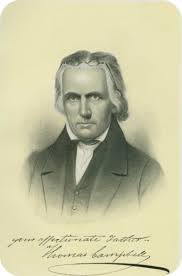
Yet that is not what the phrase means at all. Interestingly enough the church fathers, whose native language is the same Greek as the New Testament, never understood the phrase as modern western folks do. The reason for this is Paul is a Jew. Paul’s point of reference is the Bible of Israel. Much to his credit, Alexander Campbell understood this truth very clearly. He wrote a long time ago,
“Every one, then, who would accurately understand the Christian institution must approach it through the Mosaic; and that he would be a proficient the Jewish must make Paul his commentator … The language of the new institution is therefore explained by that of the old. No one can understand the dialect of the kingdom of heaven who has not studied the dialect of the antecedent administrations of heaven … All the leading words and phrases of the New Testament are to be explained and understood by the history of the Jewish nation and God’s government of them” (Christian System, pp. 117, 118-119).
“Paul was a Hebrew, and spoke in the Hebrew style. We must learn that style before we fully understand the apostle’s style. In other words, we must studiously read the Old Testament before we can accurately understand the New” (Christian System, p.231).
Campbell would go on to say that though the NT is written in Greek “it has the soul of Hebrew” (I like that nice play on words by Uncle Alex).
Therefore, to quote Campbell one last time, “it is not the doctrine of Plato that the resurrection is a proof and pledge.” Thus Paul never speaks of the immortality of the spirit but of the body.
All of that to say this, Paul is not a Greek (Platonic) dualist. In Hebrew thought (inspired by the same God that inspired Paul) a human is not split into inferior flesh and superior “spirit/soul” (philosophically termed “anthropological dualism”).
But in the Bible, in Hebraic eyes, a human is a complete integrated being. In Hebrew the word “soul” (נֶ֫פֶשׁ nephesh) simply refers to the individual as a whole. A “self.” A person. It can be a way of saying “I.” So, for example, the famous line,
“as the deer pants for the water so my SOUL longs for you” (Ps 42.1)
This does not mean there is an unseen part of the psalmist that wants God while another visible part (the body) does not. The text can be justly, and more accurately, translated,
“as the deer pants for the water, so I long for you” (Ps 42.1, NEB, REB, TEB, GNB, Bible, An American Translation, CEV, etc).
A human being is a psycho-somatic unity in the Bible (or anthropological monism). This is the direct opposite of Platonic dualism. In Platonism the material world is inherently inferior than the “spirit” world. Materiality will be cast aside and done away with in the Platonic doctrine of salvation.
But in the Hebrew Bible, the physical creation is the loving handiwork of the Creator God and is filled with God’s own Presence, filled with God’s hesed and God’s justice. It is Gooooooooooood. In fact it is very GOOOOOOOOD. There is nothing bad about Creation. The NT even extends the goodness of creation because it is the work of Christ himself. The physical is “spiritual” in the Bible.
This includes everything about a human being. This is why for Paul, the dyed in the wool Jew, our physical material body is (as throughout the Hebrew Bible) the vehicle of worship to God. In fact, it is “spiritual.” “Therefore, brothers and sisters, by the mercies of God, to present your BODIES as a living sacrifice, holy and acceptable to God, which is your spiritual worship” (Romans 12.1). This is a classic Jewish view expressed from a lifetime of very physical pilgimages to Jerusalem, a lifetime of very physical lifting hands, shaving heads, placing hands on animals, of eating very physical sacrifices in joyous communion with Yahweh. We can only worship through our body. Even our “mind” is in our body. The material body is spiritual and the spiritual is physical and material just as God created it.
When we unconsciously read the Bible through those Platonic eyes (even when we have never heard of Plato or his disciple Plutarch) however we can split creation apart by misunderstanding because “soul” in Greek thought refers to that interior hidden part of us that is superior to materiality. This is Plato, not the Bible. The material world in Plato is not good but it is Moses and God’s great ‘Yes’ to the material world is when the Word became “FLESH” (emphasis not shouting).
So, returning to “spiritual bodies.”
The Greek in 1 Corinthians 15.44f (πνευματικόν) does not refer to the substance of the body. That is, it does not refer to what that body is composed/made out of. In fact, most scholars recognize that even the English translation of “spiritual bodies” is exceedingly problematic. (see N. T. Wright’s extensive discussion in Resurrection of the Son of God, pp. 348-356; Ben Witherington III’s Conflict and Community: A Socio-Rhetorical Commentary on 1-2 Corinthians, pp. 307-309).
The adjective means something quite different. An illustration may help. If we say “there goes the steam locomotive,” no one imagines that an immaterial ghostly train is passing by. The train is not composed of steam. My dad is a diesel mechanic. The Snap-On or Mac tool dealer comes by and my dad says, “I want to buy a new pneumatic drill.” The Snap-On dealer does not imagine that dad wants a drill made of air. Rather the train is powered by steam. The drill is powered by air. And pneumatic body is powered by the Spirit – not made of it. So, in the Kingdom New Testament: A Contemporary Translation we read,
“But you don’t get the spirit-animated body first; you get the nature animated one, and you get the spirit-animated one later.”
God redeems whole humans in the resurrection. Jesus’s resurrection is the NT definition of resurrection (that is the meaning of the phrase “first fruits” in 1 Cor 15). Jesus’s resurrected body was the same Jewish body that was hung upon the cross composed of flesh and bones as Jesus states himself (Luke 24.39). That same Jewish body ascended to the Father as the Model for what the Creator God promises to do with you and me (that is the very meaning of “first fruits.” Humans are not spirit creatures we are materially, creationally, embodied souls (living beings).
The “soul” normally refers to the whole human being not an invisible part. Paul does not teach that God redeems some of us, but all of us. Paul for example never says God redeems our spirit. Such a statement never occurs in the Bible. He says God redeems our “mortal body” (Rom 8.11, 23). Because our body cannot be separated from who we are. Our resurrection, redeemed from the grave, body will be empowered by the Spirit not made of spirit (like a pneumatic wrench is powered by the pneuma not made out of it). God does not intend to surrender an ounce, not even a hair, of us the curse Sin brought into God’s good creation.
Reading the New Testament from the point of view of Genesis, Deuteronomy, Psalms, Isaiah (i.e. the Hebrew Bible), etc makes a huge difference than when we read it from the pov of Greek dualism. It is the difference between biblical creation and Gnosticsim. These misunderstandings, because we read the Bible through Platonic eyes, also divorce Paul’s saying about “flesh and blood” from its Hebraic context (and it is explicitly a Jewish idiom) but I will say more on that later perhaps.
Let’s do the work to read the NT correctly, as Campbell called us, with Hebraic eyes. We look forward to the resurrection, the redemption, of our mortal bodies from power of sin and death.
“The Psalms speak of change, but more importantly they are AGENTS of change: change within the humans who sing them, and change THROUGH those humans, as their transformed lives bring God’s kingdom and justice into the world … I find it impossible, therefore, to imagine a growing and maturing church or individual Christian doing without the Psalms” (N. T. Wright, The Case for the Psalms, pp. 164-165, emphasis in original)
Making Friends with the Psalter
The Psalms are one of the most important books in the Bible. They have been called the “Holy of Holies,” the Little Bible, Prayer Book of the Bible among other superlative titles. The Psalms have occupied a special place with theology, corporate worship as well as personal Spiritual disciplines among both Jews and Christians for over two thousand years. In my opinion, every preacher needs to intentionally cultivate a relationship with the Psalms for the benefit of self and congregation.
Here is a list of, in my opinion, indispensable works for reading, praying, growing in, and preaching the Psalms.
A Relationship with the Psalms begins by reading them … frequently
Read the book through on a regular basis in a translation that you do not normally use. Reading the Psalms daily, every day, throughout Christian history has often been a requirement of anyone regarded as a leader within the community of faith. For example, around AD 450, Leo “the Great” (as history has dubbed him) once refused to sanction the ordination of an elder/bishop in the church on the grounds that he was not familiar enough with the Psalms, as Leo thought was demanded for the task. Leo said this indicated “the man was not serious enough about HIMSELF” (Epistle 48, my emphasis).
Have several translations of the Psalms. I recommend reading/praying through the Psalter beginning to end, in lectio continua style, every month in a different translation.
Robert Alter, The Book of Psalms: A Translation and Commentary (the commentary is principally to justify translation) read it again and again.
A Comparative Psalter, ed. John R. Kohlenberger III. Embraces the Hebrew, Septuagint, the RSV, and the NET of the LXX in parallel columns.
I strongly urge obtaining audio version of the Psalms to listen to them.
Praying the Psalms is as important as simply reading them
“The Psalms were the prayer book of Israel; they were the prayer book of Jesus; they were the prayer book of the church. At no time in the Hebrew and Christian centuries (with the possible exception of our own twentieth) have the Psalms not been at the very center of all concern and practice in prayer.” (Eugene Peterson, Working the Angels: The Shape of Pastoral Integrity).
For those who practice the daily office going through the Psalter is like greeting the Sun each morning – majestic
Thomas Merton, Praying the Psalms
Dietrich Bonhoeffer, The Psalms The Prayerbook of the Bible
Eugene Peterson, Answering God: The Psalms as Tools for Prayer
These three books, especially the first two, are small. But no library on the Psalms can claim the title without them with evidence of having been used repeatedly.
Studying the Psalms … Losing Ourselves in the Biblical Sanctuary
“The words the Psalms contain in themselves all the Old and New Testaments, the whole Mystery of Christ” (Thomas Merton, Praying the Psalms, p.9)
The following are not all the important books on the Psalm for deeper study. They are just ones that I cannot imagine being without and my library will not be without.
Bernard W. Anderson, Out of the Depths: The Psalms Speak to Us Today. This is a classic and basic introduction to the type of literature the Psalter is.
Walter Brueggemann, The Message of the Psalms: A Theological Commentary. Does not follow the canonical arrangement but through the groundbreaking categories of Orientation, Disorientation, and New Orientation. Rich Book
William P. Brown, Seeing the Psalms: A Theology of Metaphor. Wonderful exploration of the thought world reflected in the imagery of the Psalms. Basic resource.
Miriyam Glazer, The Psalms of the Jewish Liturgy: A Guide to their Beauty and Meaning
John Goldingay, The Psalms, 3 Volumes. This is the essential commentary for the preacher in my view. Fresh translation, verse by verse commentary that pays attention to the form and social setting but equally attune to the theological message of the psalm.
James Luther Mays, The Psalms. The Interpretation Commentary. Mays has been an interpreter of the Psalms for half a century. This volume is outstanding. Approaches each Psalm as a whole via expository essay form. A goldmine.
Peter Craigie, Psalms 1-50. Word Biblical Commentary. Probably one of the best technical commentaries in print for this section of the Psalms. Craigie died before the rest of the project could be completed with others contributing (in my view) inferior contributions to the Word Biblical series.
Nahum M. Sarna, On the Book of Psalms: Exploring the Prayers of Ancient Israel. Sarna is one of my favorite Jewish scholars. Erudite. Passionate. Genuinely insightful. Grounded in the ancient context and illuminating the text for Spiritual growth.
Claus Westermann, Praise and Lament in the Psalms. Landmark volume. One the great German scholars and helps us get into the true grit of the psalter.
Othmar Keel, The Symbolism of the Biblical World: Ancient Near Eastern Iconography and the Book of Psalms. What a book! Not a commentary. Keel’s book takes you through a time machine to the ancient near east. Six major chapters on the Cosmos; Destructive Forces; The Temple; Conceptions of God; The King; and Man before God illustrated with 500 illustrations from ANEastern sources that really help us see the world through the eyes of ancient Israelites – especially in the Psalms.
C. S. Lewis’ Reflections on the Psalms. Lewis needs no justification for reading. Don’t agree with him on the laments but rich and insightful as Lewis always is.
N. T. Wright, The Case for the Psalms: Why They Are Essential. A highly readable and engaging introduction to the thought world of the Psalms and how they interact with the way of discipleship. God’s Time, God’s Space and God’s Creation – a worldview. Outstanding book full of insights.
John D. Witvliet, The Biblical Psalms in Christian Worship: A Brief Introduction & Guide to Resources
Erich Zenger’s A God of Vengeance: Understanding the Psalms of Divine Wrath.
Frank Lothar Hossfeld and Erich Zenger Psalms 51-100 and Psalms 101-150 (vols 2 & 3) in the Hermeneia Series are technical, scholarly and simply the best commentaries on the Psalms. They are not for the faint of heart. They are aimed at critical scholars. Volume 1 will be translated out of German sometime in the future. These are not for beginning your Psalm library.
Reading Psalms with Friends …
“It is in praying the Psalms one attaches him or herself to the community and he or she participates in the community in so far as they pray the prayers of the community … Shoulder to shoulder with David, Asaph, the Exiles, Christ and the whole church (Dietrich Bonhoeffer, Psalms: The Prayer Book of the Bible, p. 21).
If you develop a relationship with anyone you always want to know more about them, their history and past. The same is true of the Psalms …
Dietrich Bonhoeffer’s Meditations on Psalms, Edited and translated by Edwin Robertson
William Holladay, The Psalms Through Three Thousand Years: Prayerbook of A Cloud of Witnesses. This is a virtual family tree of the Psalter. How were the psalms used in David’s day, the time of Hezekiah, the Exile, Second Temple, the NT, the monastic order, the Jewish liturgy since the closing of the canon, the church year, etc. This is a fascinating work.
Susan Gillingham’s wonderful three volume set, Psalms Through the Centuries
Bruce Waltke & James Houston, The Psalms as Christian Worship: A Historical Commentary. This is a “spiritual” and “exegetical” commentary on select Psalms. It focuses upon a handful of Psalms that have been unusually important in the life of the church. You journey through the Church Father, the Reformation and the liturgy in the commentary … as well as the traditional historical critical approach. Very worth spending time with.
These are just some building blocks for a good functional Psalm library
What Did Luke Say? Acts 8.26: Does Philip “head south” or does he “set out at noon?”
Many English translations read essentially, “the angel of the Lord said to Philip, ‘Get up and go toward the south ...” (NIV, etc) and that is it.
What does μεσημβρίαν mean? The term occurs one other place in Acts when Paul is explaining what happened on the Damascus Road. “About noon as I came near Damascus, suddenly a bright light from heaven flashed around me” (22.6).
In Paul’s recounting we have another supernatural happening, as we do in Acts 8. Saul encounters the voice and a blinding light at noon. Throughout the Septuagint the term μεσημβρίαν means “midday” or noon” with only two exceptions in Daniel.
If we read Acts 8.26 in the Jerusalem Bible and New Jerusalem Bible we read, “the angel of the Lord spoke to Philip saying, ‘Be ready to set out at NOON ...”
Likewise if we read in the Contemporary English Bible (CEB) we have a time indicator rather than a direction given. “An angel from the Lord spoke to Philip, “At noon, take the road that leads from Jerusalem to Gaza.” (This is a desert road.)“
And if you read in the NRSV or the ESV there will be a footnote that suggests, “or at noon.”
So is it South? or is it Noon?
If we go to BDAG (Baur-Danker-Arndt-Gingrich) 3rd edition and turn to page 634 we read that the suggested reading is “noon” as is typical of the word. For the sake of full disclosure BDAG gives a secondary meaning as “south” with Acts 8.26 is the only suggested possible example of that. But the normal gloss is “noon.” It is a time indicator not a point on the compass.
Contrary to the many English translations, quite a few scholars argue that “south” is not what Luke intends. I have concluded that it should be “noon.” There are a few reasons for this. I think it fits nicely with Luke’s larger and surprising interest in “all things Jewish” (and Luke does have a major interest in Jewish “stuff.”
1) that is the normal idea of the word and it makes as much sense in the context as the much rarer idea of “south.”
2) the hours of prayer seem to be significant to Luke. The hour/s of prayer are 9, Noon, and 3.
The morning and evening hours coincide with sacrifice. The Gospel of Luke begins with Zechariah offering sacrifice at the morning offering, and an angel shows up (Lk 1.8-20).
Jesus is crucified and dies at the hour of prayer in Luke 23.44. Luke notes it was “dark” at “noon” (23.44, More supernatural stuff).
The Way keeps the hours of prayer (Acts 2.42). (See my article, What Does Luke Say the Disciples are doing in Acts 2.42?). A man is healed/saved at the “hour of prayer” (3 pm) in Acts 3.1-9. Cornelius is praying and visited by an angel at the hour of prayer in Acts 10.3, 30. More supernatural stuff. Meanwhile, Peter was praying at the hour of prayer (noon) when he fell into a supernatural “trance” and had a vision from God (10.9).
In the book of Judith, the heroine whom God uses to deliver the people of Israel is at prayer at hour of prayer/sacrifice (Judith 9.1f). In Jewish tradition “strange things” can happen at the hour of prayer, thus Daniel is praying at the hour of prayer/sacrifice and low and behold … Gabriel shows up just as he did to Zechariah at the beginning of Luke’s story (cf. Daniel 9.21).
All of these “coincidences” that Luke narrates seems to suggest that Acts 8.26 is not giving ancient MapQuest directions. Rather, Luke is, yet again, saying God acted decisively at the hour of prayer for the salvation of one historically excluded.
One might encounter angels, visions, and even encounter Jesus himself as Paul did at “noon” in 22.6. And though Luke does not give a time stamp, Paul was in the temple “in prayer” when he (like Peter) fell into a “trance and saw Jesus” (22.17).
At any rate, I think the footnote is right in the NRSV/ESV and the text is correct in the Jerusalem Bible, New Jerusalem Bible, Contemporary English Bible. The angel of the Lord appeared and told Philip to be ready at the hour of prayer for an act of God.
When did we see you a stranger and invite you in, or needing clothes and clothe you? When did we see you sick or in prison and go to visit you?’ “The King will reply, ‘Truly I tell you, whatever you did for one of the least of these brothers and sisters of mine, you did for me.’ (Matthew 25.38-40)
This morning we were thinking about “justice.” American Evangelicals consider it biblical to write, preach and even protest over such matters as “evolution” being taught in schools. They also will preach, write, picket, and even on occasion shoot someone over the matter of “abortion.” These are matters of the Bible to them. But the moment we talk about justice in the courts, justice for the poor, justice for the working poor (which is most!), justice for women, justice for “minorities,” we are told that those are political issues rather than biblical issues. This is, frankly, a bizarre misreading of Scripture.
I am thinking of the story in 1 Kings 21 this morning.
The Bible does not merely speak of the needs of the unborn. Nor does the Bible ever talk about evolution per se.
But it does talk about justice for the born, for the poor, for the aliens, for women, for impoverished children (orphans). First Kings 21 presents us with a story of a peasant, a powerless man named Naboth. Naboth owned a piece of “ancestral land” (laws such as those in Leviticus 25 and other places, are assumed in 1 Kings 21). The land is is not merely his but the whole family. Further the land is the means of the the family for keeping future generations alive.
This king, Ahab, was indeed powerful as we know from sources outside the biblical narrative. He was able to contribute two thousands chariots and ten thousand infantry to one of the greatest battles of the ancient world against the mighty Assyrian Empire, the Battle of Qarqar. And win! Ahab was a man of considerable power in his world. Ahab is a powerful man, but petty. The king thought of the land as a mere commodity.
Yet, Ahab could not obtain the land however according to Israelite law. The law of the land, that recorded in Exodus and Deuteronomy, always sides with the powerless, not the powerful. The powerful Ahab was humbled before the powerless Naboth. Ahab did what many powerful people do when the powerless do not swoon before them, he sulked. “He lay down on his bed, turned away his face, and would not eat.” Almost a classic description of a tantrum.
So a genuine conspiracy was hatched. Sounding as if it came straight from any number of conspiracy podcasts or news channels, the powerless peasant was accused of disrespect and lack of patriotism. Read the story carefully. What is Naboth accused of? He disrespected God and Country (Yahweh and King). He is not patriotic towards the powerful Ahab who has stood up to the mighty Assyrians!
A few sufficiently influenced (bought off) people, witnesses were produced that lied about Naboth. Naboth was executed for treason against “God” and King. His ancestral property seized by the ones who wanted it in the first place.
The story of Naboth happens in our world on a daily basis. It is not about the unborn nor evolution yet the Bible addresses it forthrightly. In fact, the most famous preacher in Israel at the time (and probably since) was called out by Yahweh personally to get out of his office and go and publicly challenge the powerful king. His name was Elijah, the Man of God.
The message God gave Elijah to tell Ahab was,
“have you killed and also taken possession? … in the place where dogs licked up the blood of Naboth, dogs will lick up your blood.”
Of all the evil that Ahab did in the sight of the Lord, it was his treatment of the powerless peasant that drew the personal promise of death from God. He set up all sort of abominations (v.25f) but it was his injustice for the poor and the powerless that moved the God of Israel to become the Divine Warrior in Naboth’s stead.
And Ahab’s greatest triumph, perhaps the greatest of all Israelite history, did not even get mentioned by the Bible. What God wanted preserved was that the powerful man, used his power against the powerless man.
Justice for the “least of these” is what God called Elijah to preach. This is in fact a central message in all the prophets including Jesus himself. I am not opposed to protests against abortion but Elijah confronted injustice against the already born. I am pro-life. Being pro-life is not merely pro-birth.
Naboth was stoned on the charge of disloyalty to God and Country. Imagine what charge would have been hurled at Elijah for personally telling the king that the God of Israel had issued a death sentence for him? Treason!!?? Can you imagine what the conspirators were saying about Elijah, the Man of God? If Naboth was unpatriotic, Elijah was worse than Judas to them.
Elijah did not preach “politics” beloved. What he preached was justice. Just like Amos, Micah, Isaiah, James and the Prophet John.
Who is Naboth, the powerless, in our world today? Who are the Ahab’s, the powerful, today? Where are the Elijah’s, the Men/Women of God, who stand in the gap for the Naboth’s?
I am one of several thousand preachers. Do we preachers have the courage to be Elijah? Do we have the courage to preach justice, mercy and faithfulness (Micah 6.8; Mt 23.23).
You know who Naboth is today? Breonna Taylor is Naboth. Migrants shipped off to Martha’s Vineyard for the sake of political talking points are Naboth.
Being Elijah will not be popular with the Ahab’s and Jezebel’s that are the faces of the principalities and powers. Confronting the powerful – and POPULAR – man, who runs over the powerless peasant, takes the courage of the Man of God.
Who are the Elijah’s who will stand up for Naboth? Why are we not out before Ahab?
Some will say “Bobby you are getting all political.” Like hades I am! No more “political” than Elijah. Rather it is called being faithful.
But they said the same thing to David Walker, Sojourner Truth, Frederick Douglass, Ida B. Wells-Barnett, Mary McLeod Bethune, and Martin Luther King Jr. Not because it was actually “political” but because they did not want to hear it.
I personally could care less what political party is in control. What we do care about is about justice, righteousness and faithfulness for the Naboth’s in our world. If Republicans pursue Elijah kind of justice, I will support Republicans. If Democrats support Elijah kind of justice then I will support them. If neither will support Elijah kind of justice then we should be Elijah to the powerful.
Thousands of preachers, white preachers, need to stand up and read 1 Kings 21. We need to say that God is as concerned about justice for the powerless Naboth as he is about evolution and “gay people.” In fact God sent a preacher to deliver a death certificate to a king over his murder of the poor innocent one, the powerless man. Of course God had already promised this long before Ahab used his power to steal from and murder the powerless (read Exodus 22.21-27 for starters).
No animosity is intended here brothers and sisters. I simply think it is time that we have eyes to see and even more ears to hear.
What follows is a series of quotations that highlight a theme that was once prominent among “us.” This theme gets at the very heart of what we where once about, thought we have always struggled to not drift into exclusivity and legalism. Often it is the case that commitment to truth fools us into thinking we have have arrived at “the truth” or that only we have the truth. Print these out and mull over them for a while.
The following quotes are arranged in essentially a chronological sequence to give a historical flow to this post. I believe you will be blessed by our Fathers and Mothers in the faith. Again I encourage you to print this out and come back to it in a few days. Let these words bath the spirit, soothe the mind, and thrill the heart — Bobby Valentine
“I do not pray for these only, but also for those who believe in me through their word, that they may all be ONE.” – Jesus
Barton Stone (1804)
“IMPRIMIS. We will, that this body die, be dissolved, and sink into union with the Body of Christ at large; for there is but one Body, and one Spirit, even as we were called into one hope of our calling …
Item. We will, that preachers and people, cultivate a spirit of mutual forbearance; pray more and dispute less . . .” (Barton W. Stone, Last Will and Testament of the Springfield Presbytery,1804,in Historical Documents Advocating Christian Union).
Thomas Campbell (1809)
“Let the ministers of Jesus but embrace this exhortation, put their hand to the work, and encourage the people to go forward upon the firm ground of obvious truth, to unite in the bonds of an entire Christian unity; and who will venture to say that it would not soon be accomplished? . . .
Nothing ought to be inculcated upon Christians as articles of faith; nor required of them as terms of communion, but what is expressly taught and enjoined upon them by the word of God… Division among Christians is a horrid evil, fraught with many evils. It is antichristian … It is antiscriptural . . . It is antinatural” (Thomas Campbell, Declaration and Address, 1809, in Historical Documents Advocating Christian Union).
Alexander Campbell (1825)
(Alexander Campbell, during a long series of articles “A Restoration of the Ancient Order of Things” responded to a Dunkard named Joseph Hostetler {a German Baptist who immersed 3x} who queried him on footwashing, frequency of the Supper, and the Holy Kiss [all of which J. H. believed Campbell to be in error on]. Campbell’s reply shows the heart of the Stone-Campbell Movement like nothing else — Bobby Valentine]). See my article: Coming Together in 1827: The Unknown Union.
“DEAR BROTHER — For such I recognize you, notwithstanding the varieties of opinion
which you express on some topics, on which we might NEVER agree. But if we should not, as not unity of opinion, but unity of faith, is the only true bond of Christian union, I will esteem and love you as I do every man, of whatever name, who believes sincerely that Jesus is the Messiah, and hope in his salvation. And as to the evidence of this belief and hope, I know of none more decisive than an unfeigned obedience, and willingness to submit to the authority of the Great King” (Alexander Campbell, “A Restoration of the Ancient Order of Things, No. XI,” Christian Baptist, 1825, p. 223).
Barton Stone (1835)
“The scriptures will never keep together in union, and fellowship members who have not the spirit of the scriptures, which spirit is love, peace, unity, forbearance, and cheerful obedience. This is the spirit of the great Head of the body. I blush for my fellows, who hold up the Bible as the bond of union yet make their opinions it tests of fellowship; who plead for union of all-Christians; yet refuse fellowship with such as dissent from their notions. Vain men! Their zeal is not according to knowledge, nor is their spirit that of Christ. There is a day not far ahead which will declare it. Such antisectarian sectarians are doing more mischief to the cause, and advancement of truth, the unity of Christians, and the salvation of the world, than all the skeptics in the world. In fact, they make skeptics” (Barton W. Stone, “Remarks,” ChristianMessenger, August 1835, p. 180).
Cyrus Bosworth (1838)
(Bosworth was a bishop of the church in Warren Ohio where Walter Scott worshiped. The following are excerpts from his sermon to the “Session School of Preachers” a sort of early preachers convention that met annually. Walter Scott and Alexander Campbell heard the speech and Scott published it — Bobby Valentine).
“There is nothing that Christians can at present do, more directly favorable to the glorification of God’s will, than the healing of divisions, the divisions of the church. This done, and the world would be converted. As to faith, repentance, confession to God, and obedience to Jesus Christ, and the hope of our calling, there would be found more unity of sentiment and oneness of mind among us all, were the matter examined, than at first sight appears to many.
For myself, I believe, from a candid review of the different denominations, and the contents of Holy Scripture, the real and true followers of Christ are ESSENTIALLY one and ever have been ESSENTIALLY ONE” (Cyrus Bosworth, “On Union,” The Evangelist, February 1838, pp. 26-27.)
“We must admit that the Godly of our Protestant brethren are true believers in Christ. . . But there is no oneness in relation to the great portion of matters that engross the attention of modern professors. This is admitted but observe a vast proportion of these matters ARE WHOLLY UNNECESSARY TO UNION… The articles of faith which constitute the bond of Union, are but few in number, and I repeat it, that all true and pious worshippers throughout Protestendom are one in these essentials — Faith, hope, love … Churches may differ on all questions of policy, and yet their loyalty to the King of Glory be wholly sound and sincere” (Cyrus Bosworth, “On Union,” The Evangelist, March 1838, pp. 49ff).
Alexander Campbell (1840)
“Union, love, and social bliss, are only three ways of expressing the same idea. That glory that Christ gave his disciples is union with him … Who that thinks of heaven, of eternal peace and love, can refrain from pleading the union, concert and cooperation of all the sincere followers of the Lamb of God? ON that all the sons and daughters of our Father in heaven were as children of one family, cordially, firmly, and visibly united in one profession . . .
I know that a considerable improvement in the MANNERS of many … would soon expel the demon spirit of party, and establish the indwelling of peace and amity and brotherly kindness… Union among believers is now desired, prayed for, and to some extent, labored for by nearly all who love our Lord. But it is with seeming ill grace that we preach the practicability of a universal union among believers, while we perpetuate dissension among those who not only believe in the same Lord, but practice the same immersion [at this point Campbell is speaking of the Baptists, Bobby V.] Let us then, put our heads, our hearts, our hands together, and establish a union … and we will be armed and supplied. in all the strength of union and love, to persuade and induce our Paedobaptist [i.e those who sprinkle, Bobby V.] friends to abandon all their sectarian practices and unite in the universal compact of Christian love and fellowship” (Alexander Campbell, “Union,” Millennial Harbinger, November 1840, pp. 41-42).
James Challen (1840)
“There is no evil of the present day more to be deprecated, and to be avoided, than that of partyism in the Christian kingdom … We venture to affirm to affirm that no sectarian institution now on earth could give the one-tithe part the reason for separation from the body of Christ, as could the Jewish converts in the original churches, for separation from the Gentile Christians, or the reverse; and yet with what jealousy did the Apostles guard this point, and how sedulously did they labor to preserve the unity of the spirit by the bond of peace . . .
We may differ about things lawful and expedient, whether repentance precedes faith, or faith repentance; about standing or kneeling in prayer; about what we shall call our public speakers, preachers, teachers, or evangelists; or whether we shall have any such persons or not, or need then; or about how we shall raise funds in the congregation, or how much may be needed … We may differ about the NAME Christian and Disciple, as the great patronymic of the citizens of the kingdom of God. We may express ourselves with freedom upon all these subjects, and may honestly differ; but `let all our works be done in love;” and no evil, but good will result” (James Challen, “Partyism,” Millennial Harbinger February 1840, pp. 66-68).
Thomas Campbell (1840-44)
(Thomas Campbell, unpublished letter to Samuel Riddle Jones, Baptist preacher in Ohio. Letter located in the archives of the Disciples of Christ Historical Society, Nashville, TN. The letter is undated but seems to originate between 1840 and 1844 when Campbell died).
“Dear Brother, I am much gratified with the account of your labors, and of their success; especially among our baptist brethren, between whom and us there never should have been any difference: nor indeed would there, had it not been for a few proud partisans in the Redstone Association, of which once we all were members. The reformation which we propose as defined upon the first page of our prospectus, (of which I think I gave you a copy) has for its object Christian Union upon Christian principles; that is the faith & obedience taught by our Lord & his apostles as expressly recorded in the New Testament. Upon this proposition the Baptists cordially received us; and afterwards were excited to reject us, because we would not adopt the Philadelphia Confession. This we could not consistently do; the adoption of any human creed being expressly contrary to our avowed principle upon which they had received us. Nevertheless we have always considered and treated them as our Brethren, and, as far as I am concerned, always hope so to do. I would humbly advise you to treat them with all christian respect as brethren; and, of course, do anything within your power to build up and edify their societies. The first Christian duty to fellow creatures is to love the brethren for Christ’s sake, as He has loved us. And by this shall all know that we are his disciples; if we manifest this love one to another. (John 13: 34, 35).”
Robert Richardson (1847)
“Were we, indeed asked to define theoretically, in terms the most brief and expressive, the reformation of which we urge, we should denominate it — A GENERALIZATION OF CHRISTIANITY. It is in this character that it presents a basis of Christian union. It is in this point of view that it lays aside the differences; the peculiarities; the distinctions, which disunite and mark out the sects; and retains the agreements, the universalities, the identities which secure harmony and peace.” (Robert Richardson, “Reformation, No. IV.” Millennial Harbinger, September 1847, p. 504).
“Christian Union on the Bible alone, has, from the beginning, been the watchword of our religious movement. To effect a union of the pious of all denominations upon this basis was its original and cherished purpose … For it has been our happiness to learn, and to show to others, that the Christian faith is not a belief in doctrines, as has been generally supposed, but that it is simply a TRUSTING IN CHRIST — A PERSONAL reliance upon the Lord Jesus Christ as our Savior. Such was the Christian faith in the beginning . . .
It is not to inferences and abstractions that the homage of the affections, the trust of the soul and the beneficent and self-denying life of the true Christian are devoted. It is a PERSON and not a particular set of doctrines, that are the object of his faith, hope and love … Inferences drawn from facts, are ever to be carefully distinguished from the facts themselves … It is hence Christ in the faith, Christ in the heart; Christ in the life, that constitute genuine orthodoxy” (Robert Richardson, “Union of Christians,” Millennial Harbinger March 1866, pp. 98-101).
Alexander Campbell (1865)
[The very last article published by Alexander Campbell was simply titled “The Gospel” it was published in November 1865. He died in early 1866. — Bobby V.]
Campbell writes of his intense concern for Christology throughout his ministry. He then summarizes seven “sublime facts” of the Gospel the basis of salvation.
1) The Virgin Birth of Jesus 2) The Life of Christ as our perfect example 3) The Death of Christ for our sins 4) The Burial of Christ 5) The Resurrection of Christ 6) The Ascension of Christ 7) The Coronation of Christ
These are the facts of the Gospel.
(Alexander Campbell, “The Gospel,” Millennial Harbinger, November 1865, p. 516).
Isaac Errett
“To persuade men to trust and love and obey a Divine Savior, is the one great end for which we labor in preaching the gospel; assured that if men are right about Christ, Christ will bring them right about everything else. We therefore preach Christ and him crucified. We demand no other faith, in order to baptism and church membership, than the faith of the heart in Jesus as the Christ, the Son of the living God; nor have we any term or bond of fellowship but faith in this Divine Redeemer and obedience to Him. All who trust in the Son of God and obey Him, are our brethren, however wrong they may be about anything else; and those who do not trust in this Divine Savior for salvation and obey his commandments, are not our brethren, however intelligent and excellent they may be besides. Faith in the unequivocal testimonies concerning Jesus -his incarnation, life, teaching, sufferings, death for sin, resurrection, exaltation, and Divine sovereignty and priesthood … are with us, therefore, the bond of Christian fellowship. In judgments merely inferential, we reach conclusions as nearly unanimous as we can; and where we fail, exercise forbearance, in the confidence that God will lead us into final agreement” (Isaac Errett, “Our Position,” in Historical Documents Advocating Christian Union, pp. 299-300.).
David Lipscomb (1875)
“So long as a man really desires to do right, to serve the Lord, to obey His commands, we cannot withdraw from him. We are willing to accept him as a brother, no matter how ignorant he may be, or how far short of the perfect standard his life may fall from his ignorance…We will maintain the truth, press the truth upon him, compromise not one word or iota of that truth, yet forbear with the ignorance, the weakness of our brother who is anxious, but not yet able to see the truth …Why should I not, when I fall so far short of perfect knowledge myself? How do I know that the line beyond which ignorance damns, is behind me, not before me? If I have no forbearance with his ignorance, how can I expect God to forbear with mine? …So long then as a man exhibits a teachable disposition, is willing to hear, to learn and obey the truth of God, I care not how far he may be, how ignorant he is, I am willing to recognize him as a brother.” (David Lipscomb, Gospel Advocate, April 22, 1875).
T. B. Larimore (1898)
“May the Lord grant that I may die before I sow discord among brethren. I have never done so yet — never. I have never introduced, advocated, agitated, said, or done anything that could tend to dissever church, family, or friends. I love the sentiment of the son of America who said, ‘If I have not the power to lift men to the skies, I thank my God that I have not the will to drag angels down. . . If I cannot bless, then let me not live. . .
How can the unity for which Christ and all his faithful followers pray be procured and preserved? . . . we must be ever ready to yield when and where no principle, but only hobby, opinion, or personal preference is involved. Always courteous and kind . . . Abraham was satisfied with the refuse, rocky and rough. So far as earthly possessions and carnal concessions were concerned, his motto seems to have been: ‘Peace at any price’ in preference to strife among brethren.’ . . .
The sinless friend of sinners and voluntary victim of Calvary, pleading, dying on the cross — all this to save the soul; and yet you, claiming to be a Christian, will deliberately doom and drag him [i.e. your brother, B.V.] to eternal death and dread destruction, rather than deny yourself one fleshly gratification, surrender one selfish desire or waive one personal preference. See him suffering on the cross, and then think of that! . . .
Remembering, ‘he that soweth discord among the brethren,’ is “an abomination’ unto God … remembering Bethlehem, Nazareth, and Gethsemane — Christ, Calvary, and the cross; remembering, we are dying dust, that, `man no sooner begins to live than he begins to die … Remembering where nothing more than hobby, opinion, or personal preference is involved; let us ‘walk worthy of the vocation wherewith ye [we] are called, with all lowliness and meekness, and with long-suffering, forbearing one another in love; endeavoring to keep the unity of the Spirit in the bond of peace.” (T.B. Larimore, “Unity,” in Biographies and Sermons, ed. F. D. Srygley [Gospel Advocate, 1898], pp. 35-50).
F. D. Srygley (1900ish)
(Srygley was front page editor of the Gospel Advocate from 1890 to his untimely death in 1900. His editorials were assembled in a book published by the Advocate under the title The New Testament Church — it is a classic]. In the first quotation Srygley is defending himself from a Baptist journal over monopolizing the name “Christian.”).
“The [Baptist] Gleaner is badly muddled when it says, `the name Christian’, as I use it, ’embraces just what the name `Campbellite’ embraces.’ As I use the word, it embraces Paul, Peter, John, and the rest of the apostles, as well as all the disciples we read about in the New Testament … I also use the word to embrace all the disciples who lived on the earth from New Testament times to the preaching of Alexander Campbell. And worst of all for the Gleaner, I use it to embrace all Christians, or disciples of Christ, who have erroneously connected themselves with the Methodists, Baptists, Presbyterians and such like since the beginning of those denominations.” (F.D. Srygley, in the Gospel Advocate, quoted here from New Testament Church, pp. 122-123.).
“The ADVOCATE has never said that “Baptists are not Christians at all,” or that “there are no other Christians in the world than the followers of Alexander Campbell.” The ADVOCATE’S point is that people can be Christians and be saved without being Baptists or followers of Alexander Campbell. Brother Lofton [i.e. of the Baptist Gleaner] admits all this … The ADVOCATE is laboring and praying to get Baptists, Methodists, Campbellites, Presbyterians, Episcopalians and all other denominationalists to … be simply Christians, or disciples of Christ.” (F.D. Srygley, in the Gospel Advocate, quoted here from New Testament Church, p. 173. — there is lots of this stuff in NTC.).
David Lipscomb (1907)
“A sectarian is one who defends everything his party holds or that will help his party, and opposes all that his party opposes. This partisan takes it for granted that everything his party holds is right, and everything the other party holds to be wrong and is to be opposed. Hence the party line defines his faith and teaching. He sees no good in the other party. He sees no wrong in his own party . . .
“A truth lover and seeker always looks into whatever party he comes in contact with, and will first look to see what truth the party holds … The love of truth is a spirit of kindness and love toward all, even to the holder of error. He loves the holder of truth because he receives truth and strength from him” (David Lipscomb, “A Sectarian and a Truth Seeker,” Gospel Advocate June 27, 1907, p. 409).
M. C. Kurfees (1921)
“Replying to my statement that we should `indorse [sic] all the truth taught by the denominations and condemn all the error,’ Brother George [of the Firm Foundation, Bobby V.], says: To do this I will have to condemn the whole business.’ WHAT A FEARFUL STATEMENT! Surely he did not think of its full import. When I was a little boy, a denomination taught me that Jesus died on the cross to save the world; that he was buried; that he arose from the dead; that he ascended to heaven; and that he is the Savior of all who obey him. It taught me that I must obey him if I would be saved, and that water baptism is one of the commandments which he required me to obey; but it also taught me that sprinkling was baptism, and I submitted to it. Later I learned that it mistaught me in this last item… and I turned as far as I saw them, into which I had been led, and did what the New Testament required; but I did not “condemn” the whole business,” and thus repudiate that Jesus died on the cross to save the world … all these things were taught me by a “sect church.” Surely brother George does not mean to teach that I should “condemn the whole business,” yet that is exactly what he says. On the contrary, I repeat, let us “indorse [sic] all the truth taught by the denominations,” or by anybody else . . .” (M. C. Kurfees, “Where Are the People of God?” Gospel Advocate, January 20, 1921, pp. 67-68).
F. G. Allen (1920s)
“To deny that there are Christians apart from those who stand identified with us in our work would make our plea for Christian union both meaningless and senseless. While we believe that many identified with the denominations are Christians, they have taken on much that is neither Christianity nor any part of it; and this we labor to have them put away. . . . It will be seen, therefore, that while we claim to be Christians only, WE DO NOT CLAIM TO BE THE ONLY CHRISTIANS. Our principles will not allow us to be anything else; and we strive to have others satisfied with the same. Hence the charge so often made, that we arrogate to ourselves alone the name Christian, is false.” (F. G. Allen, “Our Strengths and Our Weakness,” a sermon in New Testament Christianity, vol. 2, ed. by Z. T. Sweeney, p. 245).
N. B. Hardeman (1928)
“I have never been so egotistic as to say that my brethren with whom I commune on the first day of the week are the ONLY Christians on this earth. I never said that in my life. I do make the claim that we are Christians ONLY. But there is a vast difference between that expression and the one formerly made… (N. B. Hardeman, “Unity [No. 1], Tabernacle Sermons, vol. 3, p. 125. The sermon was preached in 1928.).
G. C. Brewer (1929)
“Our brethren did not make the distinctions that we make. They had a much better grasp upon the idea of a non-sectarian church than most of us have. We are far more sectarian than they were. (I am prepared to prove this any day.) The plain fact is that they were better educated, better informed, better balanced men, as a rule, than we are today. The cause of this is easily seen. We have ceased to emphasize broad culture and profound Bible knowledge and have exalted men into the positions of ‘big preachers’ simply because they know a few first principle sermons and ‘skin’ the sects, when they are wholly deficient in many other respects. Then jealousy and a sectarian spirit causes these ‘big preachers’ and their admirers to suspect and to disfellowship any man who gets into the field where they are not acquainted … Think it over, brethren.” (G. C. Brewer, “More Criticism, Gospel Advocate, March 14, 1929, p. 245).
[In the middle of the “premillennial” controversy Brewer spoke on Unity at the ACC lectures and makes a traditional appeal to the Seven Ones in Ephesians 4 as the basis of unity — Bobby Valentine]
“ONES. Seven is a prominent number in the Scriptures. It is by some people supposed to be a magic number; to possess a, charm. We do not attach any such idea to that number but there seems to be no doubt that the number seven is symbolic. It represents something that is complete; a whole, a cycle, a perfect work, a finished mystery. Hence Paul shows us the perfection of unity and subsists in the divine arrangement by enumerating the seven ones that compose the Spirit’s plan. There is One body … There is One Hope … There is One Lord … There is One Faith … There is one Baptism … There is one God . .. What a tremendous appeal this is for Christians to be united. How can we imagine to please God or ever expect to see Him in peace if we foment factions, sanction divisions or perpetuate parties? …
Have we nevertheless divided into factions and contending sects . . . Even we it is said, fight and devour each other and split and divide over the most insignificant things. It is sad to have to admit that there is all too much truth in this objection …
Of course, those who are involved in a division always claim that some vital point is in question… Frequently however, it is only our opinion or our judgment that has been disregarded and not the word of God … Even if he [i.e. a brother, B.V.] teaches error, this error would have to be very heinous if it is as great a sin as the sin of division…
This point may have to do with the state of the dead, or the question about the millennium or what will become of the heathen … or some method of getting our money together … or about educating our children … but surely no truth can be as vital as union with God and therefore union with all the children of God. Nothing should separate us from each other unless it is something that separates us from God.” (G. C. Brewer, “A Plea for Unity,” Abilene Christian College Lectures, 1934, pp. 169f).
OBSERVATIONS
These are just a few illustrations of that great foundational theme in the Stone-Campbell Movement — a UNITY movement. These quotations could be multiplied into the hundreds rather easily. I have posted these at the present time because it is at this moment in our history that we need the perspective of our Fathers and Mothers in the Faith, perhaps more than any other time. There are many running up the flag of division, many building walls and burning bridges — over things that our Fathers and Mothers found to be less than righteous grounds for division. Ask these hard questions:
1) Do we have a zeal for the unity of the Body? Do we recognize the already existing spiritual unity of the Church? Do we pray for that visible unity daily — ever?
2) What is a key theme that runs through all of the above quotations from 1804 to 1928? Where our Fathers wrong in saying there are only a “few” essentials for unity?
3) Is it possible that we have succumbed to the very partyism that our Fathers and Mothers in the faith was running from? Are we intolerant? Do make anything less than “obvious” truth a test of fellowship? Are focused upon Christ in the way Campbell, Richardson and Errett advocated in their quotes? If not perhaps this is a clue to the tension that now exists in the “brotherhood.”
The sad truth is that many times throughout our history we have not sounded these nonsectarian notes but the reality of why were exist as a people is expressed here.
Read and ponder. Ours is a glorious heritage of UNITY within DIVERSITY.