The Rule of Faith, A Guide, Everett Ferguson (Review)
Author: Bobby Valentine | Filed under: Books, Church, Church History, Reading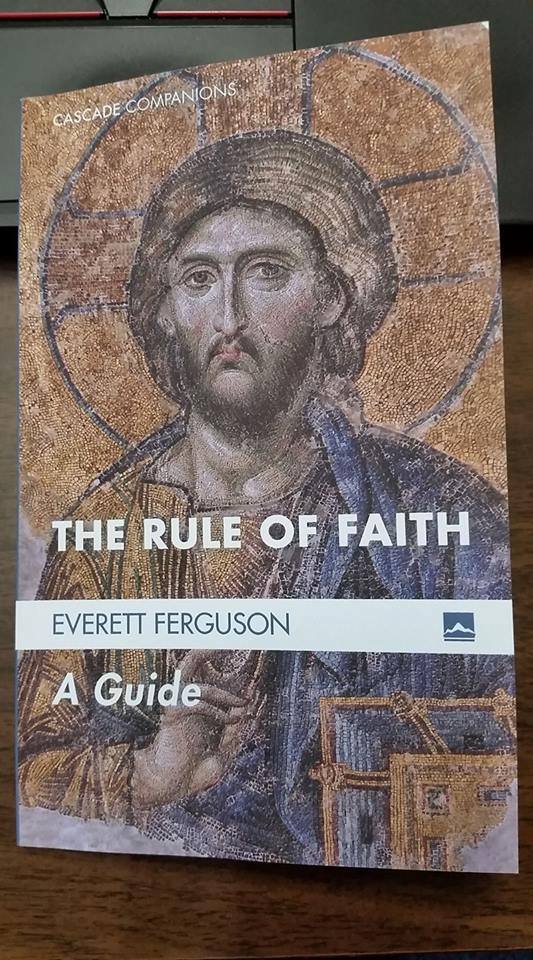
(I actually wrote this in 2017 but posting it on my blog just now. Previously I had this on Facebook).
May 11, 2017. Everett Ferguson, The Rule of Faith.
The Rule of Faith was (and is) important in the second and third centuries of the Christian Church. In a period when the Scriptures received from Judaism were pretty much accepted though there was no exact agreement (Protestant claims notwithstanding) on the exact boundaries of the canon and the writings for the Apostles were not all recognized uniformly (the NT canon was not settled), the Rule of Faith functioned as the canon. In fact it was sometimes even called the canon.
Everett Fergson has written a timely and succinct overview of what the Rule is and the history of scholarship on it. His book was published by Cascade in the Cascade Companions series. “The Rule of Faith: A Guide” (2015). The book is small being a mere 104 pages.
The Rule of Faith is divided up into six small chapters:
1) Statements of the Rule/Canon of Truth
2) Notes on Terminology and Other Pertinent Statements
3) Interpretation of the Rule of Faith
4) Studies of the Rule of Faith
5) Functions of the Rule of Faith
6) Relevance for Today of the Rule of Faith
Ferguson reproduces numerous lengthy quotations of the Rule from Irenaeus, Tertullian, Origen, etc to illustrate its content. These quotations in chapter one form the basis of discussion in the rest of the book.
In chapter 2 he notes that the Rule is identified most frequently as the “rule of faith” or “regula fidei” (in Latin). Other terms were uses like “canon of truth,” “canon” “canon of faith,” etc.
Chapter 3 is probably the most important. The Rule defines the content of the Christian faith. Ferguson notes that the Rule seems to follow the “narrative” outline noted by C. H. Dodd on the Apostolic kerygma. A brief outline may be in order.
– the Word as the one thru whom God the Father created all things,
– has become incarnate thru the virgin birth in order to restore humanity to communion with God,
– his suffering under Pontius Pilate
– his resurrection in the flesh
– his bodily ascension to the Father,
– his coming again for the general resurrection/salvation of the flesh and judgment, bringing eternal punishment to the ungodly and eternal life to the faithful (see p.38)
In other examples of the Rule it narrates creation, to prophets, to the gospel in Christ, the giving of the Spirit to resurrection of the flesh in the eschaton. The Rule is a “narrative” that reflects the preaching of the church.
In Chapter 4, Ferguson provides an overview of the history of scholarship on the Rule beginning from the mid 19th century to the early 2000’s. Here the key issues seem to be the relation of the Rule/Canon to baptismal formulas, liturgy and the emerging canon of NT scripture. As Ferguson is cautious to point out the Rule is not the same thing as Scripture but he stresses repeatedly that it is “related” to Scripture. Scripture is never defined by Ferguson but he notes that Four Gospels were a staple by the time of Irenaeus and the epistles function as much the same. Irenaeus and Origen are seemingly key figures but so is the Rule of Faith.
Chapter 5 relates the function of the Rule. It describes “what” was preached and believed. The Rule was the base from which arguments against heresy and apologetics arose. Things contrary to the Rule were to be rejected. There was not some squashing of exploration but “authors allowed multiple interpretations provided they did not transgress the BOUNDARIES set by the rule of faith” (p. 78, my emphasis). So the Rule sort of marked the circumference of the faith. The Rule provides a guide for interpreting Scripture in light of the “point” or theme of the faith. The Rule keeps you grounded in the Story of God to put it in today’s lingo.
Finally chapter 6, Ferguson discusses the relevance of the ancient Rule for today. There are a number of statements in this short chapter that could serve Restorationists well. “[T]he ruld of faith as a summary of the basic facts of the gospel” is “deeply relevant” (p.85). The Rule functions as a protection of going off on tangents, extremes, and keeps even “non-creedal churches” rooted in the “core doctrine” of Christianity. So let me quote,
“Churches, especially non-creedal churches, but others as well, often need succinct statements of their basic doctrine–in addressing inquirers or visitors, in instructing new converts, or in clarifying their core beliefs to Christians who seek to identify with them. The rule of faith can serve these purposes well.”
Leaders should look to the Rule as to “what must be embraced, taught, and handed on” in order to be Christian. The Rule “keeps the focus on Christ and His story” (p. 86). Finally, Ferguson notes that the Rule keeps us on point while reading Scripture itself. “Scripture is not ‘flat’; not all of it is of equal importance …” (p.88). The call to remember the narrative of faith God is the Creator, He has pursued redemption thru Israel and sent the Word to become completely human in order to completely same “body and soul” of humanity, Jesus died and was raised in the flesh, God gave the Spirit and will send the Son to judge the living and the dead.
This little book could be a very important one for those in Evangelical and Restoration traditions. It has important implications on what is necessary for unity and allows for diversity that does not contradict the Rule (Ferguson explicitly discusses this). The Rule forces us to major in the majors as the saying goes while granting latitude in areas that the Rule does not legislate.
Finally, the little book matters because all of us today are a product of the second century church every bit as much as the first century church. The Rule of Faith was the guide for ultimately deciding the contents of that NT canon itself in its full extent. This is an interesting conundrum for traditional pattern theology. And in integrity it needs to be wrestled with. The Old Testament canon (a term that was coined by Melito of Sardis around 180 in his sermon on Easter/Passover) was never settled until the Protestant reformation (Ferguson for his part acknowledges this) and the NT would not be for quite some time. But there was still agreed upon Scripture and the Rule was both the summary content and the interpretive guide for Scripture that focused supremely on Jesus the Messiah.
This is definitely worth reading and wrestling with. Churches of Christ as one of those “non-creedal” churches could certainly profit from a greater knowledge of the Rule. We certainly have split the Body of the Lord asunder over things that clearly are not part of the Rule of Faith.
Perhaps the biggest value of the Rule is it sort of forces us to “know our story.” The issue of the moment is, likely, not the core of Christianity … except Macionism and Gnosticism. And in light of Scripture itself this seems to be a fairly big deal.
Leave a Reply