Growing Up in Black and White: A Reckoning of Faith and Race in the Heart of the Mississippi Delta (2024): Review and Reflection
Author: Bobby Valentine | Filed under: Books, Church, Ministry, Race Relations, Restoration History, Unity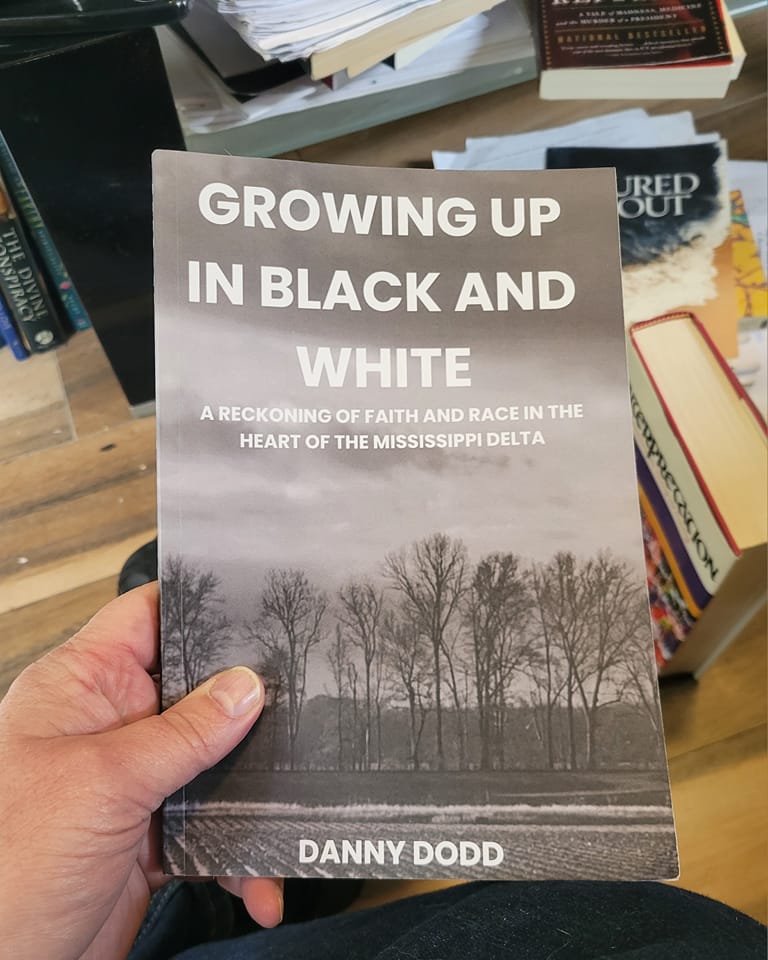
Danny Dodd, Growing Up in Black and White: A Reckoning of Faith and Race in the Heart of the Mississippi Delta (2024)
Honestly examining our lives in retrospect is no easy task and often avoided. But Danny Dodd, long time preacher at the Levy Church of Christ in North Little Rock, Arkansas has blessed us with just such an exercise. He joins a number of recent memoirists from Churches of Christ that not only offer such a glance in the mirror but do so within the context of race relations. These include, Mark Wallis an elder at the Littleton Church of Christ (Colorado) who offers a humbling look into his family history in A Profound Contradiction: A Racial Autobiography (2024); and Dodd’s fellow Mississipian, Al Price in Gravel and Grit: A White Boyhood in the Segregated South (2020) offers a deep look into his life in Jim Crow Mississippi. Each of these have blessed and enriched me, each calling for both confession and hope.
Dodd, in nine brief chapters, takes us on a journey from Greenville (Mississippi) to Kosciusko to Lithuania and finally to his reading of Paul’s Epistle to the Romans as hope for reconciliation. He introduces us to “Ole Mose” a black man who happened to be in the wrong place at the wrong time. Dodd confesses fright at the sight of this massive black man for “I knew all the of the stories” of black men who snatched white children away (p.7). In spite the fact that this man was the victim of missiles, both verbal and sticks, he showed young Danny that not all tales were true. (There is some irony in a town in Mississippi, Kosciusko, named not only for a Polish prince but an abolitionist who crusaded for black freedom).
In Danny’s journey people like Ma Whit, Jesse, Hoss and others not only expanded Danny’s view of reality but eventually led him to discovering (or rediscovering) his family’s faith through the Churches of Christ. His new-found faith led him to the fledgling college, Magnolia Bible College and his deep involvement with black saints (like Roosevelt) in Mississippi churches. During his college days he witnessed, by his testimony, one of the ugliest examples of racism. A young preacher had baptized a black person in the church baptistry only to have the hounds of hell (my words, not his) descend upon that poor minister (who was soon dismissed, pp. 75-77). The “wall” (a metaphor that appears throughout the book to symbolize the separation of white and black) did not exist only in the world but also within the church.
But Danny believes there is hope for removing that wall. The hope is symbolized in the story of Clay. Clay was simply a “product of his environment and social conditioning” (p. 87). Clay had to confront his own demons so to speak when students from Magnolia Bible College descended upon Clay’s little congregation for a “campaign.” Among those was a black student, Roosevelt. Roosevelt went out of his way to extend the right hand of fellowship with Clay. Over the years Clay came to realize that his views were simply wrong. He would make this confession to Danny. For Danny this was the power of the gospel at work.
Danny ends his brief memoir by offering a Danny Dodd theology of racial reconciliation. He rightly appeals to Acts and Ephesians but focuses upon the Letter to the Romans. Grace is the key to transformation of hearts and the building of a true community of the kingdom of God with no invisible wall. He ends with the example of Willie Nettle’s integrated ministry in Vicksburg as a beacon of hope of what all Churches of Christ could be. One can only pray for that to become true.
Reflections/Wonderings
There is no wrong way to tell one’s own story if they are brave enough to do it. I am thankful that Danny has graced us with his story of growing up in Black and White. Any such exercise is one of growth when looking in the mirror. Danny’s story is both easy to read as he gently tells us of our failings. Grace changes things.
I was especially interested in Danny Dodd’s story for a number of reasons. I know Danny and think he is a great servant in the kingdom of God. Second, while I did not “grow up” in Mississippi (Alabama), I lived and preached in Grenada – and was fired there – over the very matters of this book. So, I was especially interested in his experiences. His experiences (read through my experiences) generated a few questions or “wonderings” that could possibly have been given a bullet point (at the end of each chapter Danny offers a series of bullet points “Memories and More.”).
First, Danny frequently confesses his journey to understanding grace. I join him in praising God for that journey deeper in the mystery of grace. His journey led him to see inadequacies in his earlier thinking and believing. My question is, has his journey also led him to see how the thinking about race was, perhaps, not quite accurate? For example, he says, “I never heard anything about racism, per se, as a young child … Things were simply as they were … Most of these folks weren’t terrible people; they did not hate” (p.11). This is, of course, not a statement from those on the receiving end. Could we now looking back say that, at best, there was a lack of love? The Levite and Priest in Jesus’s Parable of the Good Samaritan probably were “not terrible people.” They just did not actually practice love toward the “other.” And surely while most white peopled did not use the word racism/racist they certainly swam in it like fish in water, else how could Danny have heard all those (racist) stories about big black men snatching white children? That was not some innocent mythmaking, it is those very myths that led to the lynching of hundreds of African Americans (not least Emmett Till).
Second, I think it would have been enlightening for Danny to reflect on the notion of “privilege.” After relating a story about Chinese grocery store owners caught in a debacle between a black patron and white patron, the Chinese owner sided with the white because “they realized which side held the power” (p.22). Someone had “power” and it was neither the Chinese nor the black patron. And at graduation, since the integration of the schools, all the official school dances suddenly evaporated. Except privately. Dodd had received an invitation to a dance and discovered that “Jesse, he had received no such invitation” (p.47). In these two vignettes, card carrying examples of what is meant by white privilege, perhaps a line or two of living with privilege was part of the “invisible wall.” Privilege being access to goods, services and opportunities. Grace includes having scales falling from our eyes and seeing that our experience of things was not how they actually were. Power was held.
Third, growing up, Danny may have been unaware of Emmett Till, Fannie Lou Hamer or James Meredith as their names never appear in the book and yet interwoven tightly with any Mississippi story of race (I have often confessed my own ignorance growing up of the life of my black brothers and sisters). How might knowing their stories now or inviting dialogue partners like Anne Moody Coming of Age in Mississippi; James W. Silver’s Mississippi The Closed Society; Richard Wright’s The Ethics of Living Jim Crow; Neil R. McMillen’s Dark Journey: Black Mississippians in the Age of Jim Crow or Jerry Mitchell, Race Against Time (Harding graduate and newspaper man) all Mississippi writers help us see over or remove “the wall?” Or the story and ministry of John Perkins. Would any such interaction cause us to change how we see – not how we remember – but how we now evaluate our family histories, the Confederacy, and our own invisible wall to injustice.
None of these are intended as criticism. They are Bobby Valentine reading Danny’s experience through Bobby’s experience. They are just further “wonderings” spurred by reading Danny’s excellent book. I loved the book and recommend it. It brought back lots of memories of Mississippi for me. I heartily say Amen to the vision of a church without walls through the Gospel of Reconciliation in King Jesus. I thank Danny for the look back and for the message of hope.
Read Danny’s book.
Related Articles
Esau McCaulley, How Far the Promised Land? One Black Family’s Story (Review)
You Sound Like a Racist! An Autobiographical Moment
Racial Concerns in Churches of Christ: Trends Since the King Years, 1950-2000
Leave a Reply