You shall love your neighbor as your self

Seeking to understand your neighbor is a work of love. We will never seek to understand our neighbor if we do not love them.

Love is Hard Work.
Love is Hard Work.
Love is Hard Work.

Love is hard work, that is why it is the path least chosen. Love is required to make an effort to listen. Listening will never happen apart from the God gift poured into our hearts, the gift of love.

The New York Life Superbowl commercial was surprisingly good and right, Love takes Action.

One of the most frequent exhortations in the Bible is some variation of “having eyes to see and ears to hear.” Have you noticed this. Yahweh said them to Isaiah (6.9ff) and Jesus quoted them (Mt 13.14-16).

Go and say to this people:
‘Keep listening, but do not comprehend;
keep looking, but do not understand
…” (Isaiah 6.9ff)

Hear this, O foolish and senseless people,
who have eyes, but do not see,
who have ears, but do not hear
” (Jeremiah 5.21)

When the Bible speaks of “listen” the text does not mean simply hearing words, rather it means “understanding.” Listen till we get it. This is, of course, difficult. We like to think we have heard. We already “get it.” Thus some have taken umbrage with me (and I at them).

Listening is love. Listening requires work because love takes work. This is true with fathers with daughters; mothers with sons; husbands with wives; and most of all it is true of our enemy and our neighbor. Listening is hard because love is hard.

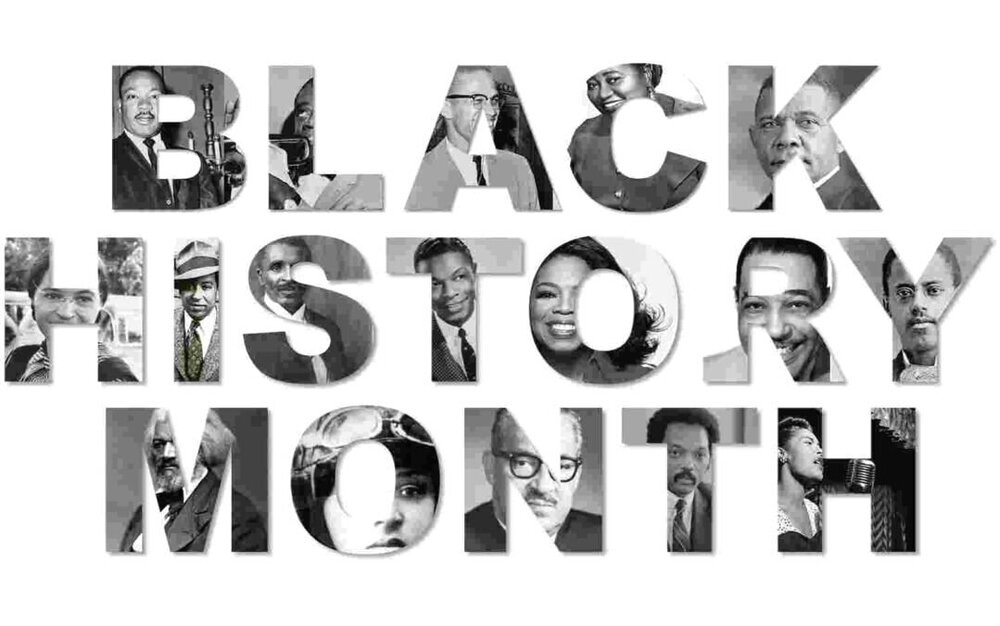
That brings me to Black History Month.

Black History Month is an exercise in loving my neighbor. Black History Month is an exercise is attempting to listen. It is digging the wax of my experience out of my ears, so that I can hear and putting the right lenses on so I can see. This is completely biblical. But it is hard work. This is why, as a Christian, the love of Christ must compel us.

I was listening to the rock band Disturbed’s rendition of “Sounds of Silence.” Have you ever paid attention to those words? The song was released in September 1965. What in the world was going on when Paul Simon wrote those words. Look at these words,

And in the naked light I saw
Ten thousand people, maybe more
People talking without speaking
People hearing without listening
People writing songs that voices never share
And no one dared
Disturb the sound of silence

Fools”, said I, “You do not know
Silence like a cancer grows
Hear my words that I might teach you
Take my arms that I might reach you”
But my words, like silent raindrops fell
And echoed
In the wells of silence

And the people bowed and prayed
To the neon god they made
And the sign flashed out its warning
In the words that it was forming
And the sign said,
‘The words of the prophets are written
on the subway walls
And tenement halls’
And whispered in the sounds of silence
” [end quote]

Just wow!
People do not listen.
They do not listen to each other.
Ears that do not hear.

What a powerful song. What a surprisingly biblical song. It is a modern Psalm.

The Civil Rights movement was in full, and bloody, swing in 1965. The “words of the prophets” are written on the subway walls. Wow. But we do not hear (=listen).

We need to listen to the biblical text till we “get it” (or it gets us). We need to listen to our Black and Hispanic friends (do you have any real ones) till we “get it.”

We need to do the work of love. This is, surprisingly, simply living the greatest comman: Love your neighbor as yourself. And do not tell me how much you love your wife, your husband, your daughter or your black or brown neighbor until you tell me how much you know about them. This is easy for those we want to love (wives, daughters, husbands, sons) but it is hard with others. But sometimes we do not do the work of love, the work of listening, even with our wives, husbands, sons and daughters.

Love takes action. What action will we take to enable us to listen? I want to encourage you to read (I offered a suggested reading list on Feb 1) and watch a few films (I suggested a few on Feb 1 in Black History Month Moment for that day).

Martin Luther King Jr said, from inside a Birmingham City jail,

“Shallow understanding from people of good will is more frustrating than absolute misunderstanding from people of ill will.”

Do we have ears to hear?? Do I?? What action of love will we take to gain insight and understanding (ears to hear and eyes to see) for the sake of loving our African American brothers and sisters. Let me recommend, indeed urge, reading one or more of the following books or watching the following films (or do both!). You can simply click on a title and purchase the item from Amazon (I make no money off this) today.

Suggested Books:
Bryan Stevenson, Just Mercy: A Story of Justice and Redemption ($10 on Amazon!)
Ta-Nehisi Coates, Between the World and Me ($13 on Amazon)
Candacy Taylor, Overground Railroad: The Green Book & Roots of Black Travel in America
Henry Louis Gates, Jr, The Classic Slave Narratives ($7 on Amazon)

Films:
Just Mercy (based on the book above)
Harriet
Selma
Hidden Figures
Malcolm X
Eyes on the Prize (PBS documentary)
African American: Many Rivers to Cross (PBS documentary)

Black History Month is our chance to focus on doing the work of love … Listening, learning, so we have ears to hear … to understand.

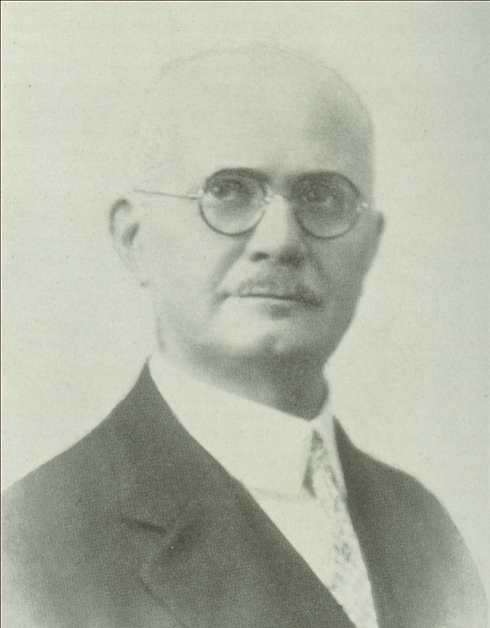
M. C. Kurfees (1856-1931)

Sectarianism is a horrid, ugly, sinful, thing. It is in the religious world what partisanship is in the political world. Every act of religious and political terrorism has been carried out with a clean conscience by a religious sectarian or a political partisan (many times these are in the same person).

Sectarianism/partisanism dwarf the soul by whitewashing our own gross shortcomings (and outright sins) while at the same time attributing nothing but lies and evil motives to the other. We hold all the truth but they hold none (even while they seemingly believe and hold many of the same values and beliefs).

One of the historic strengths of the Stone-Campbell Movement has been that we resist the notion that we have the corner labeled “Truth.” This is essential, in fact, for any notion of undenominational Christianity. Restoration is a quest not a destination.

However, this noble commitment to openness, to searching, and seeking has been difficult to maintain. So sectarianism has not infrequently raised its horrid head even in our midst … even as we decry “sectarianism.”

Religious terrorism has resulted from the growth of the acrid festering boil of sectarianism. Everyone is the enemy except ourselves (or “me”).

Everyone is blind and rebellious except for my own, seemingly, “sinless heart” (the very notion is unbelievable) even though “we” embrace some radically false doctrine (i.e. the indwelling and work of the Spirit, we have deniers of the Trinity, we have Preterism that has grown out of our semi-gnostic views of resurrection, racism, etc, etc).

Back in 1922, M. C. Kurfees published an article in the Gospel Advocate in which he recognized that other people were genuine believers and lovers of the Lord and his word and were Christians even though in a “denomination.” Kurfees stated that we “should endorse all the truth taught by the denominations and condemn all the error.” This, of course, is the classic Stone-Campbell position.

Sectarianism had grown to such an extent that some could not even recognize nondenominationalism when confronted with it. Kurfees was soundly rebuked in the pages of the Advocate. The critic told Kurfees “I think we have to condemn the whole business.”

Kurfees did not back down. “What a fearful statement” (my emphasis), he declared. He goes on and writes,

When I was a little boy, a denomination taught me that Jesus died on the cross to save the world; that he was buried; that he arose from the dead; that he ascended to heaven; and that he is the Savior of all who obey him. It taught me that I must obey him to be saved and that water baptism was one of his commandments …”

To condemn the “whole business” would mean condemning such powerful truths. What a fearful thing that only blind sectarianism could do. Instead of condemning we should recognize and celebrate every truth that is held. These, in fact, are the most important of all truths.

Kurfees confesses that while he came to believe that immersion “for the remission of sins,” but he could not, and did not, “condemn the whole business.”

Why? Because what he learned, as a boy, was in fact the Gospel of Jesus Christ.

Kurfees, in true Stone-Campbell Movement fashion, did not arrogate all goodness and truth to himself, nor “us.” As my shepherd, Monroe Hawley, once noted, “the focus of our faith is Christ and not ourselves, Jesus not the church.”

The fact of the matter is, the “stuff” Kurfees claimed to have learned is what the apostle Paul calls “the gospel” and of “first importance.” How can anyone but the blind sectarian “condemn the whole business?” I am with Kurfees (though Kurfess and I would likely disagree on a few minor things)

Sectarianism and partisanship, in the end, produce cults. The problem with sectarianism and partisanship is that the circle of accepted people becomes smaller and smaller till, as Alexander Campbell noted, we become a church made up of only our self.

When it comes to sectarianism … I condemn the whole business. But I celebrate all the truth held by all seeking to follow the Lord Jesus. Just as I am also seeking to follow God’s truth.

(On Kurfees see, “Where Are the People of God?, Gospel Advocate [20 January, 1922], 67-68)

We will let Barton W. Stone have a final word.

“If our faith be ever so imperfect, and blended with error, yet if it leads us to do the will of God, and bear fruits of the Spirit; if it works by love; if it purifies the heart; if it overcomes the world — it is the faith of a Christian” (Barton Stone, Christian Messenger 2 [Nov 1827], 5.

Shalom.

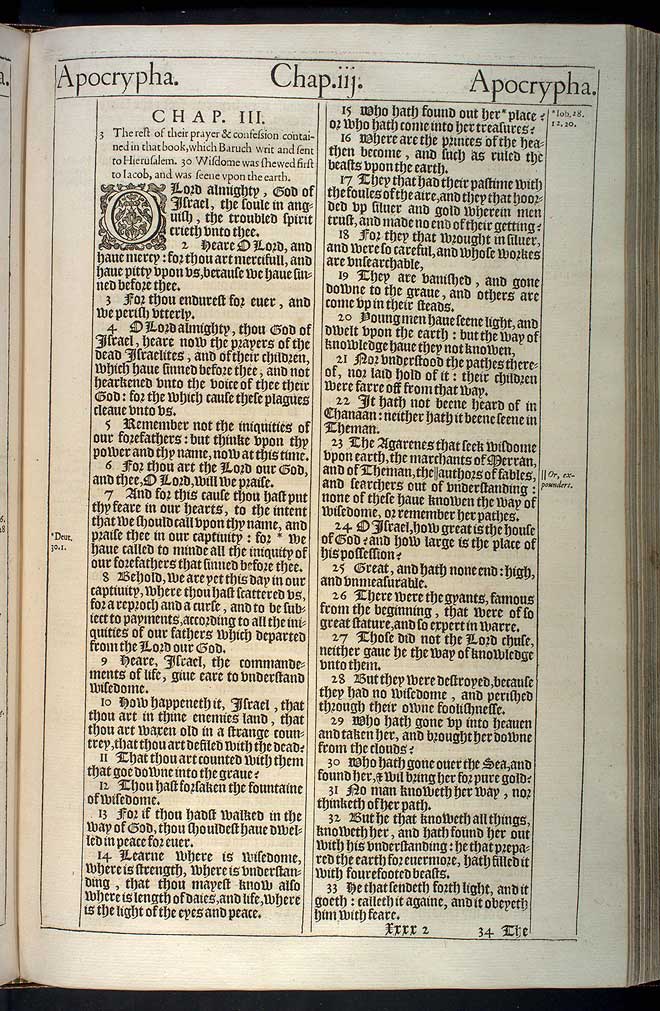
Baruch, ch. 3 in 1611 King James Version

Baruch, An Old Little Treasure

The little book of Baruch is one of the oldest books in the “Middle Testament” (my “term of endearment” for what Protestants call “the Apocrypha”) dating, according to many, as far back as before 300 BC. Baruch and the Letter of Jeremiah are almost always together and attached to the Book of Jeremiah itself in the manuscript tradition. This is true in ancient Greek, Latin, Armenian, Ethiophic versions. This means Christians everywhere were reading this little treasure.

The Letter of Jeremiah was discovered in Hebrew among the Dead Sea Scrolls, we do not know if it contained Baruch as the piece is not complete but in most manuscripts the two are together. Many Jews continued to value Baruch highly and used it in worship as it directs (cf. 1.3, 14). According to the fourth century A.D. Apostolic Constitutions, Jews read from Baruch (at least in Syria) on the Ninth of Ab. The text reads,

For even now, on the tenth day of the month Gorpiæus, when they [= Jews] assemble together, they read the Lamentations of Jeremiah, in which it is said, The Spirit before our face, Christ the Lord was taken in their destructions; [= Lamentations 4:20] and Baruch, in whom it is written, This is our God; no other shall be esteemed with Him. He found out every way of knowledge, and showed it to Jacob His son, and Israel His beloved. Afterwards He was seen upon earth, and conversed with men [=Baruch 3.35-37]. And when they read them, they lament and bewail, as themselves suppose, that desolation which happened by Nebuchadnezzar; but, as the truth shows, they unwillingly make a prelude to that lamentation which will overtake them. (Apostolic Constitutions 5.20, Gorpiæus is from the Macedonian calendar and corresponds to Ab).

Baruch was regarded as Scripture among many in the early church. Among the Fathers it was typically regarded, along with the Letter of Jeremiah, as part of the greater book of Jeremiah.

Discovering a Small Treasure

Baruch contains some wonderful passages. Both chapter 4 and 5 have been used in Eucharistic (communion) liturgies for many centuries in various Christian traditions. Though I had read through Baruch numerous times previously, it was in 2014 that I discovered “treasure” in Baruch. I had gone through an unexpected and painful divorce. I spent a week at Santa Rita Abbey in Kentucky Canyon not far from the Mexican border in AZ. Baruch was included with a Psalm reading. I talked with Sister Margarita after and asked where this passage was. She encouraged me to read 4.30-5.9 for the rest of the day. It was powerful. I had been rejected and humiliated like the lady in the text (Jerusalem) but the voice of God comes through with amazing comfort and promise of renewal, salvation and the return of joy.

Take courage, O Jerusalem,
for the one who named you
will comfort you
” (4.30)

For God will lead Israel with joy,
in the light of his glory,
with the mercy and righteousness
that come from him
” (5.9)

I have since learned 4.30-5.9 was part of readings associated with the Eucharist/Lord’s Supper for many ancient Christians. On that day in the southern Arizona desert it was a powerful word of grace.

Baruch, Paul, and the Fathers

Baruch 3.29 shows up in Paul in Romans 10.7. Baruch 3.29 reads,

Who has gone up into heaven, and
taken her,
and brought her down from the clouds

New Testament scholar, Richard Hays calls this a “filtered citation of Deuteronomy.” Filtered through what? the wisdom traditions contained in Baruch and Sirach. Christ is the answer to the “who.”

Another passage that Church Fathers such as Origen, Cyprian, Lactantius and Tertullian quoted as Messianic and fulfilled in the Incarnation. It is in 3.35-37 (this text was cited also in the Apostolic Constitutions in the quote above).

This is our God;
no one can compare to him.
He found the whole way to knowledge,
and gave her to his servant Jacob and to
Israel, whom he loved.
Afterward she appeared on earth and lived with humankind.

(Baruch 3.35-37).

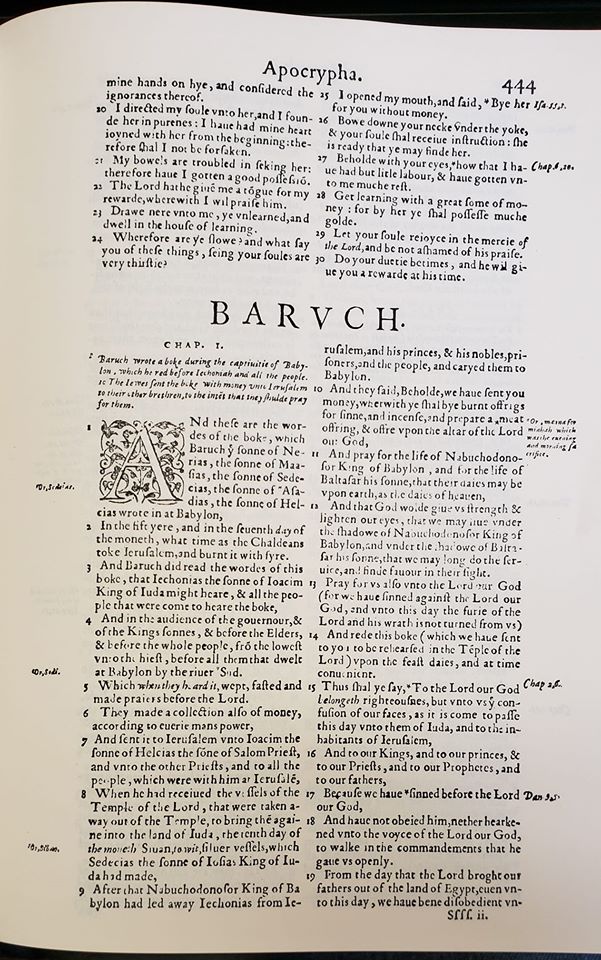
Baruch, the Geneva Bible, 1560 edition

Discovering Great Treasure: Gracious Prayer

Chapter 2 contains a beautiful prayer of penitence, pleading with God for salvation. This is typical, honest, praying in Spirit and Truth. Prayer, someone has said, reveals our true doctrine of God. If that is true then what a wonderful doctrine Jesus, James, Mary, etc inherited with their Jewish ancestors. I will quote the whole.

And now, O Lord God of Israel, who brought your people out of the land of Egypt with a mighty hand and with signs and wonders and outstretched arm, and made yourself a name that continues to this day,

we have sinned,
we have been ungodly,
we have done wrong,
O Lord our God,
against all your ordinances
.

Let your anger turn away from us, for we who are left, are few in number among the nations where you have scattered us. Hear, O Lord, our prayer and our supplication, and for your own name sake deliver us, and grant us favor in the sight of those who have carried us into exile; so that all the earth may know that you are the Lord our God, for Israel and his descendants are called by your name.

O Lord look down from your holy dwelling, and consider us, Incline your ear, O Lord, and hear; open your eyes, O Lord and see, for the dead are in Hades, whose spirit has been taken from their bodies, will not ascribe glory or justice to the Lord; but the person who is deeply grieved who walks bowed and feeble, with falling eyes and famished soul, will declare your glory and righteousness, O Lord.

For it is not because of any righteous deeds of our ancestors or our kings that we bring before you our prayer for mercy, O Lord our God.”
(Baruch 2.11-19)

The prayer ends with the forthright confession that,

we did not obey your voice … which you spoke by your servants the prophets.

The prayer is offered simply so the Lord God will show mercy. Neither we nor our ancestors are righteous. But God is full of “kindness and compassion” (an echo of Ex 34.6-7 in v.27).

For “your own sake delver us” is the plea. This is a plea for GRACE pure and simple.

If a person did not know any better, and read this prayer, they would think it was in the Book of Psalms. This is a Spiritual treasure. And it was quoted by the Church Fathers, the Desert Fathers, included in congregational worship to this day in churches across the Middle East and the ancient Mar Thoma Christians in India.

This prayer can and will feed your spirit. It cultivates humility before our God. It exudes no self righteous claim. It models what our own stance before God should be:

God is right.
We are wrong.
God is merciful.

We are grateful for his “kindness and compassion” given to us in spite of our sin. There is no conception here of salvation by precision obedience, earning standing before God by works of righteousness or any other such heresy. That God hears our prayer is an act of grace, of Steadfast love, we do not demand. But Israel is driven by powerful, trusting, faith in the God who will hear our prayer in mercy.

O Lord Almighty, God of Israel, the soul in anguish and the wearied spirit cry out to you. Hear, O Lord, and have mercy, for we have sinned before you” (Bar 3.1-2).

Mercy, the Discovered Treasure

God is the God of all comfort. God is the God of all mercy. God is the One who disciplined but refuses to caste off. God hears our prayers even as we are “guilty as sin.” “This is our God; no other can be compared to him” (3.35). God is merciful in spite of our sin. What a treasure for me!

So the Gift of the Apocrypha here is not only understanding the world in which Jesus was born. It literally feeds our souls. And we learn that God has never been without witness. God has worked, and continues to work, even in the anonymous author of Baruch … when we go around the museum in the renewed earth and find all the treasures that God has kept that were made by his people, I will not be surprised in the slightest to find Baruch on display. I may utter underneath my breath, “Well, I’ll be!”

Blessings

If you enjoyed this then you May Be Interested in …
Spiritual Treasures of the Old Testament Apocrypha

Words from The Prophets

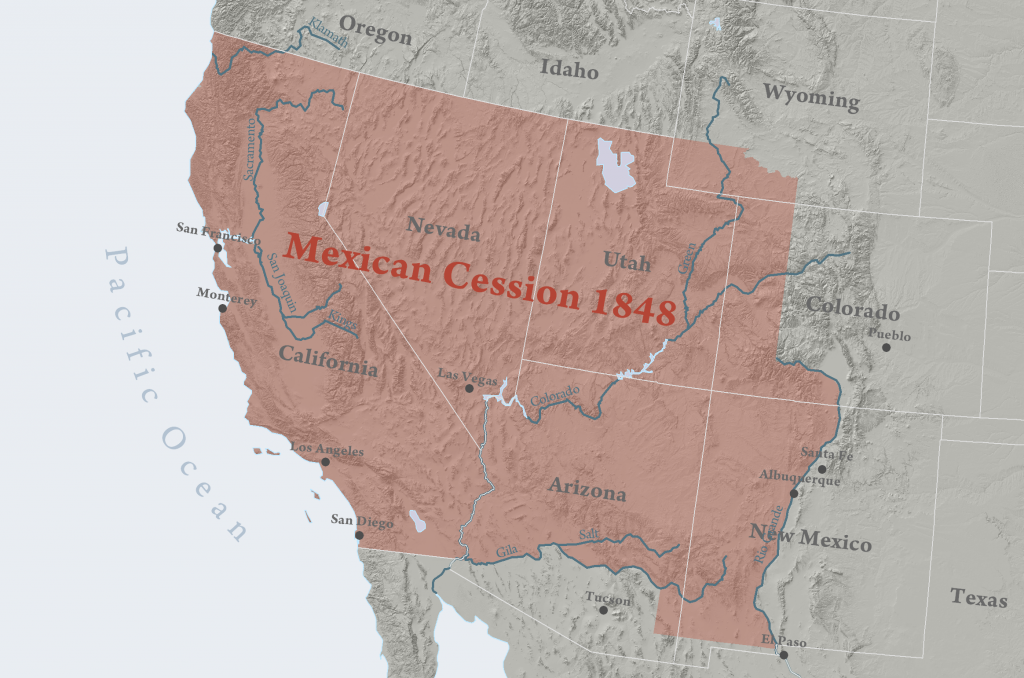
Many Americans are stunned by how much of the USA was once part of Mexico. This map, remarkable as it is, still does not tell the whole story. This is only the territory surrendered after the US invasion in 1848. All of Texas, Oklahoma, New Mexico, Colorado and Wyoming was also once part of Mexico. Mexico lost about 50% of its territory.

He [Yahweh] shall judge between the nations, and shall decide disputes for many peoples and they shall beat their swords into plowshares, and their spears into pruning hooks;
nation shall not lift up sword against nation, neither shall they learn war anymore.” (Isaiah 2.4)

He shall judge between many peoples, and  shall decide disputes for strong nations far away;
and they shall beat their swords into plowshares,
and their spears into pruning hooks; nation  shall not lift up sword against nation, neither

shall they learn war anymore” (Micah 4.3)

Crises of 1846-1848

It is a great loss that Campbell is hardly known by his spiritual descendants. He was a man of great vision and liberality. A child of his times in many ways (as we all are) but burst beyond them in astonishing ways. A huge supporter of education, he even advocated education for women. He was one of the few to protest Andrew Jackson’s “barbaric” removal of the Cherokee, Choctaw, Chickasaw, Creeks and Seminoles from their lands in the southeast in what has become known as the “Trail of Tears.” As much as Campbell, a immigrant from northern Ireland, loved his adopted homeland, he did not live by the philosophy “my country right or wrong.” Loyalty to Christianity trumped allegiance to any human nation. But, like us all, Campbell had blind spots, some glaring.

He was also a man consumed with a biblical vision of God’s kingdom of peace. Occasionally, he even took up a nearly prophetic mantle in its pursuit. He did this in 1848 in his Address on War. In 1846 the United States invaded Mexico. Alexander Campbell, with stunned alarm, viewed this invasion as nothing but naked American aggression and a thinly veiled land grab for the sake of expanding slavery. Campbell was appalled. He dared to sound “anti-American” in his opposition to the war.

So, Campbell addressed the Congress of the United States on the subject of war (and he delivered it in other places as well). It is a remarkable speech. He denounced the war with Mexico. He decried war as an entity. In an astonishing move, he called for the creation of an international court to arbitrate disputes among nations to avoid wars. “Why not have a by-law-established Umpire? … a Congress of Nations and a High Court of Nations for adjudicating … all international misunderstandings and complaints?” A United Nations, a century before there was a UN.

Campbell lamented how much money nations dedicate to the evils of war. You can read the entire text of Campbell’s Address on War (follow the link). Near the end of this (by today’s standards) long speech he waxes eloquently what he would do if he was given control of the money nations use to make war upon one another. I quote,

Give me the money that has been spent in wars, and I will clear up every acre of land in the world that ought to be cleared–drain every marsh–subdue every desert–fertilize every mountain and hill–and convert the whole earth into a continuous series of fruitful fields, verdant meadows, beautiful villas, hamlets, towns, cities, standing along smooth and comfortable highways and canals, or in the midst of luxuriant and fruitful orchards, vineyards and gardens, full of fruits and flowers, redolent with all that pleases the eye and regales the senses of man. I would found, furnish, and endow as many schools, academies and colleges, as would educate the whole human race, — would build meeting-houses, public halls, lyceums, and furnish them with libraries adequate to the wants of a thousand millions of human beings … [if such monies were used in literature, science and art] What would be wanting on the part of man to ‘make the wilderness and solitary place glad,’ and to cause ‘the desert to rejoice and blossom as the rose.”

A drone can cost 28 million dollars. That same drone can cost over 3,600+ dollars per hour to operate. That drone is armed with a Hellfire missile that cost 115,000 dollars (the meme to the right is out of date).

The money used on the planning, the carrying out, and paying for previous wars from a single year, could permanently change the world. Campbell found it remarkable that Christians do not hesitate in defending billions (and trillions) on the war machine but balk loudly at spending trifles, by comparison, on human development. But Campbell argued that spending money on human advancement is not only more cost effective but also more biblical. Campbell’s vision is breathtaking.

Given the fact that what was spent on war in 1848 was “peanuts” compared to today I can only imagine what Campbell would say. (For example the war in Iraq has cost the United States trillions of dollars. Study The Cost of the Iraq War: It’s Timeline and Economic Impact.

Sometimes our forefathers and mothers give us reason to stop, ponder and smell the roses of a better world.

Blessed are the peacemakers for they shall be called the children of God.” (Jesus the Nazarene).

James Shannon

Or how slavery and women’s equality are linked historically.

James Shannon (1799-1859) was one of the most educated men of the Stone-Campbell Movement prior to the Civil War. He served as president of the first college among in the Stone-Campbell Movement, Bacon College, and other institutions. He was recognized as a scholar as part of the American Bible Union and edited its critical edition of the Gospel of Luke.

However, Shannon utterly bought into the Southern way of life as the ideal human society. He would become a vocal and passionate defender of slavery. In 1849, he delivered a speech, then published it, “The Philosophy of Slavery as Identified with the Philosophy of Human Happiness, An Essay.” He won lots of kudos for this essay. He would go on and debate John C. Young, himself a slave holder who believed in “gradual emancipation” (and did emancipate some of his slaves). Shannon rejected the notion of even gradual emancipation because people of color were ordained by God to be slaves.

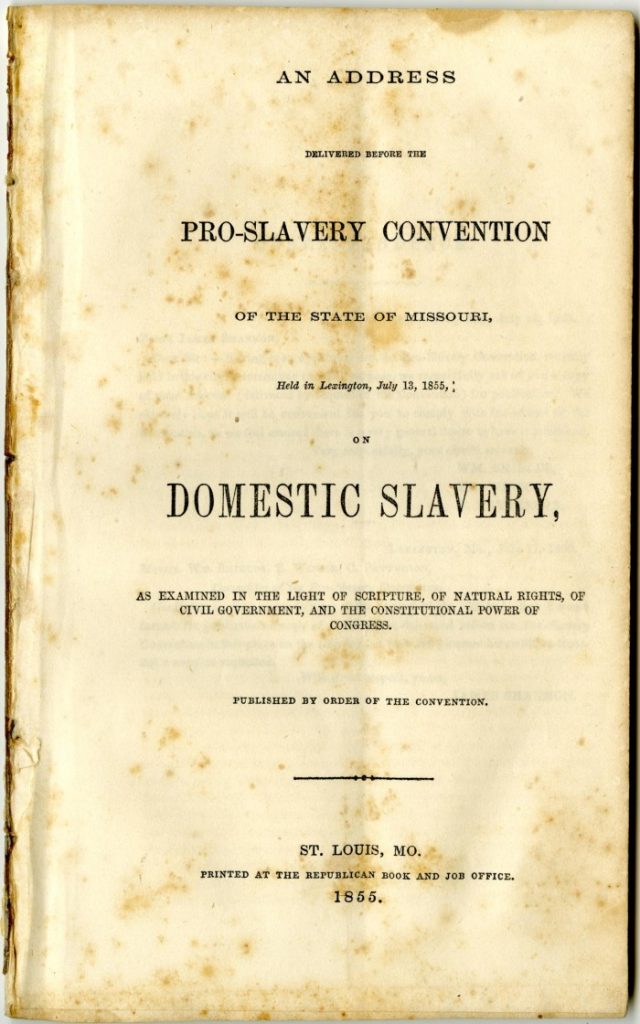
Against the backdrop of the “Bleeding of Kansas” (where the Civil War began long before Ft. Sumter) he addressed the Missouri Pro-Slavery Convention in 1855. His An Address … On Domestic Slavery amounted to a declaration of war on abolitionists for trying to “steal our property.”

a persistent violation of that right [to own slaves], even by government, is as villainous as highway robbery; and when peaceable modes of redress are exhausted, IS A JUST CAUSE OF WAR BETWEEN SEPARATE STATES, AND OF REVOLUTION IN THE SAME STATE.” (emphasis in original).

Those who dream the Civil War was not about slavery live in delusion.

Shannon argued that God instituted “various grades of bondage.” It will probably offend a lot of white women today to know that men of that day made no bones about women also being in “bondage” to men. Shannon appeals to women’s subjugation to justify, and explain, black subjugation through slavery to whites.

Abolitionists like William Lloyd Garrison and, more importantly, Frederick Douglass, and Sojourner Truth, realized the link between race and gender in the fight for justice in the United States. Garrison, Douglass and Truth promoted women’s equality while fighting for abolition of slavery for blacks.

This riled up white men in many ways. Many do not realize the deep roots of the Suffrage Movement in the Abolition Movement. This movement for women’s right to vote was, according to Shannon, certain symptoms of “politico-religious fanaticism and infidelity of the age” that if left unchecked results in “anarchy” and “speedily overthrow our liberties.” He continues,

The attempt, which is being made in these United States, to elevate the wife to a POLITICAL EQUALITY with her husband [i.e. the right to vote, right to divorce, right to property, etc], or to change in any respect the relation established between them by God himself is rank infidelity, no matter what specious disguise it may assume; and it cannot fail to be replete with mischief to both parties, and to the best interest of the family, the State, and the Church. For the PUNISHMENT, then, as well as for the CURE of her sin, she was put in bondage to her husband. And though infidel fanaticism may blaspheme, enlightened Christian philanthropy will always say amen.” [emphasis in original].

Women are in “bondage” to men. For Shannon it was the crystal clear. The man, a father or husband, has complete control by the design of God over women. Shannon moves from the wife bondage, slavery, to black slavery for the next twenty-eight pages or so.

Today the same passages (1 Cor 14.34-35 & 1 Tim 2.12) folks hijack, out of both historical context and literary context, to claim women can do nothing are the same ones used in previous generations to say a woman was held in bondage, slavery, to her husband, could not vote, could not do anything without permission … she could even be physically abused. Consider the words of R. C. Bell in The Way in 1903, p. 776 (The Way was edited by James A. Harding).

woman is not permitted to exercise dominion over man in any calling of life. When a woman gets her diploma to practice medicine, every Bible student knows that she is violating God’s holy law. When a woman secures a license to practice law, she is guilty of the same offense. When a woman mounts the lecture platform or steps into the pulpit or the public school room, she is disobeying God’s law and disobeying the the promptings of her inner nature. When God gives his reason for women’s subjection and quietness, he covers the whole ground and forbids her to work in any public capacity … She is not fitted to do anything publicly … Every public woman – lawyer, doctor, lecturer, preacher, teacher, clerk, sales girl and all – would then step from their post of public work into their father’s or husband’s home, where most of them prefer to be, and where God puts them … You are no longer a public slave, but a companion and home-maker for man; you are now in the only place where your womanly influence has full play and power.

It is no accident that Shannon and men generally saw gender equality as a natural progression of racial equality. He, and many others, believed that God had set up grades of bondage. If a woman can be in “bondage” to a male though the “image of God” based on sex organs then one can enslave the “image of God” based on color. There is little evidence however that Shannon truly believed Blacks were the image of God. (See footnote on this paragraph).

What makes the example of Shannon so tragic is that 150 years later … so many Christians are still such horrific readers of Scripture. Race and Gender are still linked … we are equal images of God or we are nothing.

While many today would balk – and distance themselves – at Shannon’s honest forthrightness, the views of many are not substantively different today.

The great images of the Messianic age in Scripture show a return to and glorification of the Adamic state of humanity. The Adam was not exclusively “male” but both “male and female” (Gen 1.27-28) and equally servant rulers of God’s creation (Gen 1.28). Dominion, ruling in God’s stead, is given to both male and female, not to the male alone.

The Adam is all humanity; male and female; white, black and all shades in between. The Adam is not merely the guys or even the white guys. Joel (2.28), Peter (Acts 2.16-18) and Paul (1 Cor 12.13; Gal 3.28) all indicate that when the Fall is undone then the degradation of images of God will cease. That “new creation” has already begun through the Messiah and is a present reality through his People. For we are “new creation” which means there is no white and black but it also means there is no male nor female that is the basis of relationship and service to God.

We need to learn the lesson of horrific exegesis from our ancestors.

Seeking Shalom.

__________________________________________________________

I am adding this Footnote on Bondage. I rewrote the paragraph above and want to add this note. Historically the women’s suffrage movement grew out of the abolition movement. Women made up a large portion of the anti-slavery movement in the United States. Julie Roy Jeffrey has amply demonstrated this in her wonderful study The Great Silent Army of Abolitionism: Ordinary Women in the Antislavery Movement (University of North Carolina Press, 1998). Many of the same women involved would later be in the Temperance Movement too. On the other hand, while it is true that men typically viewed women as essentially property, white women often had great privilege and power over Black women and men especially in, but not limited to, the South.

Stephanie E. Jones-Rogers, a Black scholar at the University of California (Berkeley) published an outstanding study called They Where Her Property: White Women as Slave Owners in the American South. She has shown beyond doubt that many white women in the South were rabidly pro-slavery and could be the cruelest “masters.” Indeed slaves were often viewed as her property. Even in the Suffrage Movement women’s rights were thought of in terms of rights for white women. Thus Sojourner Truth’s speech at the Fourth National Woman’s Rights Convention in 1853 where she famously said “ar’nt I a woman?” (see her entire speech in Black Women in White America: A Documentary History, pp. 566-572). Truth sought the rights of all women, which included herself and Black women. Douglass also sought the rights of all women, including Black women. They were hardly the only African Americans arguing for such. In any ways the struggle continues to this very day for genuine respect and equality for Black women. So in spite of the rhetoric of James Shannon and the sexist, even misogynist, views of many men of the day, there is neither a moral equivalency between slavery and the experience of white women nor a practical day to day equivalency. I do not want to leave the impression that I think there is any such equivalency.

I realize, before I post this, that some will be troubled by it. Yet it is the truth as I understand it. My thoughts are not new and have shared them before. It is possible to hold biblical truth as we understand it yet do so in nonbiblical and sectarian ways, this seems especially true on the doctrine of baptism. Baptism is the victim of both neglect and zeal without knowledge.

I Believe Baptism is GOD’s Work

I believe the Great Commission: Preach, Make disciples, Baptize them in the name of the Father, Son and Spirit. I believe in Matthew 28.19, Acts 2.38; Romans 6, Colossians 2 and 1 Peter 3.21.

Go therefore and make disciples of all nations, baptizing them in the name of the Father and of the Son and of the Holy Spirit” (Mt 28.19)

Repent and be baptized every one of you in the name of Jesus Christ so that your sins may be forgiven; and you will receive the gift of the Holy Spirit” (Acts 2.38)

all of us who have been baptized int Christ Jesus were baptized into his death. Therefore we have been buried with him by baptism into death, so that, just as Christ was raised from the dead by the glory of the Father, so we too might walk in newness of life” (Rom 6.3-4)

And baptism, which this prefigured, now saves you–not as a removal of dirt from the body, but as an appeal to God for a good conscience through the resurrection of Jesus Christ” (1 Peter 3.21)

These are wonderful and great texts in the New Testament. They, and other texts, many of us had memorized before we even knew John 3.16 or Psalm 23. We believe every one of them.

I celebrate the fact that the wider Christian world is rediscovering the beauty of baptism. (Some never lost it). May we also continue to grow in a healthy and robust doctrine of baptism. We need to stress the wonderful grace centered biblical doctrine of baptism, for a positive exposition of baptism as I understand it see my Baptism: Work of God, Dripping in Grace.

The great baptismal hymn of Baptist missionary Adoniram Judson captures well this part of our blog.

Come, Holy Spirit Dove divine, On these baptismal waters shine,
And teach our hearts, in highest strain, To praise the Lamb
for sinners slain …

“We sink beneath Thy Mystic flood, And thank Thee for they saving grace;
We die to sin and seek a grave With The, beneath the yielding wave

(Songs of Faith and Praise, #427, vv. 1 & 3)

Alexander Campbell celebrated the great work of Judson in India and Burma. No reason we cannot too.

Avoiding the Human Centered Sectarian Trap

Sometimes we react to the (seeming) trivialization of the sacraments in (especially) American Evangelical churches by going to the other extreme. One of the great gifts of the Stone-Campbell Movement has been pointing to the significance of the Lord’s Supper and Baptism. We must stay grounded in healthy biblical theology by reminding ourselves that

Christ is the Savior. Baptism is not.

Christ is the Judge. Baptism is not.

But, sometimes, when I read brethren and sisters, I think we have come to view baptism like some ancient Israelites did Moses’s bronze serpent (Num 21) that became an idol that needed to be destroyed (2 Kgs 18). It seems to me that some of us in Churches of Christ make baptism their whole canon (with instrumental music possibly in there). Baptism is everything, that is it is exalted above every Christian duty. K. C. Moser even quipped,

I have long noticed that most any position is tolerated just so it appears to exalt baptism, even at the expense of faith or the blood of Christ.”

So recently, I had a brief discussion about baptism that highlighted this sectarian tendency among us. I was accused of not believing in baptism because I will not declare that Martin Luther, John Newton and millions of others who have served the Lord sacrificially but were baptized as infants were automatically condemned to hell.

According to this brother, if I admit that God is merciful – this is not an opinion but fact – then I deny baptism altogether. In his position, baptism is the savior rather than Christ, in his position baptism is the judge rather than Christ. This is actually false doctrine even has he was attempting to protect baptism. Salvation by “Precision Obedience” is simply false doctrine.

Mercy, Not Sacrifice: Who is a God like You?

I confess that I not only believe such servants of the Lord are in fact part of the new creation, but that I pray that is the case. These disciples are not Hindus, Muslims and witch doctors. It was suggested I “need to study the Bible more.”

I agree we all need to study our Bible more. And it is because I have spent years studying the Bible, that I am troubled by this position not only on baptism but more importantly on the doctrine of God and Christ that support it.

So let me pose some questions that give me cause for pause. When we do we will find out that God “delights” in mercy. What does the Bible mean when it says God “Who is a God like you, who Delights in showing mercy” (Micah 6.18)?

What does it mean when God claims to “forgive wickedness, rebellion and sin“? (Ex 34.6; Joel 2.13; Num 14.17f; Pss 86.15; 148.8; etc).

It was Jesus who chastised some pretty sophisticated Bible students with these words, “But if you had known what this means, ‘I desire mercy and not sacrifice,’ you would not have condemned the guiltless. For the Son of Man is lord of the sabbath” (Mt 12.7-8, citing Hosea 6.6 which Jesus also quotes in Matthew 9.13)

If such people like Augustine, Luther, William Tyndale, John Newton, C. S. Lewis, and millions more are automatically lost, in spite of a lifetime of sacrificial service to the Lord because they were poured on rather than immersed, this is hard to reconcile with the claim God “delights in mercy.”

Such a godless doctrine is not out of line with the pagan deity Zeus however!

So when we say “who is a God like you?” the answer is none because our God “delights in mercy!”

Are we like the Pharisees who need to “go learn what this means, ‘I desire mercy not sacrifice?‘” (Mt 9.13, citing Hosea 6.6). I do ask that question, do we know what that means?

Do we have the courage of Hezekiah to pray for those who were technically wrong (and it was not even a mistake but deliberate!) about the technical details … read 2 Chronicles 30, not once, not twice, but three times. All 27 verses. Underline everything from v.16 to v.20.

Then they took up their regular positions as prescribed in the Law of Moses the man of God. The priests splashed against the altar the blood handed to them by the Levites. Since many in the crowd had not consecrated themselves, the Levites had to kill the Passover lambs for all those who were not ceremonially clean and could not consecrate their lambs to the Lord. Although most of the many people who came from Ephraim, Manasseh, Issachar and Zebulun had not purified themselves, yet they ate the Passover, contrary to what was written. But Hezekiah prayed for them, saying, “May the Lord, who is good, pardon everyone who sets their heart on seeking God—the Lord, the God of their ancestors—even if they are not clean according to the rules of the sanctuary.” And the Lord heard Hezekiah and healed the people.”

If this is not mercy over sacrifice then nothing is. Here the Holy Spirit is teaching us what mercy means. Hezekiah’s prayer is rooted in his faith that Yahweh is a certain kind of God, one who delights in mercy. That is the basis of his intercession. Is not the story of Hezekiah written for our learning (Rom 15.4)? What do we learn from it? Is it not something that is good for doctrine and makes us wise unto salvation (2 Tim 3.15-17)? What doctrine does it proclaim for our salvation?

It blows me away to, absolutely, insist that those heroes that gave us our Bible itself … Caedmon, Alfred, John Wycliff … men who loved the Lord with all of their heart, soul, strength and mind – like William Tyndale – who gave the ultimate sacrifice to the Lord. Tyndale was burned at the stake — and we are going to insist that these men who sacrificed everything they had to share God’s word (and we ourselves would not have it, if not for them) but they are no better than a pagan witch doctor to us? None of them were immersed. But they all thought they had been baptized!

Christ the Savior, Christ the Judge

But Jesus himself said “not greater love has any man than to lay down his life for his friends” (Jn 15.13). These disciples (and many more) certainly have more love for Christ than many a sectarian, who is technically correct on baptism.

The Jesus who is the Savior prayed for those who hung him on the cross, “Father forgiven them,” … are we going to believe that Jesus the Judge is going to look at these people and on the day of judgment not stand up for them before the God of Steadfast Love??

Is failing to be dipped a bigger crime than crucifying the Son of Man?

Again what does it mean to “delight in mercy” (Micah 7.18-20)? I find it interesting that Jonah certainly had no doubt that Yahweh would forgive, at the drop of a hat, even the pagan Assyrians … Notice his words, carefully, in Jonah 4.1-2 … God “is gracious, merciful, full of steadfast love and relents from punishment.” Jonah, like Hezekiah, knew what kind of God our God is. G. C. Brewer once lamented, and for years I simply did not know enough of Bible to grasp how truthful he was, “we sing a better gospel than we preach.”

To admit that God has reserved judgment for Christ, the One who died for the ungodly enemies (Rom 5.1-11), and that William Tyndale and John Newton will be saved in the end … in no way minimizes the reality of faith in Christ and being baptized in his name. It simply recognizes the biblical truth that God has a long record of forgiving people that God’s people would not because he delights in mercy.

And He ordered us to preach to the people and solemnly to testify that this is the One who has been appointed by God as Judge of the living and the dead” (Acts 10.42)

He has fixed a day in which He will judge the world in righteousness/ through a Man whom he has appointed, having furnished proof to all men by raising him from the dead” (Acts 17.31)

For we must all appear before the judgment seat of Christ …” (2 Cor 5.10)

Jesus is the Judge. The Judge is not even God the Father. Jesus has been appointed by the Father to that role.

The Judge is the One who died, the One who shed his blood, the One who said “Father forgive them.”

I simply do not believe that that Jesus will look at a person who has loved him in everything, worshiped him, served him, many have even died for him but failed to understand a technical point on getting wet will be treated as if they are a rebellious rejecter of God. I think of those 45 disciples who were slaughtered in Alexandria, Egypt in 2017 refusing to deny Christ, yet not one had been immersed.

An old time preacher named Basil the Great commented on baptism and those who died without it but died in the service of Christ. It is insightful and I agree with it.

There have been some who in their championship of true baptism have undergone death for Christ’s sake, not in mere similitude, but in actual fact, and so have none of the outward signs of water for their salvation, because they were baptized in their own blood. Thus I write not to disparage the baptism by water, but to overthrow the arguments of those who exalt themselves against the Spirit.” (quoted in Everett Ferguson, Baptism in the Early Church, p. 591)

Our “Fathers” Understood Mercy, Not Sacrifice

Alexander Campbell met Nathan Rice from November 15 to December 1, 1843 in an epic debate. Campbell certainly did not back away from his understanding of biblical baptism. He also did not divorce it from biblical theology. He said, seemingly anticipating a myriad of bad Facebook memes and posts,

according to our teaching, there is no one required to be baptized where baptism cannot be had. Baptism, where there is no faith, no water, no person to administer, was never demanded as an indispensable condition of salvation, by Him who has always enjoyed upon man ‘mercy, rather than sacrifice.‘” (Campbell-Rice Debate, pp. 519-520)

This is a deeply embedded biblical principle in Campbell. Campbell himself had been baptized as an infant and knew that he loved the Lord, worshiped the Lord, served the Lord and even had fellowship with the Lord for a good portion of his life before he came to believe that adult immersion was the proper biblical practice. So he wrote in what has become known as “The Lunenberg Letter,”

I cannot, therefore make any one duty the standard of Christian state or character, not even immersion into the name of the father, of the Son, and of the Holy Spirit, and in my heart regard all that have been sprinkled in infancy … as aliens from Christ and the well grounded hope of heaven … Should I find a Pedobaptist more intelligent in the Christian Scriptures, more spiritually minded and more devoted to the Lord than a Baptist, or one immersed on a profession of the ancient faith, I could not hesitate a moment in giving preference of my heart to him that loveth most. Did I act otherwise, I would be a pure sectarian, a Pharisee among Christians. Still I will be asked, How do I know that any loves my Master but by his obedience to his commandments? I answer, In no other way. But mark, I do not substitute obedience to one commandment, for universal or even general obedience. And should I see a sectarian Baptist or a Pedobaptist more spiritually minded, more generally conformed to the requisitions of the Messiah, than one who precisely acquiesces with me in the theory or practice of immersion as I teach, doubtless the former rather than the latter, would have my cordial approbation and love as a Christian. So I judge and so feel. It is the image of Christ the Christian looks for and loves; and this does not consist in being exact in a few items, but in general devotion to the whole truth as far as known.” (Alexander Campbell, “Any Christians among the Protestant Parties,” Millennial Harbinger 8 [September 1837], 412)

These words by Campbell are not cited to give him biblical authority. They are cited because they demonstrate understanding of biblical theology and nonsectarian Christianity. For a deeper look on Campbell’s baptismal journey see Alexander Campbell, Rebaptism & Sectarianism.

Conclusion

I believe and teach baptism as much as anyone (its in books with my name, there are articles on my blog, there are sermons, I’ve baptized many over the years). I will continue to do so. But when we make baptism an idol we gut the biblical witness and loose any credibility when we paganize those whose faith dwarfs our own.

I love baptism. But I don’t worship baptism. I am thankful because it is a powerful gift. It is God’s work. But I know that as Jesus said that “the sabbath was made for man, not man for the sabbath” that that same principle applies to baptism. Sectarian positions on baptism are powerful obstacles that often hinder presenting the biblical and historic Christian teaching on baptism.

Baptism serves faith; faith does not serve baptism.

We have faith in Christ our faith is not in baptism nor any other thing we may treasure and hold dear. We honor baptism by kneeling before Jesus’s cross … “nothing in my hand I bring, Simply to Thy cross I cling.”

Christ is the Savior. Baptism is not.
Christ is the Judge. Baptism is not.

Paul, quoting the Lord God himself, “I will have mercy on whom I have mercy, and I will have compassion on whom I have compassion” (Romans 9.15; Exodus 33.19)

That settles it. For me. God is Merciful and does not ask my permission.

I already know some will go say I do not believe in baptism.

Related Articles

Baptism: Work of God, Dripping in Grace

Alexander Campbell, Rebaptism & Sectarianism

The Ethics of Baptism, Colossians 3.1-17
(It is possible that only bibliophiles will be edified by this post)

It is poor form to embrace an “argument” solely because it serves a partisan/sectarian purpose. It may not true but it sure makes the home crowd happy and may even win a debate in our own eyes.

The example of Alexander Campbell is notable when he embraced a critical reading of a textual variant, in his Living Oracles version of the NT. Campbell was chastised because the other variant was “useful in proving the deity of Christ.” Campbell responded, “though I am as convinced of the proper divinity of the Saviour … as ever John Calvin was, I would not do as this ‘Friend of Truth’ insinuates I ought to have done, made the text bend to suit my views.

False information (fake news), honestly, simply serves the useful purpose of furthering partisan and sectarian agendas. Truth is not the objective rather the rejection of “them” is.

Three times over the recent Christmas holidays, I was asked about the “Four Hundred Years of Silence” that supposedly lie between Malachi and Matthew. God supposedly withdrew from the world, took prophecy (inspiration) away and the like.

Interestingly, the “four hundred years of silence” is not a historic Christian doctrine but a position forged in the Protestant-Roman Catholic debates in the 16th-17th centuries. To my knowledge it is not found in the Church Fathers at all. It has now become a staple of conservative Evangelical identity. The argument was crucial for rejection of books in the Apocrypha. I have not found this argument among the Reformers themselves. I do not claim to be a Reformation expert so I may have simply not read enough.

But today, scholars of all persuasions (Protestant, Roman Catholic, Orthodox, Jewish, even Atheist) recognize this simply will not stand up to critical evaluation.

The notion that Malachi (because it is the last book in our modern “Old Testaments”) is the last book of the “Old Testament” is simply incorrect. I pulled down one of the most conservative Introductions to the Old Testament around, Roland Kenneth Harrison (Eerdmans 1969, I got my copy in 1989). Here are some dates this famous conservative scholar recognizes for books in the Hebrew Bible …

Ecclesiastes, 444-328 BC
Esther no later than 350 BC
Daniel scholars are all over the place but most put it around 180 BC
Jonah final form possibly as late as 200 BC but probably earlier (Jonah has so many allusions to the rest of the biblical corpus that it is universally seen as one of the last books of the “Old Testament”)
Psalms has a loooooooooooooong compositional history with some dating back to David and some down into the third century BC
Chronicles forth to third century BC

There was no 400 years of silence.

Protestants in the 16th-17th to present centuries often have claimed that Jews themselves thought prophecy had ceased. (The Talmud preserves some Rabbinic debate on the matter but these are later than the biblical period.). Protestants go to 1 Maccabees 9.27, which reads “since the time prophets ceased to appear among the people.” The text does indicate there was no prophet among the people at the time.

But context matters even when quoting the Apocrypha. This same kind of phrase occurs in the Protestant Old Testament and no Protestants imagine they indicate God withdrew prophecy as such. For example,

there is no longer any prophet” (Ps 74.9)
her prophets obtain no vision from the LORD” (Lam 2.9).

But First Maccabees certainly expects a prophet will in fact appear. Thus Simon is elected leader of Israel “until a trustworthy prophet should appear” (1 Mac 14.41). The author clearly believes a prophet will appear soon and say whether this course of action is the right one or not.

But if the Apocrypha is to be appealed to, incorrectly, that prophecy ceased, then what do we do with the myriad of texts that indicate it had not.

Judah the Maccabee himself certainly receives what can only be called a prophetic vision in 2 Maccabees 15.11-16. The divine manifestation of the rider on the horse to protect the temple from the pagan Heliodorus (2 Mac 3) clearly shows the author believed God was currently miraculously involved in life.

Tobit tells the story of Raphael coming to travel with Tobias and is revealed as the angel that stands in the presence of the Lord and he ascends “to him who sent me” (Tobit 12.6-22). Ezra, in 2 Esdras, certainly receives a number of divine revelations (2 Esdras is a composite work and dates to after the fall of Jerusalem).

In the Gospels, Anna is a prophet the better part of a century before John and Jesus were born (Lk 2.36ff). Simeon is filled with the Spirit and prophecies (Lk 2.26-35). Elizabeth is also a prophet and the Spirit fills her (Lk 1.42-43). John recognizes that even the High Priest sometimes was a prophet (Jn 11.51).

Josephus is often appealed to by those who claim there was “400 years of silence.” Josephus believes no such thing. There were both genuine and false prophets that Josephus mentions (some folks cite him who have never read him). So one such prophet is Jesus b. Chananiah. He was a prophet in Jerusalem through the AD 60s and prophesied the fall of Jerusalem and the destruction of the temple. Josephus quotes from this Jesus (who in this instance also prophesied the fall of the Temple.

A voice from the East,
A voice from the West,
A voice from the four winds;
A voice against Jerusalem and the sanctuary,
A voice against the bridegroom and the bride,
A voice against all the people
. (War 6.301)

Josephus even mentions there was a group of Pharisaic prophets in Herod’s court (Antiquities 17.43ff). There are numerous other figures we could mention.

Recognizing a poor argument, and the partisan/sectarian motivation, for it however, does not mean that any or all of the books of the Apocrypha were divinely inspired. It is the case that some Jews apparently, and after the dawn of the Christian era, and Christians did believe in the divine origin of these books. It may be the case that no one will “win” such a debate.

Do not be afraid of truth.

Recognizing the complexity of reality simply means we live in the real world. Recognizing the truth does not make any book in the Bible less significant or less important.

But we should not misrepresent anyone … we cannot represent the truth if we are “lying” about the truth. Do not embrace something simply because “it suits my views.”

Shalom … Time for a refill of Coffee

Gregorian Calendar

Our Calendar

There is a massive historical chasm between the world of the Bible and the world north American believers live in. This becomes a problem when we are unaware of it because we can distort the biblical text with the hidden assumption that ancient people lived, and thought, as we do.

Take as one example, the calendar that we live by. Today is December 30, 2019. Not only in California, but everywhere. Sometimes we are vaguely aware that there is a Chinese calendar, but we typically assume that it is December 30th in Beijing, Moscow, and even Iran. This is a dangerous assumption.

This has not always been the case in the world and certainly was not in the Bible (in either Testament). The calendar is one of the most important ways groups of people have, historically, understood their self-identity. Calendars were not simply a method of keeping time but vehicles to tell national or religious stories.

The modern world, of which the United States is part, follows the Gregorian Calendar that was promulgated by Pope Gregory XIII in 1582. It was followed almost immediately in Roman Catholic lands like Italy, Spain, Portugal, etc. But Protestant Europe (Germany, England, Norway, etc) resisted mightily this intrusion of the Roman Catholic Church. Eastern Europe did not adopt it. But within 200 years the land of Germany adopted it. The British Empire did not adopt it until a few years before the Revolutionary War. When adopted the date went from September 2 to September 14, 1752, overnight! Thus this became the calendar in the American Colonies too. The Soviet Union (formerly Russia) did not adopt this calendar until the 20th century.

The adoption of the Gregorian Calendar was to change the date of Easter because it was not falling where it needed to. This is why the date of Easter (for example) is different for the “West” than for the “East” because Eastern Christians never adopted the Roman Catholic calendar. One of the great ironies of certain critics of Christmas and Easter as “papal” inventions blissfully (unaware!) use a real Roman Catholic invention every single day of their lives.

Calendars in the First Century

But it was not so in Jesus day or the first century church nor ancient Israel. The Roman Empire officially adopted the calendar of Julius Caesar in 46 BC. Today’s date on the Julian Calendar is actually December 15, 2019. This was the basic calendar of western Europe until it was supplanted by the Roman Catholic Gregorian calendar.

In the Roman Empire there were numerous competing calendars: Macedonian (retained in most of the areas held by Alexander the Great), Egyptian and Jewish. The Julian Calendar, like the Gregorian, is a solar calendar of 365 days. It would not be until the time of Constantine that the seven days for a week became normative.

Israel’s Festival Calendar

But the Jews never adopted the Julian nor the much later Gregorian Calendar. Many do not realize there is a calendar in the Bible itself. It is a lunar, not solar, calendar that runs from new moon to new moon and is 29 or 30 days. Today’s date on the Jewish calendar is 2 Tevet of the year 5780. This calendar comes out of the Law of Moses and dates in the Bible are in relation to that calendar. The day ran from sundown to sundown, thus what we call Saturday evening was actually the beginning of what we call “Sunday.”

The Jews had a seven day week (the Romans had an eight day week. Interestingly enough, it was the Emperor Constantine who adopted a seven day week in AD 321) which is based on the days of creation and the Sabbath. Days are simply numbered in relation to the Sabbath. The New Testament continues the “policy” of the Hebrew Bible in numbering days in relation to the Sabbath. Thus “Sunday” (a word that is never used in the Bible) is never “Sunday” in the Bible but the “first of the sabbath” and so on. In fact it not certain that any apostle would even know the word “Sunday.”

Our modern days, however, are all named for pagan gods:

Sunday (Sol, Sun god);
Monday (Moon god);
Tuesday (Tiu, Anglo-Saxon name for Mars god of war);
Wednesday (Odin/Woden, supreme deity of the Anglo-Saxon/Norse mythology);
Thursday (Thor, Anglo-Saxon god);
Friday (Frigga, the goddess wife of Odin);
Saturday (Saturn, Roman god of fun and feasting).

In the Bible, including the NT, days are not given these pagan names but numbered in relation to the Sabbath as noted above.

In the biblical calendar there is no winter, spring, summer and fall seasons. Israel has basically two meteorological seasons, a long warmer summer and a cooler wetter “winter.” What the Bible calls “seasons” in older translations of Genesis 1.14 are not winter, spring, summer and fall. In the 2011 NIV we read, correctly,

And God said, “Let there be lights in the vault of the sky to separate the day from the night, and let them serve as signs to mark sacred times, and days and years

The “sacred times” are marked on the calendar in Genesis 1. these are the festival “seasons” of Israel. The season of Passover, the season of Weeks, the season of Tabernacles, etc. What is so interesting is that though Paul certainly told Gentiles they did not have to observe special days as a requirement for salvation, it is certain that he taught Gentiles Jewish time. For more on Genesis 1.14 see “Seasons or Special Days: Genesis 1.14 and Israel’s Worship Calendar.” The NT does not follow “Roman” time but “Jewish” time.

In modern America, even for most believers, “time” is a completely secularized concept. This is not only unknown in Scripture but it is completely alien to it. It would also have been alien to any Greek or Roman of the day.

Time is filled with God and tells the story of Yahweh and God’s mighty acts on behalf of creation through God’s people Israel. The Calendar was the vehicle for teaching the faith in Yahweh and what God had done and will continue to do.

This calendar is deeply embedded in the very fabric of Scripture itself. A simple example would be the prophet and book of Haggai. Haggai’s name, חגי, is quite literally “festive” or “festival.” The book of Haggai dates itself as follows,

1.1, “on the first day of the sixth month,
the word of the Lord came through the prophet Haggai

2.1 “on the twenty-first day of the seventh month,
the word of the Lord came through the prophet Haggai

Etc. The sixth month is Elul. The seventh month is Tishrei. Haggai dates the oracle to the “twenty-first day.” What is the twenty-first day? It is the last day of Sukkot or the Festival of Tabernacles which follows on the heels of Yom Kippur on the 10th of Tishrei. Jews would read (or hear) these words in association with the festival they were observing. Haggai’s message is clearly appropriate for the calendar it is associated with and adds considerable layers of meaning to the book. But when we ignore the biblical calendar we miss what the text assumes you and I bring to the text.

The early church continued this calendar. The Way did not tell the story of Rome or Alexander but of what the God of Israel had done in and through Jesus the King of the Jews who has inherited the nations. This explains a great deal in the early church. The calendar is the story of God with God’s creation blessing the world through the family of Abraham. That is the story the Way celebrates in the “time” allotted to it.

Jesus lived according to this calendar.
Jesus died according to this calendar.
Jesus was raised by Yahweh in the flesh according to this calendar.
Yahweh poured out the Spirit and renewed God’s covenant according to this calendar.

It would serve us well to at least recognize it in the biblical narrative.

Helpful Resources

David Ewing Duncan, The Calendar: Humanity’s Epic Struggle to Determine a True and Accurate Year. (A general and lively read into the history of calendars around the world).

Michael LeFebvre, The Liturgy of Creation: Understanding the Calendars in the Old Testament in Context. (This is one of the better introductions to the biblical calendar and how it structures the biblical narrative).

Jin K. Hwang, “Jewish Pilgrim Festivals and Calendar in Paul’s Ministry with Gentile Churches,” Tyndale Bulletin 64 (2013): 89-107. (This is an in-depth look at calendars in the Roman Empire of the first century. Hwang delves deeply into the evidence in the New Testament, especially Paul, on how the NT uses the Jewish rather than a Roman or Gentile calendar. He concludes that Paul did teach the Jewish calendar to his Gentile converts even as he did not require Gentile observance of sacred days).


17 Dec 2019

“Winter” Weather in Israel and Christmas

Author: Bobby Valentine | Filed under: Christmas, Exegesis, Jesus, Jewish Backgrounds, Luke
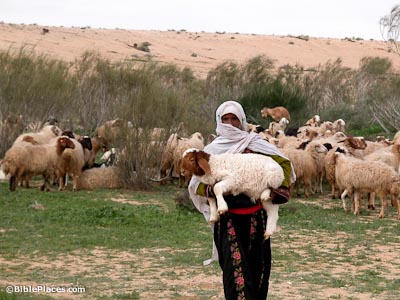
Shepherd in Israel’s Negev

Every year North Americans (including disciples of Jesus) hear the “classic” “Baby its Cold Outside” either by Dean Martin or Ella Fitzgerald or some modern version. Culturally we simply associate Christmas (or winter) with cold and often snow. Then you will hear well meaning disciples (and even ministers) affirm confidently that Jesus could not have been born in December because “it was too cold outside!”

I have often (repeatedly) said in sermons, Bible classes, writings that there are two fundamental rules for reading the Bible: Context and Context. These rules are regularly ignored especially during sectarian polemics. Let me illustrate with “winter” and “Christmas.”

Many conservative Christians have heard (and repeat) that December 25 could not have been when Jesus was born because it would be to cold for shepherds to have their flocks out in fields. (How the Nativity came to be associated with December 25 had nothing whatsoever to do with Saturnalia, Sol Invictus or Constantine such claims were never made until the 17th century and have been rejected by all historical scholars. See Defending Christmas … From Christians.”).

Context! Context!! Historical Context!!!

This point of view is often expressed with no knowledge of the weather and historical realities in Israel at all. In short we are witnessing a violation of the rule of context and context.

We unconsciously impose Northern European and North American experiences of “winter” onto the biblical text. It is assumed that December is freezing cold because it is freezing cold in New York, Milwaukee, Oklahoma City, or perhaps Abilene, TX, etc. I have written on the dangers of assumptions here: Assumptions: What We Simply Assume often Hides the Truth.

It is easy but very dangerous to simply ignore the Grand Canyon that separates modern American disciples from the biblical text. See also Evel Knievel, the Grand Canyon & Us: The Strange and Deep Gulf to the Bible.

A little bit of research on the historical setting (geography and climate certainly are part of the historical setting of Scripture) reveals that Israel has a Mediterranean climate. Except for the amount of rain (Israel has somewhat similar rain patterns as the Bay though), we need to see the weather in Israel as far more like Florida or San Francisco. The weather is mild. Snow is very rare in Israel, just like in San Francisco. It happens once in a blue moon (Jerusalem gets snow every three to four years and will receive “flurries” about twice a “winter.”)

Israel does not have “four seasons” as North American Christians think of “winter, spring, summer and fall.” Nicholas Raphael notes “Winters in North America and Europe are cold and cool whereas summers are hot and or warm … it would be more appropriate to consider seasonality in terms of wet and dry seasons [in Israel]” (“Geography and The Bible (Palestine),” Anchor Bible Dictionary, vol. 2: D-G, p.970).

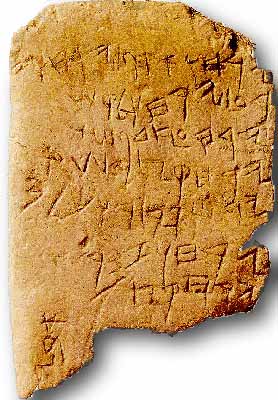
The Gezer Calendar dates to the time of Rehoboam. It reports when farmers planted and harvested during the times of Ruth, David, Solomon, etc. Translations are available on the net or see Zondervan Illustrated Bible Background Commentary, ed. John H. Walton vol.2, p.251.

The land of the Bible has a long warm “summer” (season) and short wetter and cooler “winter” (season). So different is this from most North American experience that we unconsciously impose upon the biblical text we often do not realize that what we call “winter” is when farmers plant their crops in Palestine/Israel. This is true throughout the Bible and has been attested to even outside the Bible from 925 BC.

In 1908 the “Gezer Calendar” was discovered. It is one of the oldest examples of Hebrew known (Paleo-Hebrew). The gentle rains begin in what we call October and last through our January. According to the Gezer Calendar (and the biblical text) ancient farmers began to plough and sow seed for wheat and barley in early November. Vegetables were planted in January to March. In North America the fall is for harvesting and winter the land is often fallow and bare.

But our seasons and Israel’s seasons are not the same. (For more on “Seasons” from the very first page of the Bible see Seasons or Special Days: Genesis 1.14 and Israel’s Worship Calendar.).

The average temperature in Bethlehem in the “winter” is 56 degrees in the day and dips down to an average of 47 at night. These numbers are almost uniform for January thru February. The classic Historical Geography of the Holy Land by George Adam Smith puts it this way.

[T]he cold of winter seldom falls to freezing-point; February is the coldest month, with a mean temperature of 46 [for a low, BV] degrees … After the rains there is a fall in November to about 60 degrees, and in December to 52” (p. 67).

Other resources to examine are Dennis Baly’s outstanding work Geography of the Bible, Revised and Expanded, which devotes chapters 4 and 5 (pp. 43-68 to the “seasons” and climate of Israel).

Today, December 17, 2019 when this brief article was written, the temperature in Bethlehem (according to the internet) is 51 degrees, 68% humidity, with a barely noticeable breeze of 3 mph. This is hardly cold critics imagine.

(As an update on this article for December 7, 2023. It is currently 9 PM in Bethlehem, Israel. The temperature is, according to the Weather Channel, 60 degrees, 75% humidity with a gentle 3 mph breeze. Tomorrow it is supposed to be nearly 70 degrees. Later in the week there is rain in the forecast. Rain in Bethlehem is not like rain in Alabama but like San Francisco this time of the year).

After having lived in Milwaukee and Gunnison, Colorado such “winter” temps are nothing at all. In Milwaukee and Gunnison they are still in their flip flops, shorts and even tank tops at 50 degrees. Certainly not difficult for pasturing sheep, planting their crops and doing most any daily activity that they have done for thousands of years.

Appendix from J. W. McGarvey’s Lands of the Bible published in 1880. The Appendix incorporates several years of weather data from Nazareth. Please note the month of December.

J. W. McGARVEY COULD HAVE SAVED US FROM THIS ERROR

Those who grew up in Churches of Christ could have been saved from these kinds of errors by reading J. W. McGarvey’s Lands of the Bible. McGarvey devotes many pages to the climate of Palestine. He notes that Israel does not have winter as Americans experience but “two seasons, a dry summer of seven months and wet winter of five months” (p.46). He discusses the planting season in what we Americans call “winter.” Planting “commences in November” (p. 92). McGarvey included, in an Appendix, the weather conditions of all the months of the year recording the high and low for every month for years (pp. 617-618). McGarvey even states there is no evidence that weather patterns have undergone any significant changes “during the lapse of the ages” (p.46). The old saw that shepherds would not be in the field in December because it is “winter” is completely unfounded.

This does not show Jesus was born on December 25. What it does show is that the objection based on weather is rooted in shaping the biblical narrative into a mirror of our experience rather than keeping it in its historical context/setting. It also highlights the fact that we need to read the Bible in its historical setting.

Below is a look at Mediterranean Climate zones.

Blessings.

30 Nov 2019

Defending Christmas … From Christians

Author: Bobby Valentine | Filed under: Christmas, Church History, Culture, Hanukkah, Sectarianism
Example of Christian Fake News Paraded on the Web

Fake News

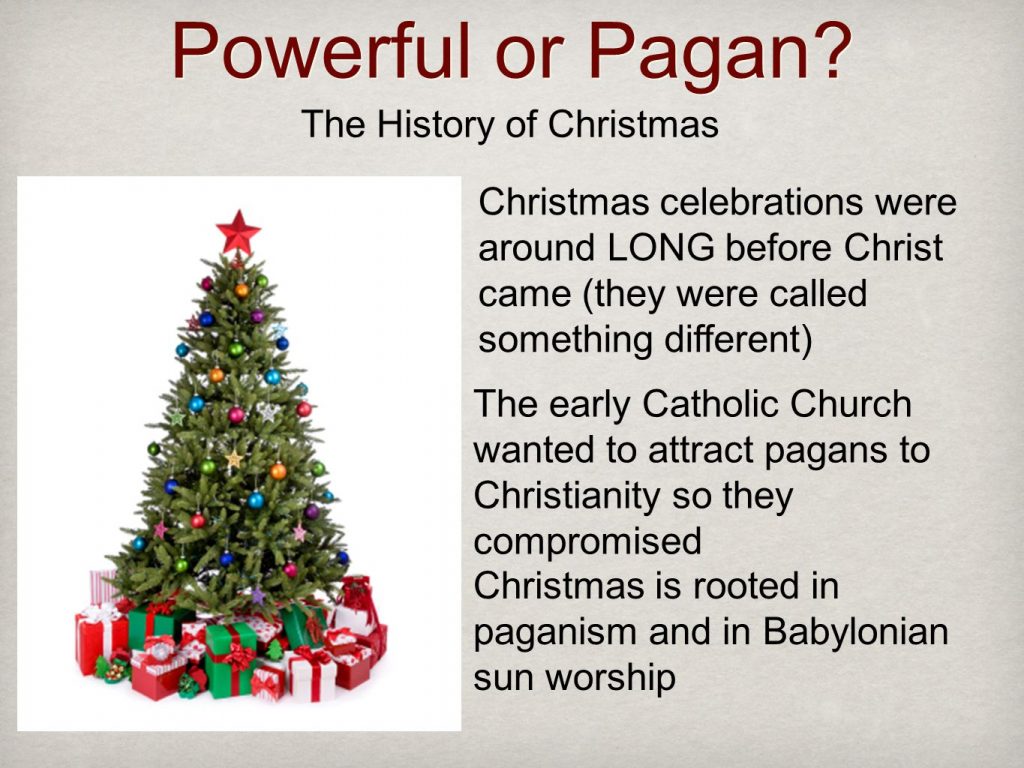
It is not even “Thanksgiving” and misguided Christians are already rolling out the “Christmas is pagan,” “Christmas is a departure,” “Christmas is sin,” nonsense. You would think these well meaning, but misguided, disciples had suddenly joined hands with the ACLU 🙂

I love Christmas. Not every one does. (I do not necessarily love the crass commercialism in America). Indeed already this very morning, I have had three things in my Facebook feed that claim Christmas is pagan and related to the Sun/Sol (or Saturnalia). Even Sheldon Cooper on Big Bang Theory has spouted this made up tripe.

All of this goes back to what some historians now call the Sixteenth and Seventeenth Century War on Christmas, which was part of liberal Protestantism’s attempt to unhinge everything they deemed Roman Catholic by rooting it in late paganism. The same was done with “Easter.” It is easy to find a myriad of old (often blatantly sectarian) Protestant sources, especially in “restoration” circles, that regurgitate this fake news.

Modern historical scholarship (Protestant, Catholic, Jewish, and even atheist), however, has recognized the baselessness – and agenda driven – nature of that fake news. Frankly, I blame preacher training schools and even our colleges who do not require some basic learning in Christian history, for the continued passing on of this nonsense. C. S. Lewis once said he “pitied the man who imagined the world began with the dawn of his own consciousness.”

Pre-Black Friday Defense of Christmas

First, Paul wrote that Holy Days were both good and acceptable to God. Paul and the early church kept Holy Days. Jesus kept them all, including the “unauthorized” Hanukkah (John 10.22ff, See Jesus the Jew and Hanukkah). Paul notes that no one was/is obligated to keep them as conditions of justification. However we (he) are not only free to do so but that they are “unto the Lord“(Romans 14.6). But Paul also says these words,

Therefore do not let your good be spoken as evil” (Romans 14.16).

There are those who are not satisfied with Christian liberty. They rail against what other believers consider valuable and even “holy” . Paul spends a chapter telling us not to do that. But he also says believers do not have to sit idly by and let their freedom be attacked and spoken of as evil. And contrary to popular thinking Paul never associates days – or even food – with the “weak” in Romans 14. He never uses the word “strong” until chapter 15. (cf. Beverly Roberts Gaventa’s, When In Romans, pp. 91-92, 107-113).

So I will defend Christmas liberty from the misguided gainsayers. In fact I grow weary of nonsense ripped off from various internet sites and memes created that contain nothing but made up stuff.

Second, Christmas did not evolve from the celebration of the Sun or Saturnalia. Constantine, much less Rome, had anything to do with origin and meaning of the celebration of the birth of Jesus, nor for that matter why December 25 became associated with the birth of the Messianic Savior. These claims were all manufactured beginning in the 17th and 18th centuries (see sources below) but there is no evidence to support them in the first thousand years of Christian history. Today historical scholars of all religious persuasions even nonbelieving ones, recognize the fallacious nature of these claims. It is sad that some would rather gainsay something than take the time to learn some basic historical facts. But the Ninth Commandment does not seem to apply to things we do not agree with.

It is true that the word “Christmas” is not in the Bible. No one denies this. But guess what the word Bible is not in the Bible either (the Greek word “biblio” is not simply “the Bible”). Yet, just because the English word “Christmas” was not used by early Christians (they did not speak English) does not mean that early disciples did not have an interest in the birth of Christ that has more space devoted to it than other event in Jesus’s life except his Cross. Luke 1-2 are fairly long!

It is without a doubt true that the early church placed far more emphasis on the death of Jesus and thus Pesch/Easter has been with Christianity since the very beginning. By the end of the second century, long before a Pope existed btw, Christians were quite interested in Jesus’s birth and by the 4th century AD two basic dates were accepted for the birth of Jesus, December 25 and January 6. These dates were not chosen because of paganism nor because of the Pope (who did not exist as people think of a pope today) but related to how redemption was understood.

There are parts of the modern traditions of Christmas that come from northern Europe (1800 miles away from the Holy Land!) and may have pagan roots but that has nothing to do with either the origin and significance of the day be it Dec 25 or Jan 6. The day was arrived at by the early church because of the death of Jesus.

I celebrate the Incarnation of God as a hinge of redemptive history. I make no apologies for it. See the Links below.

See also (Links in title):

A Doctrinal Christmas: Two Theological Gifts of Christmas

Emmanuel: Why Christmas is Essential to Biblical Faith

Some Historical Resources

Andrew McGowan, How December 25 Became Christmas, Biblical Archaeology Review (2002) (Linked in title)

McGowan is a premier authority on early Christian worship and professor at Yale

C. P. E. Nothaft, “From Sukkot to Saturnalia: The Attack on Christmas in Sixteenth Century Chronological Scholarship,” Journal of the History of Ideas 72 (2011): 503-522

C. P. E. Nothaft, “The Origins of the Christmas Date: Some Recent Trends in Historical Research,” Church History 81 (2012): 903-911

Nothaft is professor in the Department of Hebrew and Jewish Studies at University College in London

Thomas C. Schmidt, “Calculating December 25 as the Birth of Jesus in Hippolytus’ Canon and Chronicon,” Vigiliae Christianae 69 (2015): 542-563

Schmidt is a Professor at Yale University

Kurt Simmons, “The Origins of Christmas and the Date of Christ’s Birth,” Journal of the Evangelical Theological Society 58 (2015): 299-324

Thomas Talley, “Constantine and Christmas,” Studia Liturgica 17 (1987), 191-197

Thomas Talley, The Origins of the Liturgical Year.

Talley is one of the foremost historians of early Christian worship.

William J. Tighe, “Calculating Christmas: The Story Behind December 25,” Touchstone: A Journal of Mere Christianity (linked in title).

Tighe is Professor of History at Muhlenberg College

Happy Advent and Merry Christmas