“Ecclesiology” or God’s People/”Church”
Author: Bobby Valentine | Filed under: A Gathered People, Church, Exegesis, Jewish Backgrounds, Kingdom, Septuagint, Worship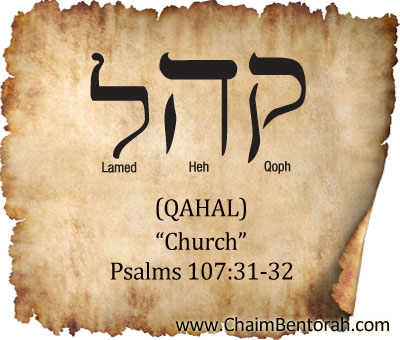
Recently there has been talk about “ecclesiology” or “doctrine of church.” For some the “doctrine of the church” is the heart of the matter (it is not) and it is basically a series of “Right Name, Right Organization, Right Five Acts of Worship,” etc.
Sometimes it is asserted that “church” is New Testament post resurrection institution. That is it is a “New Testament” thing that is completely new and different from the so called “Old Testament.”
But this probably cannot be sustained from the Scripture itself. We can say, however, that there is DEVELOPMENT or more precisely EXPANSION on the idea of “church.” When we see the term “church” we should think either “the people of God” or “a gathered people” (gathered by God).
As with most things, the NT conception of the “people of God” comes straight from the Hebrew Bible. This should not surprise us since the “Bible” of the “New Testament church” was in fact the “Old Testament.” (No one in the NT ever quotes the “New Testament”). The writers of the documents that became the “New Testament” did not invent the notion of church/ekklesia rather they not only get the idea from the Hebrew Scriptures but the very word itself.
The word ekklesia occurs in the Greek Septuagint (LXX) over 120x, almost as much as the New Testament itself. The NT is very uneven in its use of the word “ekklesia.” Paul is by far the largest user but it is very unevenly spread. But three books account for the lion’s share of the term: Acts (18x); the Corinthian epistles (35 between them); and Revelation (19x).
In the LXX “ekklesia” always translating the Hebrew word “qahal.” Paul, who uses the term “church” more than anyone was no stranger to the ekklesia of God in his Bible. It never occurs in 2 Timothy nor Titus. It is used but once in Peter (1 Pt 5.13), James (5.14) and Hebrews (12.23) but never in Mark, Luke, John, Hebrews, 1-2 John, and Jude. But it occurs, again, over 100x in Paul’s “Bible” that is the Hebrew Bible/LXX.
But the NT has a decidedly “Old Testament” view of God’s people. It presents this teaching through Hebraic motifs.
The Old Testament Doctrine of Church includes the following ten themes. See if they resonate:
1) We are first Yahweh’s Family.
2) We are Yahweh’s Bride and He is our Husband
3) We, though divided into twelve tribes are Yahweh’s One People.
4) We are deliberately picked, or chosen, by Hesed (steadfast love) and grace
5) We are loved with a love that is beyond human conception
6) We are Yahweh’s treasured possession
7) We are taught by Yahweh in the way of holiness
8 ) We are Yahweh’s temple the place of God’s dwelling (the leaven of the renewed creation) within fallen creation
9) We are Yahweh’s priests calling and leading all creation to worship
10) We are, interestingly enough, an Exclusive people with an Inclusive agenda.
When we read and ponder the Hebrew Bible it loudly proclaims what it means to “be” the church. When Paul and Peter speak of the people of God they do so explicitly in categories of thought that are writ large on the pages of the “living oracles.” Often, they simply quote the very words of the Hebrew Bible.
I look at this list of motifs and it is wonderful. Ecclesiology teaches us that God has created and redeemed a people to be God’s own. It is a profound message of Steadfast Love, Mercy and Grace.
We are not God’s People, God’s qahal/ekklesia, because we get things right. We are a holy people but it is not a holiness by our virtue or correctness but through God’s redeeming Presence (Holy Spirit). Our holiness is always a redeemed and forgiven holiness. Holiness is not a moral superiority of anyone but rather God’s vessel to serve the fallen world.
We are God’s family by design. We are God’s precious Bride. We are God’s one people. We are God’s chosen treasures, beloved possession. We are God’s temple or dwelling place … God’s home! … we are taught by God and made by him to be his priests to the world.
This, beloved, is ecclesiology in Scripture. This is what the Bible, the whole Bible, means when it says God’s People are distinct. This is a vision that captures the heart and thrills the soul.
The Psalms of Ascents (Psalms 120-134) has a wonderful “doctrine of church.”
Be blessed
For more on “ekklesia,” See Jennifer Eyl, “Semantic Voids, New Testament Translation, and Anachronism: The Case of Paul’s Use of Ekklesia.” Method and Theory in the Study of Religions 26 (2014): 315-339.
April 29th, 2025 at 7:02 am
Excellent article