AMMONIUS: THE BLIND “READER”: The Bible in the Early Church
Author: Bobby Valentine | Filed under: Bible, Church History, Romans, Worship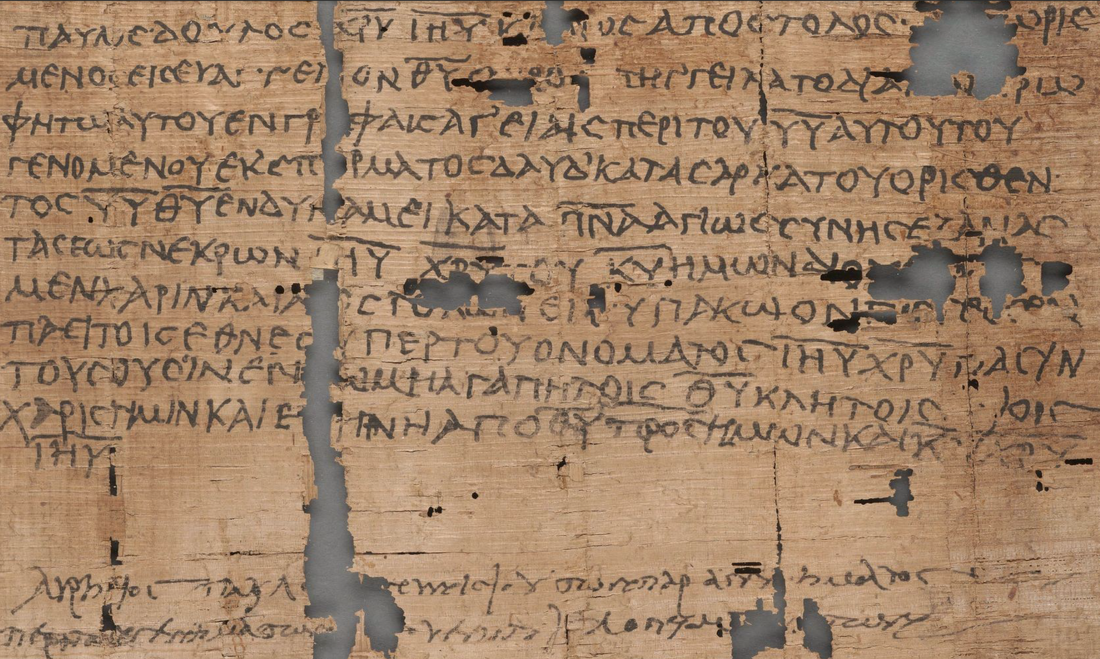
The Bible as we know it is a fairly modern invention (since basically the Reformation period). Neither Jews nor Christians ever owned a Bible. A “book” bound together did not exist until the Second century AD. Scrolls were outrageously expensive (the Scroll of Isaiah in the Dead Sea Scrolls nearly 25 feet long and would cost thousands of dollars to produce; Romans would cost 1500 to 2500 dollars, several years salary of an ordinary person in Corinth; Rome and more in Galilee).
The other reason is 85 to 90 percent of the population was illiterate. They could not read. And fewer could write. Intelligence was not equivalent to literacy. In fact one could highly educated and not be able to read or write. Literacy was limited to professional circles like scribes. Average Jews and Christians did not READ the Bible, any of it. They heard it read. And it was written for trained readers to read to the assembly. Just the layout of the text required training to read. So the opening of Romans is:
“PAULASERVANTOFJSCHTCALLEDTOBEANAPOSTLESETAPARTFORTHEGOSPELOFGDWHICHHEPROMISEDBEFOREHANDTHROUGHHISPROPHETSINTHEHOLYSCRIPTURESTHEGOSPELCONCERNINGHISSNWHOWASDESCENDEDFROMDDACCORDINGTOTHEFLESH”
Now take a good look at that. You may recognize certain words because you already know what it says BECAUSE you are literate. But the average person in the first century was not. Second this is written in scriptio continua. The words are all capital letters, no spaces between words, no punctuation marks. And in Christian manuscripts something strange happens, certain words don’t have all the letters. These words are called nomina sacra (sacred words). Frankly this stream of letters can be broken up in other ways. A person was trained trained to read this writing. Some rather intensive preparation was involved in just reading properly any text.
But reading was “performed.” Aurelius Ammonius was the congregational “reader” for a Christian congregation in north Africa in AD 304. In the sands of Egypt a papyrus letter was discover from Ammonius on behalf of the local church to the authorities. He explained that the church owned no property except a few bronze objects. But Ammonius could not write, he had to hire a scribe named Aurelius Serenus to write his letter. The congregational lector was illiterate.
But the story does not end there. We might be perplexed about an illiterate congregational reader of the sacred texts. But Ammonius was blind! But often the “reader” had the text memorized and trained how to present it. A good memory was more important than even eyesight in “reading” the Bible in the ancient church. Just think about musicians in our world like Jeff Healey, Ray Charles, Stevie Wonder, etc. They cannot read, nor see, but can perform.
Typically in the ancient church, there would be one person (like Aurelius Ammonius) who had been taught how to decode not only scriptio continua but the nomina sacra. They had to have the sentences right and this was often committed to memory. Thus we have our blind reader at the church in Egypt. For example,
“PAULASERVANTOFJSCHT”
Can just as easily be “Paula, servant of Jesus Christ” as “Paul, a servant of Jesus Christ. How do we break the words apart? And we have to know that JSCHT (the nomina sacra) stands for Jesus Christ.
When we look at Aurelius Ammonius we have a wonderful window into how early Christians encountered the word of God. Ammonius PERFORMED the biblical text during the public gathered worship of the Way. Disciples HEARD it. They did not take Bibles home after worship. The became familiar with the STORY in its grand sweep through the Calendar just as Israel did. This is perhaps one reason that Paul told them not to “argue about words.”
I am grateful to have my Bible and the ability to read it. But many things go into producing what is in our hands. Many decisions are made long before we hold that text.
But sometimes having our Bible in our hands just may contribute to us actually missing the big Story that both Israelites and the early Way focused upon in the festivals on the Calendar: Creation (Sabbath); Redemption (Sabbath/Passover); Covenant of Love/Hesed/Presence (Shavuot); Faithfulness in the Journey to the Promised land/New Creation (Booths). You will note that the festivals focus, not on minutia but on the big story of what GOD HAS DONE.
The early Way took this Jewish calendar and baptized it. They did not repudiate the calendar of Israel, they simply nuanced and extended the meaning of the festivals to incorporate the culmination of the festivals in the Jewish Messiah, Jesus of Nazareth. That is why even “Easter” in the early church was simply called Pascha … aka Passover. It still told the story of the Exodus but now the Exodus includes exodus from the grave not just for Jesus but for all creation. May we focus on the Big Picture too.
Blessings on this Good Friday.
P. S. Good Resources for this post:
Larry W. Hurtado, The Earliest Christian Artifacts: Manuscripts and Christian Origins (Eerdmans 2006)
G. W. Clarke, “An Illiterate Lector,” Zeitschrift fur Papyrologie und Epigraphik 57 (1984): 106-122.
Leave a Reply