Making Melody, Making Zamar, Making ψαλῶ
Author: Bobby Valentine | Filed under: A Gathered People, Ephesians, Exegesis, Patternism, Psalms, Worship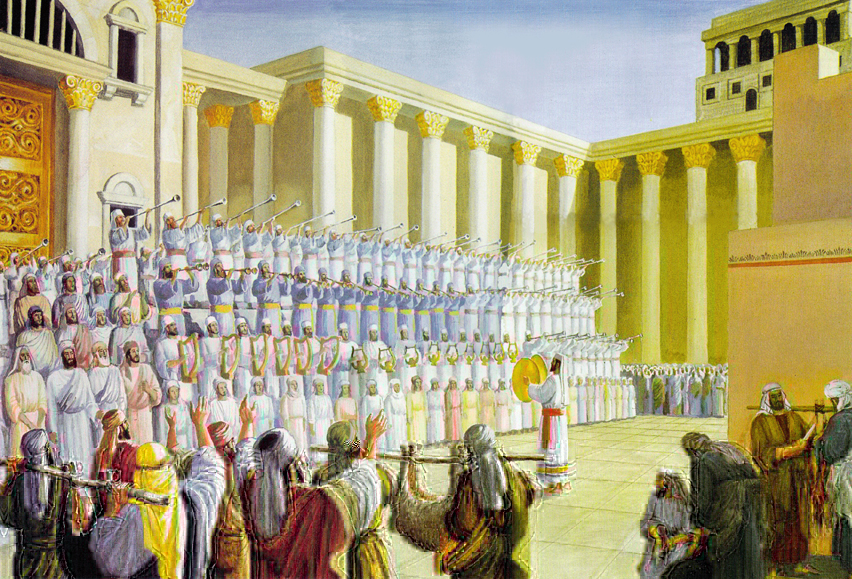
Making Melody, Making Zamar, Making ψαλῶ
“Have you ever seen an instrument sing and make melody in its heart?“
This question was directed to me, via a meme. There were a chorus of “Amen’s” underneath the meme. I neither said “amen” nor “liked” the meme. Instead I winced. I knew, as you likely do too, what the point of the supposed was.
Having read the Gospels at least once, I know Jesus often tried to get people to have “eyes to see” and “ears to hear” by asking questions.
I would preface my question(s) with, “I think you have missed Ephesians 5.19.” Then I would ask some of my own questions.
First, I would say, “Have you seen a PERSON sing and make melody in their heart with an instrument?” See that is the question.
Second, I would ask, “Did David and the myriads of God’s people ever sing and make melody in their hearts with instruments?“
Third, I would ask, “Do you know the apostle Paul just quoted the Book of Psalms with the phrase “sing and make melody to the Lord?” I’m willing to wager that is not the case.
The phrase “sing and make melody to the Lord” is a direct quotation of Psalm 27.6. The Hebrew for “make melody” is zamar, which is explicitly instrumental. Look it up in any Hebrew lexicon. So, the Psalm does not think there is a problem. But Paul quotes the Septuagint which is a Greek translation of the Hebrew Bible. It reads,
“I will offer sacrifices with shouts of joy,
I will sing and make melody to the LORD {ᾄσομαι καὶ ψαλῶ τῷ κυρίῳ}” (Psalm 27.6 = 26.6, LXX)
The context of Psalm 27 makes it abundantly clear that the worshipers are craving the God’s face, God’s beauty, God communion. Were they singing and melodying in their heart? Surely, they were. It says so.
Just a few verses away down in Psalm 33 we find the same expression “make melody” (same Hebrew as Ps 27). In the Septuagint it reads,
“Rejoice in the LORD,
O you righteous.
Praise befits the upright.
Praise the LORD with the lyre;
make melody {ψαλῶ} to him [the Lord]
with the harp of ten strings”
(Psalm 33.1-2).
You will note, immediately, that both Psalm 27 and Psalm 33 have the term ψαλῶ, the very term of Ephesians 5.19 (and of course it is because it is a quotation of Psalm 27!) But we also notice that there is not the slightest conflict. They are singing and making melody in their heart WITH instruments. The word “heart” is one of the most common terms in the Book of Psalms occurring a whopping 105x.
In the very context of Psalm 27 we read, “Come,’ my heart says, ‘seek his [Yahweh’s] face!” (Ps 27.8 ). But notice how Psalm 108 brings these together.
“My heart, O God, is steadfast;
I will sing and make music with all my soul.
Awake, harp and lyre!
I will awaken the dawn.”
“ἡ καρδία μου ὁ θεός ἑτοίμη ἡ καρδία μου ᾄσομαι καὶ ψαλῶ ἐν τῇ δόξῃ μου.
ἐξεγέρθητι ψαλτήριον καὶ κιθάρα ἐξεγερθήσομαι ὄρθρου ” (v.1-2, this is Psalm 107 in the LXX).
Here is our phrase “sing and make melody” (note ψαλῶ and ψαλτήριον). Note the “heart” and also note how this is done with “harp” and “lyre.”
We could actually illustrate this, like Paul does, just by saying look at the Book of Psalms. The problem, as I see it, is we simply do not take Paul seriously. We do not know Paul is literally quoting the Psalms. We do not know that righteous people sing and make zamar/ψαλῶ with the heart to the Lord with instruments. So, another example that brings these all together is Psalm 57. Twice the Psalmist declares “my heart” is ready to praise and make music. There is no doubt what is meant.
“My heart [καρδία] is ready, O God,
my heart is ready,
I will sing and make music [ᾄσομαι καὶ ψαλῶ].
Awake, my glory!
Awake, O harp and lyre!
I will awaken at dawn,
I will acknowledge you, O Lord, among the peoples;
I will make music [ψαλῶ] to you among the nations”
(Psalm 57 [56, LXX], 8-10).
Here my second and third questions come together. Did David, the people of God, sing and make melody from their heart with instruments. Psalm 57 is a problem for those who claim they didn’t.
Fourth, my fourth question would be, “do you know, “with or in the heart” is not the location of the singing and making melody?” This is abundantly clear in the Psalms. This Hebraism means “I am giving it all I got.” “I am not withholding an iota of myself from the worship of God.” When David is singing and dancing “before the Lord” (sounds like something out of Psalm 27!) he is doing it with all his heart.
My final question would be, “Did Jesus sing and make melody (zamar/ψαλῶ) to the Lord?” This is an important question and we avoid it way too often. Jesus sang the very Psalms referenced in the temple. And he did so with those very instruments. So, did Jesus sing and make melody to the Lord with his whole heart (whole being!) with instruments? Did Jesus worship in “spirit and truth” (a saying that we reserve for another day, that is equally misconstrued).
My answer is yes. People can and do sing and make melody with their hearts (whole being, holding nothing back) to the Lord … with instruments. David did it. God’s people did it. Paul did it. And most important of all, Jesus did it.
The question is wrongly formulated from the get go. Thus the response to it is completely at odds with the very source of the of the phrase ‘sing and make melody’: The Book of Psalms.
Oh, yes. It is more than possible to sing and make music (that is what zamar means!) to the Lord with our whole being … with instruments.
April 17th, 2024 at 7:42 am
Good questions. Good answers. Good exegete. Haven’t been part of congregations who use instruments. My preference for non-instrumental is mostly related to family and our long-running tradition/comfort level with non-instrumental. I began working through this topic about 15 years ago and pretty much came to your stated conclusion here. You have also illustrated here the folly and danger of putting the NT on a pedestal & proclaiming “only the NT is for our doctrine” as many in our faith tradition do.
Shalom
November 18th, 2025 at 5:27 am
Thank you – I too have come to these same conclusions. Can you clarify please, when you say, “Jesus sang the very Psalms referenced in the temple. And he did so with those very instruments,” is this an assumption or inference you make, you do you see this in the text somewhere?
December 25th, 2025 at 5:45 pm
The question is, can you sing and make a melody in your heart without a mechanical instrument of music and still be pleasing to God?
The Jews religion was set up to accommodate mechanical instruments of music. The church of the New Testament was not set up in that way. I know of no brother who says you MUST worship God with the things. And if we are to obey the command not to offend our brother. We can not use the mechanical instruments if it offends. Besides it is an individual command to make a melody. And if I can’t play an instrument I would not be able to worship in a way that pleases God. And it would create division and strife. And this is the point. The only thing mechanical instruments has done is divide brothers.