A Doctrinal Christmas? Two Theological Gifts of the Nativity
Author: Bobby Valentine | Filed under: Christmas, Church History, Faith, Jewish Backgrounds, Precision Obedience, Worship
An earlier version of this article was published in Wineskins (December 7, 2017) and can be accessed here.
I grew up in a fellowship that was, seemingly, conflicted during the Christmas holidays. We decorated our homes with trees with a the star of Bethlehem on top. We put nativity scenes out. We made cookies. We sang “Away in the Manger,” “What Child is This?,” and “Silent Night.”
Then during the month of Christmas we had annual sermons on why we do not celebrate Christmas. We heard that Roman Catholicism stole Christmas from the pagans. December 25 was really about Saturnalia. Perhaps these seemingly contradictory moves were not limited to my own fellowship.
But these sentiments regarding Christmas, along with the myth of Saturnalia, continue to be paraded as truth among the descendants of the Reformed branch of the Protestant Reformation. But Christmas is neither pagan in origin nor is it theologically, or doctrinally, empty. Christmas teaches us. (For a good look at how December 25 became associated with the birth of Jesus see Dr. William J. Tighe’s, Calculating Christmas: The Story of Behind December 25).” See my article Defending Christmas … From Christians.
The Calendar: How Faith Was Taught in Israel and the Early Church (Understanding How and Why Things Happened)
It is important to remember the actual environment of the early church. Their world and ours are radically different. Ours is a print based culture but for millennia the culture of the Near East was oral. I grew up in a home with dozens of Bible’s lying around. Even families that did not attend church usually had a Bible somewhere. It is easy to forget this reality is still relatively new in the history of Christianity.
Our unconscious ideas often skew our understanding of both Scripture and the early church. In the early church no one owned a New Testament, much less a whole Bible. The vast majority of Christians would never have even held a portion of the Bible nor be able to read a page if they had held one (literacy is a modern convention not an ancient one).
In fact, many congregations themselves might not have had an entire collection of what we call the New Testament or the Bible. Literature was owned by the community in the ancient world. We find examples of this like in Luke 4 where the scroll of Isaiah was owned, and protected, by community in the synagogue. Another example would be the collection of scrolls owned by the Essenes at Qumran. The existence of thousands of lectionaries testify to this reality (a lectionary is a work that contains portions of scripture that were frequently used in worship, they served a very practical purpose of being an anthology of important passages without having the expense of owning expensive scrolls or later codices). Literary works were incredibly expensive. Again, I cannot stress enough the fact that the vast majority of disciples never held or owned or could read any portion of Scripture until approximately 1500 years later at the Reformation (it was in the 16th century with the invention of the printing press Bibles became cheap enough and literacy rates improved for Christians to have biblical texts).
So how did the Way pass the faith on? The early church followed the precedent set in Israel by the Holy Spirit, they followed a calendar. In fact, the Way inherited a preexisting calendar. This calendar is everywhere even in the pages of the New Testament. Thus we read about Sabbath, Passover, Pentecost, the Fast (Day of Atonement, etc) with the full expectation these are meaningful terms. The “Old Testament,” or biblical, calendar directed the the life of Jesus, though we American disciples often fail to recognize this. The calendar served the fundamental practical purpose of instructing believers in the basic outline of the Christian faith.
The calendar was not just about keeping the days straight. Ancient Israelites did not have a copy of the Bible anymore than did disciples in the Way. The calendar taught a way of life. In many ways our calendars today do the same thing. In the Mediterranean area there were numerous calendars in competition in the early life of God’s people. Everyone’s calendar told the “story” of who they were.
– The Julian/Roman calendar proclaimed the important events in the history of Rome through days and festivals.
– The Macedonian calendar aligned life with the story the Greek gods through days and festivals.
– The Persian calendar proclaimed the acts of various monarchs through days and festivals.
The calendar in the Hebrew Bible, the calendar Jesus lived by, told a Story. In fact the calendar preaches. It proclaims(ed) the mighty acts of grace by Yahweh. It is a God filled, grace saturated story of life under God. So we read about the festivals Sabbath, Passover, Tabernacles, Weeks, Purim and Hanukkah. The festivals tell the Story of God:
– God creates the world [Sabbath],
– God delivered Israel by grace from the kingdom of death [Sabbath and Passover],
– God walks with Israel in the wilderness [Tabernacles],
– God provides food and gives torah [Weeks/Pentecost],
– God protects from annihilation [Purim],
– God redeems his temple [Hanukkah].
The calendar teaches the content of the faith in the God of Israel. And, indeed, the calendar actually focuses believers upon the main thing and keeps the main thing the main thing. Israel did not so much as read the Bible as lived it out day to day via the calendar. This calendar is, again, all over the pages of the New Testament itself.
The early church faced the same practical issue that existed in Israel, how do we pass on the content of the faith. The answer was to tweak the already existing calendar. They used time, the calendar, to teach what God has done. Jesus and important truths of the faith were stuck on the calendar. It is the same story and same God as the already existing calendar but now it also tells what the God of Israel has done and promises to do in Jesus the Messiah, the King of the Jews. The first day of the week, Easter, Pentecost … and what became known as Christmas.
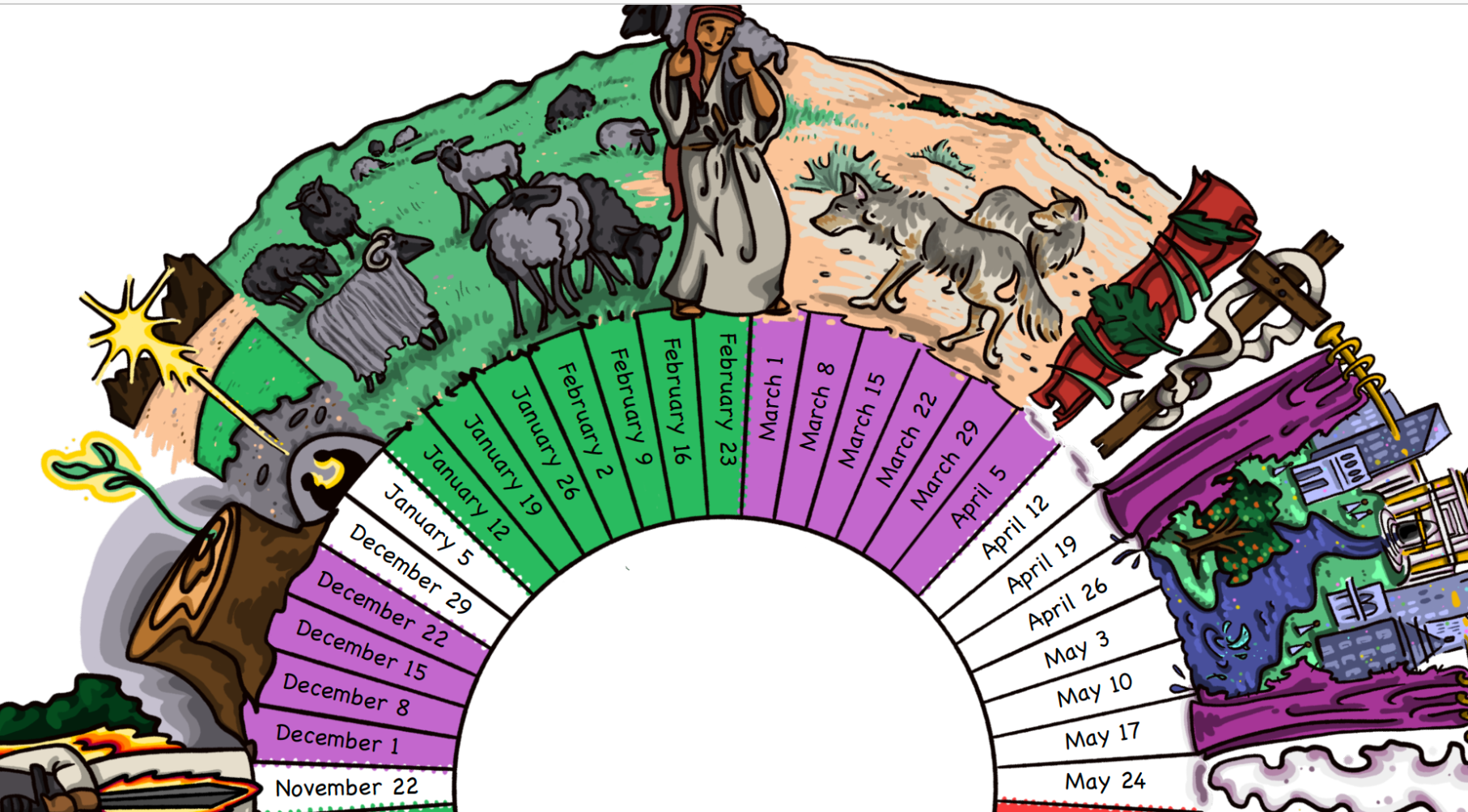
– God began a new creation,
– God renews his covenant and makes us his people, …
– God became one of us in the Jewish Messiah.
The calendar was a way to teach the Christian faith. The calendar guided the teaching of the faith to the masses. Just as it had done in Israel and the life of Jesus himself.
Theological Gifts of Christmas
From a theological point of view, what does Christmas, festival of the Nativity (the terminology is not important, the term Christmas was not used by early Christians since they did not speak English) teach? What might be of importance that a second, third and fourth century believer needed to know or to be reminded. Again these believers did not not have personal copies of Matthew, Luke, John, much less entire Bibles. What might have been in dispute? What might Christmas counter? What gift did the Nativity on the calendar give to the average believer? In fact, it proclaims two essential truths to the Christian faith. We need these as much today as they did in the second century.
Jesus the Jew
First of all, the Festival of the Nativity answers the Marcionites. The Marcionites wanted to sever Christian faith from anything Jewish. The easiest way to do this was to remove anything that hints at Jewishness from the faith. The “Old Testament” was the first sacrificial lamb of the Marcionites. It had to go. The “Old Testament” was Jewish. But it was not only the Hebrew Scriptures that had to go. Marcion, who lived in the second century, rejected much of the apostolic writings because they also were “too Jewish.” Matthew, Mark, the Gospel of John, all gone. The Gospel of Luke was retained though highly edited. Even Paul’s epistles were seriously sliced up by Marcion because Paul thinks Jesus is a Jew. Marcion was a major threat to the faith in the second century.
The Christian Church has always struggled with the ghost of Marcion. Through various ways and means the Hebraic origin and content of the faith has been minimized and at times outright rejected. The most glaring example is Nazism.
Many Church Fathers struggled with anti-Semiticism. It is painful to read John Chrysostom at times. But to their credit the Fathers knew it was, and is, impossible to have Jesus the Messiah without David and Abraham coming along for the ride. In fact, as inconvenient a truth it may be, the Christian faith proclaims the church cannot have Jesus the Messiah apart from Israel.
Christmas as we call it today, the season on the calendar (Christmas is a season not a specific day in historic Christianity) of the birth of Jesus, proclaims as clearly as anything ever could several radically important truths to the Christian faith. First and foremost, Jesus is, not was, a Jew. Matthew and Luke chapters 1 and 2 are deeply embedded subterranean roots that bind Christian faith to Genesis through Malachi as good as nuclear forces bind hydrogen to oxygen to make water. If you separate them water literally ceases to exist. And “Christmas” says if we divorce Jesus from Israel you no longer have Christianity.
The Gospel cannot be divorced from Israel. It is hard to find something that stresses the Jewishness of the Messiah more than telling a story of the “son of David’s” circumcision in the temple on the eighth day of his life. “Christmas,” the season of the Nativity, tells the good news of the One “born King of the Jews.” Before he is Lord of all, he was born King of the Jews, we cannot have the former without the latter.
The Messiah is Jewish. The church simply cannot forget this. In a culture that was rabidly anti-Jewish, including many of the Church Fathers, “Christmas” puts the breaks on rejection of Israel and the Hebrew Bible. To reject the history of Israel is tantamount to rejecting Jesus himself. Christmas preaches this. The birth narratives of Matthew 1-2 and Luke 1-2, Christmas, reveal that the Gospel begins with what people today call the “Old Testament.” There is no Good News without Abraham, David … the Messiah is, before he is anything else, the King of the Jews. This is the ever present doctrinal message of Christmas. We must never forget this. Christmas taught and teaches, Marcion is wrong.
Jesus is a Real Human Being
Christmas answers the Gnostics. The Gnostics believed they had liberated Christianity from its carnal or fleshy Jewishness by making it truly “spiritual.” All that matters is our unseen spirit/soul.
In Gnosticism the material realm of creation is a problem to be freed from. The physical, material, world is really transient and of no ultimate value. What matters is being redeemed from the pain, misery, suffering, and more importantly the appetites of this physical world. Salvation, according to Gnosticism, is the ultimate “spiritual” liberation where we rejoin deity in some pure spiritual existence.
If matter does not matter then the human body of flesh does not either. Christmas, the season of the Nativity, smacks this heresy with as much force as it does Marcionism. Christmas declares that the “spiritual” Logos (Word) became flesh itself. It became “matter.” Humans did not become pure spirit rather God became human in Jewish flesh.
Christmas declares that humans do not become gods but that God became Human. John 1 does not preach a different Jesus than Matthew’s Immanuel. The Word did not merely take up temporary flesh. The word became flesh. Immanuel is not what was put on Jesus’s birth certificate. Immanuel is Matthew’s theological claim that the one born of Mary/Miriam’s flesh as King of the Jews is in fact God living with us fulfilling a major theme in the Hebrew Bible.
It is hard to be more “in the flesh,” to be more human, than to be inside a womb. To be “born of a woman” into a specific Jewish family, into a specific Jewish town. It is hard to be more “in the flesh,” to be more human, than having your diaper changed, nurse from your mother, be circumcised on the eighth day, to go through all the growing pains of being human.
Christmas stresses, in neon lights, that the God who Created the material world, is the God who now lives in the material world (Emmanuel) as the Son of David. Salvation is not from materiality as the Gnostics declared. Salvation is of the whole creation that God made. Matter matters.
Like Marcionism, Gnosticism has been a constant threat in the modern post-Enlightenment Christian faith. There are many parading around under the banner of “sound doctrine” whom the second century Gnostic Valentinus would praise. Christmas was not the selling out to paganism. The festival of the Nativity defended the faith against anti-Semiticism of Marcion and the real paganism of Plato’s so called spiritual vision of reality.
The Church Fathers were not selling out the faith, they were teaching the faith. Christmas reminds us that that the divine was united with the created, God now dwells with humanity in the flesh of the Son of David, the Son of Abraham, the Son of Mary, Jesus of Nazareth. Christmas proclaims that God loves so much that God redeems that which God created. The resurrection and the Incarnation/birth are two sides of the exact same redemptive coin.
These truths celebrated in the Nativity began historically rather independently in geographically diverse places like Africa, Syria, and Turkey long before Constantine and for good reason. People needed to be taught about Jesus the Messiah and the nature of salvation.
These are just two reasons that what become known as Christmas found its way into Christian calendar. So we see Jesus really is the “reason for the season.” It matters that Jesus is the King of the Jews. If he is not then we have the wrong Jesus. And it matters that God loves the world and dwells among us by becoming one of us.
If our God does not then we may have never actually heard “the Christmas gospel.”
See Also
Emmanuel: Why Christmas is Essential to Biblical Faith in Wineskins.
Leave a Reply